

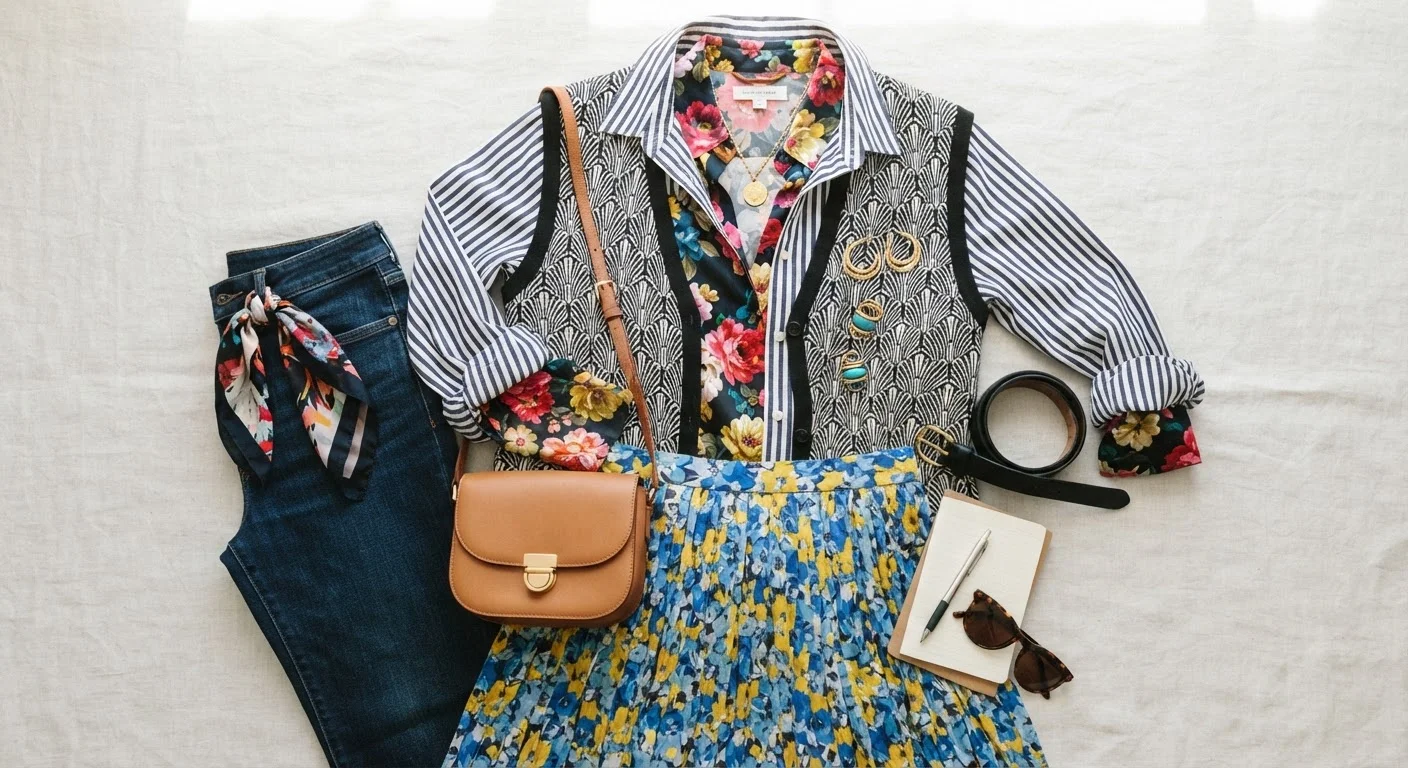
Key Takeaways
- Varying pattern scale is the single most reliable way to keep mixed prints from looking chaotic.
- Sharing at least one colour between patterns creates visual harmony without matching effort.
- A neutral anchor piece - solid-coloured bottom, layer, or accessory - prevents outfit overload.
- Starting with two patterns before attempting three builds confidence and reduces missteps.
- Proportion of each pattern's coverage on the body matters as much as the patterns themselves.
What you will need
Why Pattern Mixing Feels Risky (And Why It Isn't)
Most people avoid mixing patterns for one reason: it feels like there are too many ways to get it wrong. But pattern mixing isn't a high-wire act - it's a set of learnable principles that, once understood, make the process feel almost automatic. The same logic that governs colour coordination applies here: look for relationships between elements, not rules to memorise.
Three variables determine whether a mixed-pattern outfit reads as intentional or accidental: scale (how large the repeat is), contrast (how different the patterns are from each other), and colour (whether the pieces share a common thread). Get at least two of the three right, and the outfit almost always works.
Same Pattern Family, Different Scale
One of the easiest entry points to pattern mixing is pairing two prints from the same family - two stripes, two florals, two checks - at noticeably different scales. Because they're related, the combination reads as curated rather than clashing. It's a lower-stakes way to build your eye before experimenting with more distinct pattern types.
What You Need Before You Start
Before pulling pieces off hangers, it helps to survey what you're working with. Lay out your patterned items and mentally sort them by scale - small (micro-gingham, fine pinstripes, tiny florals), medium (classic plaid, medium stripes), and large (bold florals, wide checks, graphic geometrics). This sorting exercise, which takes about two minutes, is the foundation of every step that follows.
What you will need
Full-length mirror
Lets you assess scale and proportion of pattern combinations across the whole outfit at once.
Neutral anchor pieces
Solid-coloured items (white shirt, black trouser, camel layer) used to separate or ground competing patterns.
Phone camera
Photographing outfit attempts helps you evaluate combinations more objectively than a mirror alone.
Step-by-Step: Building a Mixed-Pattern Outfit
Follow these steps in order the first few times. As your eye develops, you'll start skipping ahead intuitively - that's the goal. For broader outfit-building context, the outfit formulas guide offers reliable starting frameworks you can apply alongside these pattern principles.
Choose Your Hero Pattern
Pick the pattern you love most or feel most confident in - this becomes the anchor of the outfit. It can be any scale, but large-scale and medium-scale patterns work best as heroes because they set the visual tone clearly. Build everything else around this piece.
Select a Second Pattern at a Different Scale
Choose a second patterned piece that sits at least one size category away from your hero. If your hero is large (bold floral), reach for a small-scale pattern (fine stripe, micro-check). If your hero is medium (classic plaid), pair it with something small or something noticeably larger. This scale contrast is the most reliable tool you have.
Find a Shared Colour Between Both Patterns
Look for at least one colour that appears in both pieces - even a small accent counts. This shared colour is the visual handshake between the two patterns. It signals to the eye that the combination is deliberate. If there's no natural overlap, use an accessory (belt, scarf, bag) in a colour that bridges them.
Introduce a Neutral Element
Even a confident two-pattern combination benefits from a solid neutral somewhere in the outfit - it gives the eye a place to rest. This could be a solid-coloured shoe, a plain belt, or an unprinted outer layer. The neutral acts as visual breathing room, making the patterns around it look more intentional, not less.
Evaluate Proportion Before You Leave the House
Step back and assess how much of your overall outfit each pattern occupies. Ideally, one pattern should cover more surface area than the other - a dominant and a supporting role, rather than a 50/50 split. If both patterns feel equally loud, try adjusting coverage by tucking, layering, or swapping one piece for a smaller-scale version of the same pattern type.
Don't Let Colour Be the Only Link
Matching colour alone without addressing scale can still produce a chaotic result. Two patterns in the exact same colourway but the same size repeat will fight for attention rather than complement each other. Always consider scale contrast alongside colour connection - both variables need to be working in your favour.
Troubleshooting Common Misfires
Even with the principles in place, some combinations still feel off. The most common culprit is proportion imbalance - when two large-scale patterns each compete for equal visual space across the whole outfit. The fix isn't always removing a piece; sometimes simply tucking in a shirt or adding a solid-coloured outer layer shifts the balance. If you're regularly finding your outfits feel visually unsettled, proportion principles are often the hidden answer.
Another common issue: patterns that share the same level of visual busyness without sharing a colour. Two medium-scale patterns in completely different palettes create noise rather than harmony. In those cases, reach for a neutral anchor piece - a camel coat, a white tee, or a grey trouser - to separate and ground them. For deeper seasonal thinking on why certain combinations succeed across different times of year, pattern mixing across seasons is worth reading alongside this guide.
When to Stop Adding Patterns
Three patterns in one outfit is genuinely achievable, but it requires all three of the core variables - scale, contrast, and shared colour - to be working simultaneously. If any one of those elements is uncertain, stop at two patterns. A sharp two-pattern combination almost always looks more deliberate than a strained three-pattern attempt.