

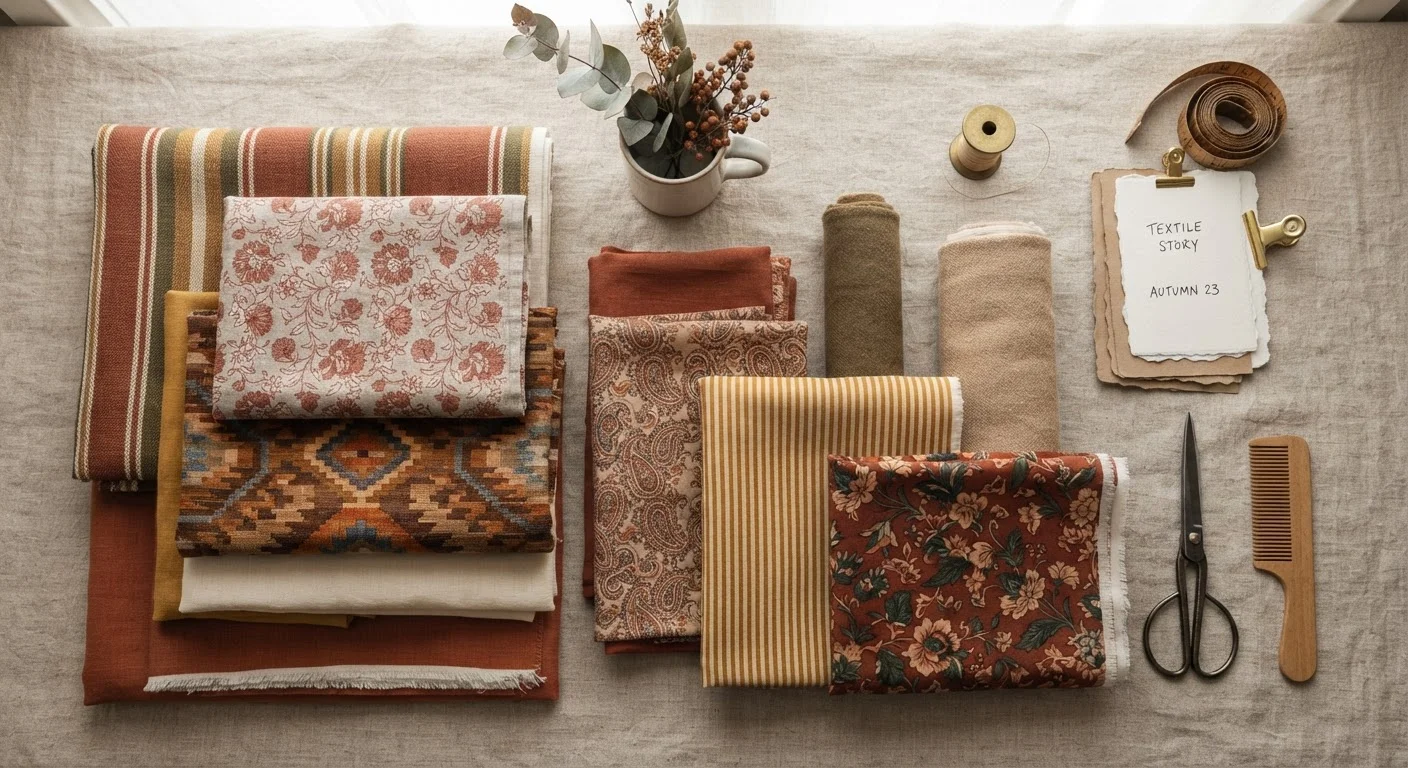
Key Takeaways
- Varying the scale of patterns - pairing large with small - is the single most reliable mixing rule.
- A shared colour across different prints creates visual cohesion without matching exactly.
- Seasonal context matters: fabric weight and pattern mood should align with the time of year.
- Solid anchor pieces give the eye a resting point when patterns compete for attention.
- Treating pattern mixing as a learnable skill, not an innate talent, makes it approachable for everyone.
Why Pattern Mixing Feels Hard - and Why It Doesn't Have to Be
Most people who hesitate to mix prints aren't short on style instinct - they're short on a framework. Pattern mixing looks effortless on a runway or a well-curated Instagram feed, but without understanding why certain combinations work, it can feel like guesswork. The good news: the principles are consistent, learnable, and apply across every season.
If you want a grounding point before diving in, it helps to understand how fashion seasons actually work - because seasonal context shapes which patterns feel right together and which feel visually jarring. A dense, moody plaid paired with an airy botanical print, for instance, can feel off-balance not just aesthetically but contextually.
Vary the scale of patterns intentionally - always pair one large with one smaller print.
When two patterns compete at the same visual scale, the eye struggles to settle, creating a chaotic rather than considered effect. Contrast in scale gives hierarchy to the combination and lets both prints be appreciated without conflict.
Anchor your mix with a colour shared across both prints.
A common colour thread acts as a visual handshake between patterns, signalling to the eye that they belong together. It doesn't require an exact match - even a close-enough hue pulls the look into coherence.
Use a solid piece as a visual break when patterns feel too busy together.
Not every element in a mixed-pattern outfit needs to be patterned. A solid belt, blazer, or trouser gives the eye a resting point and lets each pattern register more cleanly. This is particularly useful when two strong prints are of similar scale.
Match the mood or era of your prints, not just their colours.
Patterns carry a visual personality rooted in their origin - a graphic 1970s geometric and a delicate Victorian floral can clash aesthetically even when their colours coordinate. Prints that share a similar tone or cultural reference tend to feel more harmonious together.
Let fabric weight and texture guide seasonal pattern pairings.
A pattern's visual weight is partly determined by the fabric it lives on. Mixing a heavy wool plaid with a lightweight chiffon floral can feel contextually as well as visually imbalanced. Keeping fabric weights in the same seasonal range grounds the combination.
The Core Principles That Make Combinations Click
Successful pattern mixing isn't accidental. Once you recognize the underlying logic, you'll start to see it everywhere - in thoughtfully styled editorial looks, in well-dressed people on the street, and in your own wardrobe experiments that just happened to land right.
2-3x
Scale difference recommended between mixed prints
Style educators and wardrobe consultants commonly cite a two-to-three-times scale difference as the reliable starting point for harmonious pattern pairing.
1 colour
Shared hue needed to unify mixed patterns
Design principles applied to fashion suggest that a single repeated colour across different prints is often sufficient to create visual cohesion in an outfit.
For a deeper look at the colour and scale mechanics behind mixed prints, the mixing patterns without the guesswork guide breaks down the visual logic in practical detail.
Applying the Principles Across Seasons
Seasonal dressing adds a useful layer of constraint that actually makes pattern mixing easier. In cooler months, heavier fabrics - wool plaids, houndstooth, cable-knit textures - tend to share a visual weight that makes them natural partners. In warmer seasons, lighter prints like thin stripes, small florals, and open geometrics share an airiness that lets them coexist without overwhelming each other.
Transitional dressing is actually the ideal sandbox for pattern experimentation, because layering between seasons naturally introduces the kind of textural contrast that makes mixed-print outfits look intentional.
Seasonal Rules Are Guidelines, Not Laws
Plenty of widely cited seasonal dressing rules don't hold up under closer inspection. Several long-held seasonal style rules around colour and texture are more cultural habit than logical necessity. When pattern mixing between seasons, trust the principles of scale, colour, and fabric weight over any calendar-based rule.
If you'd rather anchor new pattern skills in reliable outfit structures, outfit formulas that take the guesswork out of getting dressed offer a solid starting point for building pattern mixing into everyday looks.