
Air Filters, Spark Plugs, and Belts: The Overlooked Maintenance Items That Matter

Key Takeaways
- A clogged air filter forces your engine to work harder, reducing efficiency and potentially causing long-term wear.
- Worn spark plugs can cause rough idling, misfires, and noticeably worse fuel economy before they fully fail.
- A broken serpentine belt can disable your alternator, power steering, and cooling system simultaneously.
- Most vehicles have manufacturer-recommended replacement intervals for all three components listed in the owner's manual.
- Catching these issues early is almost always less costly than waiting until a symptom becomes a breakdown.
The Maintenance Items Easy to Forget - Until They Fail
Oil changes and tire rotations tend to dominate the conversation around car maintenance - and for good reason. But several components sit quietly in your engine bay, doing critical work, rarely discussed until something goes noticeably wrong. Air filters, spark plugs, and belts fall squarely into this category.
None of these parts announce their decline with a dramatic warning light (though some will eventually trigger one). Instead, they degrade gradually, sapping performance and efficiency in ways that are easy to dismiss as a car simply "getting older." Understanding what each component does and when to address it can help you avoid that false assumption - and the more expensive repairs that sometimes follow.
For a broader picture of how these fit into year-round vehicle care, see our seasonal maintenance breakdown.
Engine Air Filter: The Lungs of Your Engine
Your engine needs a precise mixture of air and fuel to combust properly. The engine air filter is the barrier that keeps dust, pollen, road debris, and other contaminants out of that airflow. When it becomes clogged, less air reaches the engine, and the combustion process becomes less efficient.
The symptoms of a dirty air filter are often subtle at first - slightly sluggish acceleration, minor fuel economy losses - and easy to attribute to other causes. Over time, a severely restricted filter can contribute to engine hesitation and, in some cases, trigger a check engine light.
Most manufacturers recommend inspecting the engine air filter every 15,000 to 30,000 miles, though driving in dusty or high-pollution environments may shorten that interval. Visually, a clean filter appears light gray or white; one due for replacement is typically dark brown or black with visible debris trapped in the folds.
A clogged air filter doesn't just reduce efficiency - it makes your engine work harder than it should.
Cabin Air Filter: Often Confused, Equally Important
Separate from the engine air filter, the cabin air filter cleans the air flowing through your vehicle's heating, ventilation, and air conditioning (HVAC) system - the air you and your passengers breathe inside the car. It traps dust, pollen, mold spores, and exhaust particles before they enter the cabin.
A clogged cabin filter reduces HVAC airflow, which can make your climate system seem less effective and force the blower motor to work harder. Some drivers notice musty odors when the filter becomes saturated with moisture and trapped debris.
Replacement intervals vary by vehicle and driving environment, but many manufacturers suggest every 15,000 to 25,000 miles. The filter is often located behind the glove box or under the dashboard - consult your owner's manual for the exact location and access procedure for your vehicle.
The cabin air filter affects the air quality inside your car - not just system performance.
Spark Plugs: Small Parts With a Big Job
Spark plugs ignite the compressed air-fuel mixture inside each engine cylinder, producing the combustion that powers your vehicle. Most modern vehicles use one spark plug per cylinder, meaning a four-cylinder engine has four, a six-cylinder has six, and so on.
As spark plugs wear, the gap between their electrodes widens or the electrode itself erodes, making ignition less reliable. The result can include rough idling, misfires (noticeable as a brief shudder or hesitation), reduced power, and measurably worse fuel economy. A misfiring cylinder may also trigger the check engine light.
Conventional copper-core spark plugs typically need replacement every 30,000 to 50,000 miles. Iridium or platinum plugs - common in many newer vehicles - are designed to last 60,000 to 100,000 miles or more. Your owner's manual specifies the correct type and interval for your engine.
Worn spark plugs often cause noticeable performance issues well before they completely fail.
Serpentine Belt: One Belt, Many Systems
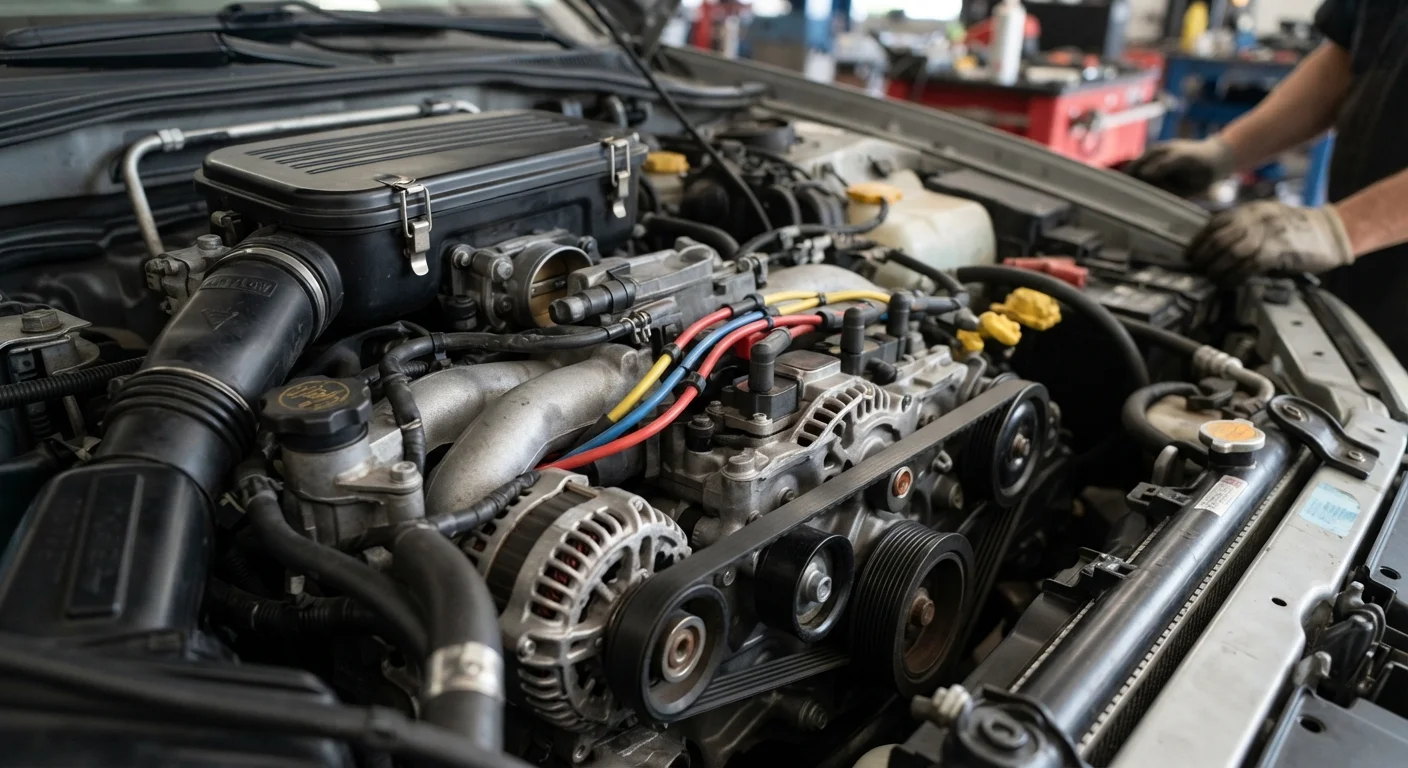
The serpentine belt is a single, continuous rubber belt that winds through a series of pulleys to drive multiple engine accessories simultaneously - typically the alternator (which charges the battery), the power steering pump, the air conditioning compressor, and the water pump (which circulates coolant). In older vehicles, separate belts handled each accessory; the serpentine belt consolidates this into one component.
Because it drives so many systems at once, a serpentine belt failure is immediately noticeable - and potentially serious. Losing the alternator means your battery will drain. Losing the water pump can lead to rapid engine overheating. Power steering failure makes the vehicle significantly harder to control. If you hear a high-pitched squealing from under the hood, especially when first starting the car or during sharp turns, the serpentine belt (or one of its tensioners) may be the source.
Replacement intervals typically fall between 60,000 and 100,000 miles, but visual inspection matters too. Cracks, fraying edges, or glazing (a shiny, hardened surface) are signs a belt is near the end of its service life regardless of mileage.
When a serpentine belt fails, it doesn't just affect one system - it can take down several at once.
Timing Belt or Timing Chain: The Component With the Highest Stakes
Not all vehicles have a timing belt - some use a metal timing chain - but for those that do, it is among the most critical maintenance items on the schedule. The timing belt synchronizes the rotation of the crankshaft and camshaft, ensuring that engine valves open and close at precisely the right moment relative to each piston's position.
If a timing belt breaks while the engine is running, the consequences can be severe. In many engine designs, broken timing belt causes the pistons and valves to collide, resulting in extensive internal engine damage that is costly to repair. Timing chains are more durable and generally do not have a scheduled replacement interval, though they can wear or stretch over time.
Timing belt replacement intervals vary significantly by manufacturer - commonly between 60,000 and 105,000 miles. Because failure carries such high risk, this is one service interval where staying ahead of the schedule matters considerably. A qualified mechanic should perform this replacement, as the procedure typically requires partial engine disassembly.
A timing belt failure mid-drive can cause severe engine damage - replacement is one interval worth not delaying.
Making These Items Part of Your Routine
None of these components require specialized mechanical knowledge to monitor. Most drivers can visually inspect an air filter in minutes. A mechanic can check spark plug condition and belt integrity during a routine service visit with minimal added time.
Ask During Your Next Service Visit
If you're unsure of the current condition of your air filter, spark plugs, or belts, your next oil change is a natural opportunity to ask. A mechanic can typically inspect all three with minimal additional time. Bring your mileage and mention how long it's been since any of these were last replaced - that context helps them give you a useful assessment.
The most reliable reference for replacement intervals remains your vehicle's owner's manual. Manufacturer schedules are built around your specific engine, operating conditions, and component tolerances - not generic rules of thumb. Our guide on what your owner's manual actually tells you breaks down how to read and use that schedule effectively.
Staying ahead of these overlooked items is a straightforward extension of the same habits covered in safe practices for maintaining your car between mechanic visits. Small, consistent attention to the unglamorous components is often what separates a vehicle that reaches 150,000 miles reliably from one that doesn't.
Driving Conditions Affect Wear Rates
Manufacturer replacement intervals assume typical operating conditions. Frequent short trips, stop-and-go urban driving, dusty environments, or extreme temperatures can accelerate wear on filters, plugs, and belts. If your driving patterns fall into any of these categories, it's reasonable to inspect these components more frequently than the standard interval suggests. Your mechanic can help you calibrate expectations based on how and where you drive.