

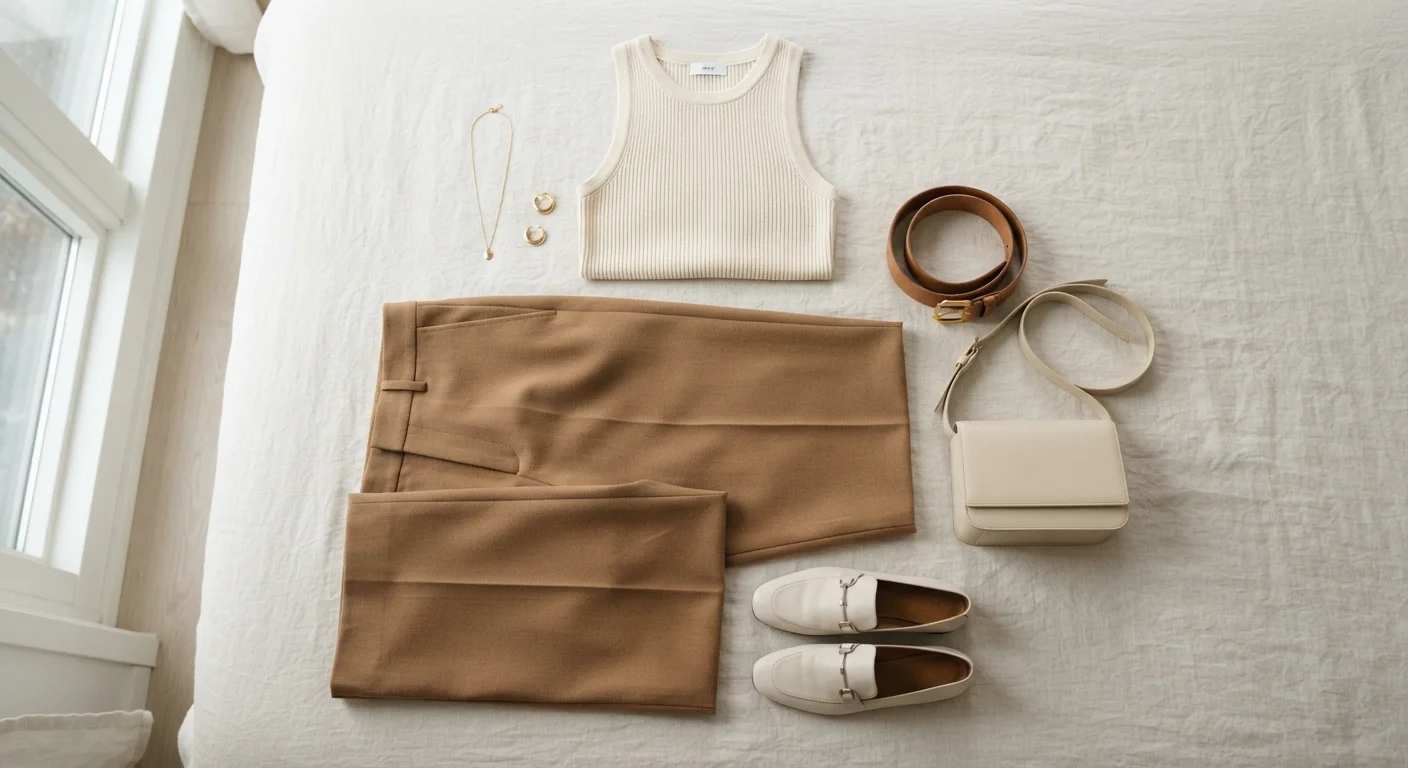
Key Takeaways
- Visual proportion, not color or trend, is usually why an outfit feels 'off.'
- Balancing volume between top and bottom is the single most impactful styling adjustment.
- Knowing where fabric ends relative to your body creates or destroys a polished look.
- Accessories follow the same proportion rules as clothing - size and scale matter.
- Small tweaks like tucking or rolling a hem can shift an entire outfit's balance.
The Hidden Reason Your Outfit Doesn't Click
You've picked pieces you individually love, the colors work, the occasion is right - yet something still feels wrong. More often than not, the culprit is visual proportion: how the volumes, lengths, and weights of your clothing relate to each other and to your frame.
Proportion is the silent architecture of every outfit. When it's off, the eye has nowhere to settle and the look feels unfinished, even if every garment is high quality and well-fitting individually. The good news? Once you understand the core principle - contrast creates balance - small, deliberate adjustments make a significant difference. No wardrobe overhaul required.
This is also distinct from fit, though the two are related. For a deeper look at why the number on a label is only part of the story, see our fit-versus-size guide.
The Most Common Proportion Mistakes - and How to Fix Them
Most proportion problems fall into a handful of recurring patterns. Recognizing them is the first step to correcting them quickly, often without spending a cent.
Pairing two voluminous pieces - such as an oversized sweater with wide-leg trousers - without any visual counterbalance.
Why it happens: Comfortable, relaxed-fit clothing is widely available and easy to reach for, so it's natural to stack cozy pieces together without thinking about overall silhouette.
Wearing a top or jacket whose hem falls at the widest part of the hip, visually broadening that area.
Why it happens: Sizing guides focus on chest and waist measurements, leaving hem placement as an afterthought - most people simply don't notice where a garment ends on their frame.
Choosing accessories - bags, belts, scarves - whose scale is mismatched with the outfit's overall visual weight.
Why it happens: Accessories are often chosen for their standalone appeal rather than in relation to the full outfit, so a delicate necklace disappears against a chunky knit, or an oversized tote overwhelms a trim suit.
Ignoring the visual 'break point' created by where a waistband, tuck, or hemline sits, leaving the torso and legs as one undivided block of fabric.
Why it happens: When clothes are comfortable and the right size, people often skip tucking or belting - both of which create the definition that gives an outfit structure.
Mixing patterns without considering scale differences, making the overall look feel visually noisy rather than intentional.
Why it happens: Pattern mixing sounds creatively appealing, but without a guiding principle it often produces visual clutter where no single element reads clearly.
Proportion Works for Every Body
Proportion principles are not prescriptive rules for achieving a specific silhouette - they are tools for creating visual harmony on any frame. The goal is balance that feels right to you, not conformity to a single 'ideal' shape. Experiment freely and prioritize comfort alongside aesthetics.
If you'd prefer to sidestep these decisions entirely, outfit formulas offer pre-balanced combinations that handle proportion for you. And for a broader foundation, dressing for your body shape explains how specific cuts interact with different frames.
Putting the Principle into Practice
Training your eye for proportion doesn't require fashion expertise - it requires a moment of reflection before you leave the house. Stand back from the mirror and ask: where does the eye travel first? Does it move smoothly through the outfit, or does it snag somewhere? An abrupt hemline, a mismatched scale of pattern, or a belt-less blob of fabric all create the same sense of visual static.
~7 sec
Time to form a first visual impression of an outfit
Research in social psychology consistently finds that visual impressions of appearance form within seconds, underscoring why overall silhouette and balance register before individual garment details.
1:2
Classic top-to-bottom ratio in balanced styling
Fashion educators commonly reference a roughly one-to-two ratio of top to bottom length as a reliable starting point for creating visually grounded proportions across different body types.
Simple fixes worth trying: roll a trouser cuff to show a sliver of ankle, half-tuck a shirt to signal the waistline, or swap a statement bag for something slimmer when the outfit is already doing a lot of work. These micro-adjustments cost nothing and often complete the look instantly. For a broader look at wardrobe essentials that naturally support good proportions, explore pieces with clean, defined silhouettes - they're easier to build balanced outfits around. And remember: fit matters more than brand or price when it comes to proportion doing its job.