

Key Takeaways
- Visual balance is achieved through the distribution of weight - not just furniture size, but color, texture, and pattern.
- Symmetrical balance feels formal and calm; asymmetrical balance feels dynamic yet equally stable when done correctly.
- Radial balance works best around a strong focal point, such as a round table or central light fixture.
- Every room type benefits from a different balance approach depending on its function and size.
- You can correct imbalance without buying new furniture by adjusting placement, lighting, and accessories.
Visual Balance in Interior Design
Visual balance is the sense of equilibrium you perceive when a room's elements - furniture, color, texture, and décor - feel distributed evenly throughout the space. It's what makes a room feel settled rather than chaotic. You don't need to be a trained designer to achieve it; it follows patterns that anyone can learn to recognize and apply.
Designers typically distinguish three types: symmetrical (mirror-image arrangement), asymmetrical (equal visual weight through varied elements), and radial (arrangement around a central focal point).
Why Visual Balance Matters More Than You Think
When a room feels "off" but you can't pinpoint why, visual imbalance is often the cause. Balance isn't about making everything match or placing furniture symmetrically - it's about distributing visual weight so the eye can move through the space comfortably. A room with strong balance feels restful and intentional. Without it, even expensive furnishings can feel chaotic.
Visual weight refers to how much a specific element draws the eye. Large objects carry more weight. Dark colors carry more weight than light ones. Rough textures feel heavier than smooth ones. Understanding this lets you arrange a room strategically - without necessarily spending money on new pieces.
For more on how design choices affect perceived space, see why small rooms feel smaller than they are.
60-30-10
Classic rule for distributing color in a room
Interior designers commonly reference the 60-30-10 rule: 60% dominant color, 30% secondary, 10% accent - a framework for achieving color balance across walls, furniture, and accessories.
3x
Impact of furniture arrangement on perceived room size
Design research consistently shows that furniture placement and visual balance have a greater effect on a room's perceived spaciousness than the room's actual dimensions.
The Three Types of Visual Balance
Symmetrical Balance
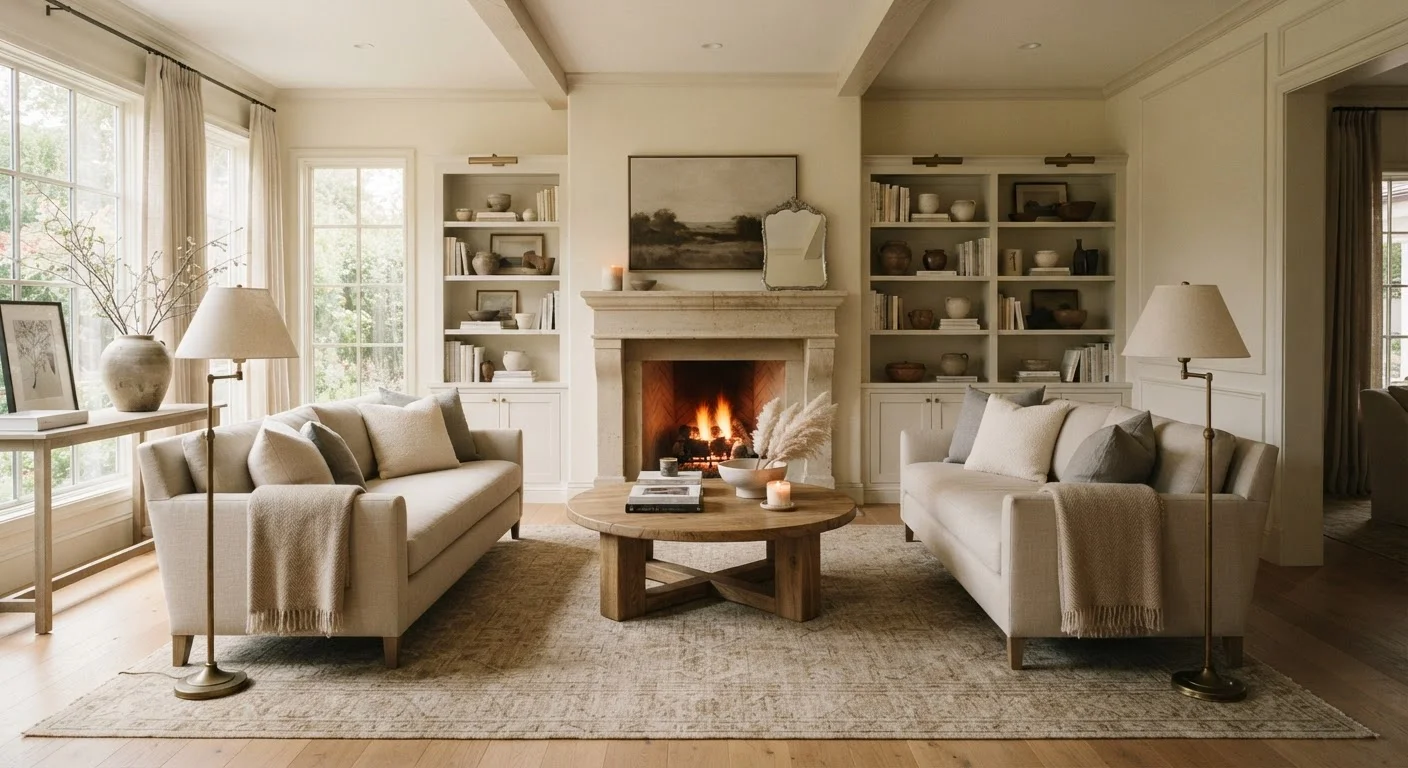
Symmetrical balance - sometimes called formal balance - mirrors elements on either side of a central axis. Think of matching table lamps flanking a sofa, or identical chairs placed equidistant from a fireplace. It creates a sense of calm and order, which is why it's common in bedrooms, formal dining rooms, and entryways. The limitation: too much symmetry can feel rigid or predictable.
Asymmetrical Balance
Asymmetrical balance uses different elements of equivalent visual weight to create equilibrium without mirroring. A tall floor lamp on one side of a sofa might balance a low side table stacked with books and a framed print on the other. The elements aren't identical, but the visual pull is equal. This approach feels more relaxed and contemporary, and works particularly well in living rooms and home offices.
Radial Balance
Radial balance radiates outward from a central point, like chairs arranged around a circular dining table or pendant lights clustered above a central kitchen island. It creates a natural focal point and gives a room clear directional flow. Radial arrangements work best in rooms where a single central element - a table, a fireplace, or a statement light fixture - anchors the layout.
Applying Balance Across Your Home
Different rooms call for different approaches. Bedrooms benefit from the calm of symmetrical balance - matching elements on each side of the bed reinforce a sense of rest. Living rooms tend to respond well to asymmetrical arrangements, which feel livelier and more open to conversation. Dining rooms and breakfast nooks are natural homes for radial balance, especially around a round or oval table.
Color plays a critical role in maintaining equilibrium. A single bold color concentrated in one corner will create imbalance even if the furniture is well-placed. Distributing color accents - through throw pillows, artwork, and textiles - throughout the room prevents any one area from dominating. See how color temperature and undertones affect room cohesion for a deeper look at color decisions.
Budget constraints don't have to limit your ability to achieve balance. Repositioning existing furniture, swapping accessories between rooms, or adding a second-hand piece with the right visual weight can be just as effective as purchasing new items. For ideas on working within a budget, visit decorating on a budget without the space looking cheap.
Use the Squint Test to Check Balance
Stand in the doorway of a room and squint until the details blur. What your eye is drawn to most strongly reveals where visual weight is concentrated. If you're pulled to one area consistently, that side likely dominates the room. Use this low-tech method to identify imbalance before making any changes.
Common Mistakes and How to Correct Them
One of the most frequent imbalances in home décor is the "one tall wall" problem - all the large or heavy-feeling pieces end up on the same side of the room. This often happens when furniture placement follows the walls rather than the center of the room. Pulling key pieces inward and anchoring them with a rug can redistribute visual weight significantly.
Another common issue is pattern overload concentrated in one zone - a patterned rug, a busy throw, and printed cushions all in the same corner, while the rest of the room is stark. Spreading textural and pattern interest throughout the space resolves this without requiring new purchases.
For a practical framework that connects balance with each room's functional needs, room-by-room decorating guidance offers useful room-specific direction. And if you're building your overall approach to home management and design from the ground up, the household essentials hub is a good starting point.
Balance Is Subjective Within Limits
There's no single "correct" arrangement for any room - personal taste, cultural background, and how you use a space all affect what feels balanced to you. The principles described here are practical frameworks, not rules. Use them as starting points and trust your own perception of what feels settled and comfortable in your specific home.