

Key Takeaways
- Matching furniture sets offer instant visual cohesion and simplify the buying process.
- Pre-matched sets can feel formulaic and limit personalization over time.
- Mixing pieces allows for more character and budget flexibility, but requires a unifying strategy.
- Neither approach is universally superior - your space, lifestyle, and preferences should guide the choice.
- A middle-ground approach - anchoring with one matched grouping, then layering in individual pieces - works well for most rooms.
Instant visual cohesion with no extra effort
Pieces designed together share proportions, finishes, and style cues, so the room reads as intentional from day one without requiring the buyer to develop a coordinating eye.
Simplifies the purchasing and planning process
Buying a set removes dozens of micro-decisions - dimensions, material compatibility, finish matching - that can slow down or complicate individual piece selection.
Predictable sizing and spatial fit
Manufacturers size suite pieces to work together proportionally, reducing the risk of a sofa that dwarfs its companion chair or a nightstand that sits at the wrong height relative to the bed.
Often more affordable when bundled
Sets are frequently priced at a discount relative to buying equivalent pieces separately, which can matter significantly when furnishing a full room at once.
Hard to replace a single damaged piece
If one item in a set is discontinued or damaged, finding a replacement that matches exactly is often impossible, leaving the room looking mismatched in a way that wasn't intended.
Limits personalization and visual interest
A room furnished entirely from one set can feel curated by a catalog rather than by the person living in it - tidy, but lacking the layered quality that makes a space feel inhabited.
Ties you to one era's design aesthetic
Tastes and design trends shift; a set bought to match a single moment in time can feel dated as surrounding décor evolves, while individual pieces are easier to swap out selectively.
May prioritize coordination over function
Pieces designed to look good together aren't always optimized for individual function - a set's coffee table, for example, may be the wrong height or size for your specific sofa and seating distance.
Our Verdict
Matching furniture sets are a practical, low-effort path to a pulled-together room, especially when you're furnishing a space from scratch or have limited time to curate. Mixed furniture, done thoughtfully, tends to feel more personal and adaptable over the long term. Most successful interiors land somewhere between the two extremes - using sets as a foundation and individual pieces to add depth.
Matching sets suit first-time homeowners or renters who want a cohesive look quickly; mixing is better for those who enjoy decorating as an ongoing, evolving process.
What 'Matching' Actually Means in Furniture Design
A matching furniture set typically refers to pieces designed together by a manufacturer to share the same material, finish, silhouette, or style - think a sofa and loveseat sold as a suite, or a bedroom collection where the bed frame, dresser, and nightstands share the same wood tone and hardware. The appeal is immediate: everything is visually related from the start.
Mixing, by contrast, involves selecting furniture from different sources, eras, or styles and creating harmony through shared elements like color, scale, or material. It's a more deliberate process - and one that can go either way depending on how it's approached. Understanding what both options actually involve helps clarify which suits your situation.
For a broader look at how function shapes these decisions room by room, see this room-by-room decorating guide.
The Case For Matching Sets
There are real, practical reasons why matching sets remain popular - and they go beyond simple convenience.
Instant visual cohesion with no extra effort
Pieces designed together share proportions, finishes, and style cues, so the room reads as intentional from day one without requiring the buyer to develop a coordinating eye.
Simplifies the purchasing and planning process
Buying a set removes dozens of micro-decisions - dimensions, material compatibility, finish matching - that can slow down or complicate individual piece selection.
Predictable sizing and spatial fit
Manufacturers size suite pieces to work together proportionally, reducing the risk of a sofa that dwarfs its companion chair or a nightstand that sits at the wrong height relative to the bed.
Often more affordable when bundled
Sets are frequently priced at a discount relative to buying equivalent pieces separately, which can matter significantly when furnishing a full room at once.
~60%
Homeowners who repurchase different furniture brands
Industry surveys consistently find that the majority of homeowners mix furniture brands across redecorating cycles rather than replacing like-for-like from the same set.
3-5 years
Typical furniture replacement cycle per room
Home furnishing research suggests most households update at least one major furniture piece per room within three to five years of original purchase.
Sets are especially useful in rooms where visual calm matters: bedrooms, for example, benefit from a restful consistency that matching pieces naturally deliver. They also make it easier to plan a room layout, since dimensions and proportions are already calibrated to work together.
The Case Against Matching Sets
Despite their convenience, matching sets have limitations that become more apparent over time - especially as tastes evolve and pieces need replacing.
Hard to replace a single damaged piece
If one item in a set is discontinued or damaged, finding a replacement that matches exactly is often impossible, leaving the room looking mismatched in a way that wasn't intended.
Limits personalization and visual interest
A room furnished entirely from one set can feel curated by a catalog rather than by the person living in it - tidy, but lacking the layered quality that makes a space feel inhabited.
Ties you to one era's design aesthetic
Tastes and design trends shift; a set bought to match a single moment in time can feel dated as surrounding décor evolves, while individual pieces are easier to swap out selectively.
May prioritize coordination over function
Pieces designed to look good together aren't always optimized for individual function - a set's coffee table, for example, may be the wrong height or size for your specific sofa and seating distance.
There's also an aesthetic argument: rooms furnished entirely from a single set can read as showroom-flat - composed but impersonal. The design principles behind mixing - contrast, layering, scale variation - are the same ones that make individual outfits feel considered rather than coordinated. The principles behind mixing patterns in fashion apply in surprisingly direct ways to interior spaces too.
The 'Collected Over Time' Look
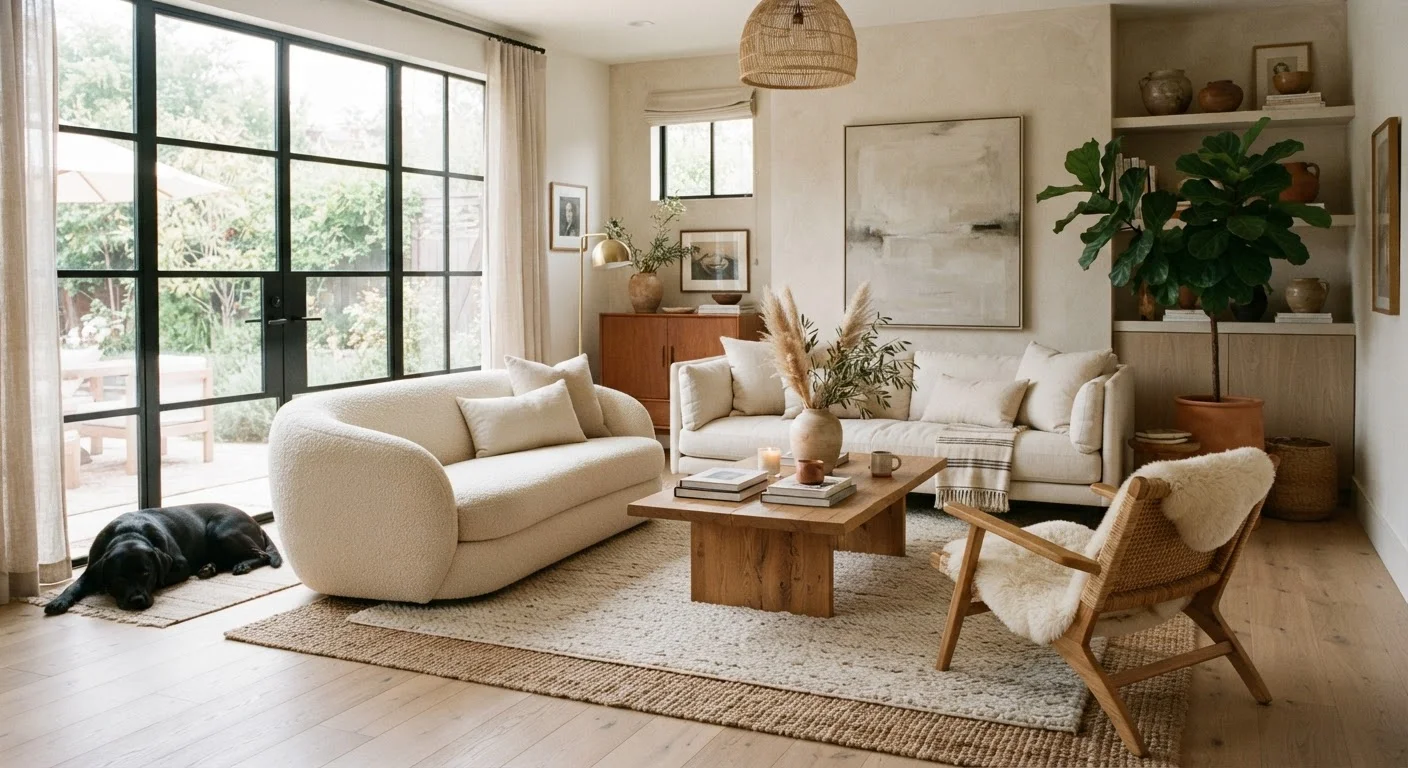
Many interior designers describe the most liveable rooms as appearing to have been collected gradually rather than purchased all at once. This doesn't require years of accumulation - it can be achieved intentionally by combining pieces with varying origins, finishes, or eras while maintaining one or two consistent visual threads, such as a repeated wood tone or a limited color palette.
How to Mix Furniture Without the Visual Chaos
Successfully mixing furniture isn't about abandoning coordination - it's about coordinating differently. Instead of relying on a manufacturer to do the visual work, you take on that role yourself by identifying the unifying threads: a consistent wood tone, a repeated accent color, a shared leg style, or a dominant material like linen or metal.
A practical starting point: anchor the room with one or two larger pieces that set the tone (a sofa, a dining table), then select supporting pieces that echo one - not necessarily all - of that anchor's characteristics. This mirrors the approach in personal style, where balancing neutral and statement pieces keeps a look grounded without being monotonous.
Scale matters too. Mixing works best when the heights and visual weights of pieces feel intentional rather than accidental. A chunky upholstered sofa pairs naturally with a lighter-framed coffee table; both heavy and delicate pieces together in equal measure can feel restless.
Finding a Middle Ground That Works
For most homeowners and renters, the most liveable approach sits between the two extremes. Start with a matched grouping for the room's primary function - a sofa set in the living room, a bed-and-nightstand pair in the bedroom - and treat individual accent pieces as the opportunity to add personality and flexibility.
This approach also makes financial sense. Investing in fewer, better core pieces and building around them over time tends to produce more durable, satisfying results than furnishing an entire room at once from a single catalog. Pieces acquired gradually often reflect genuine preferences, whereas a set purchased quickly under deadline (a move-in, a renovation) may not.
Ultimately, the question isn't which approach is objectively better - it's which one fits how you actually live in and evolve your space.