

Key Takeaways
- Overhead fixtures provide general illumination but cast flat, unflattering light when used alone.
- Ambient, task, and accent lighting each serve a distinct purpose and work best together.
- Layering light at different heights creates depth and makes a room feel more finished.
- Dimmer switches allow one room to serve multiple moods and functions throughout the day.
- Layered lighting can be achieved gradually - you don't need to overhaul a room all at once.
Lighting Layers
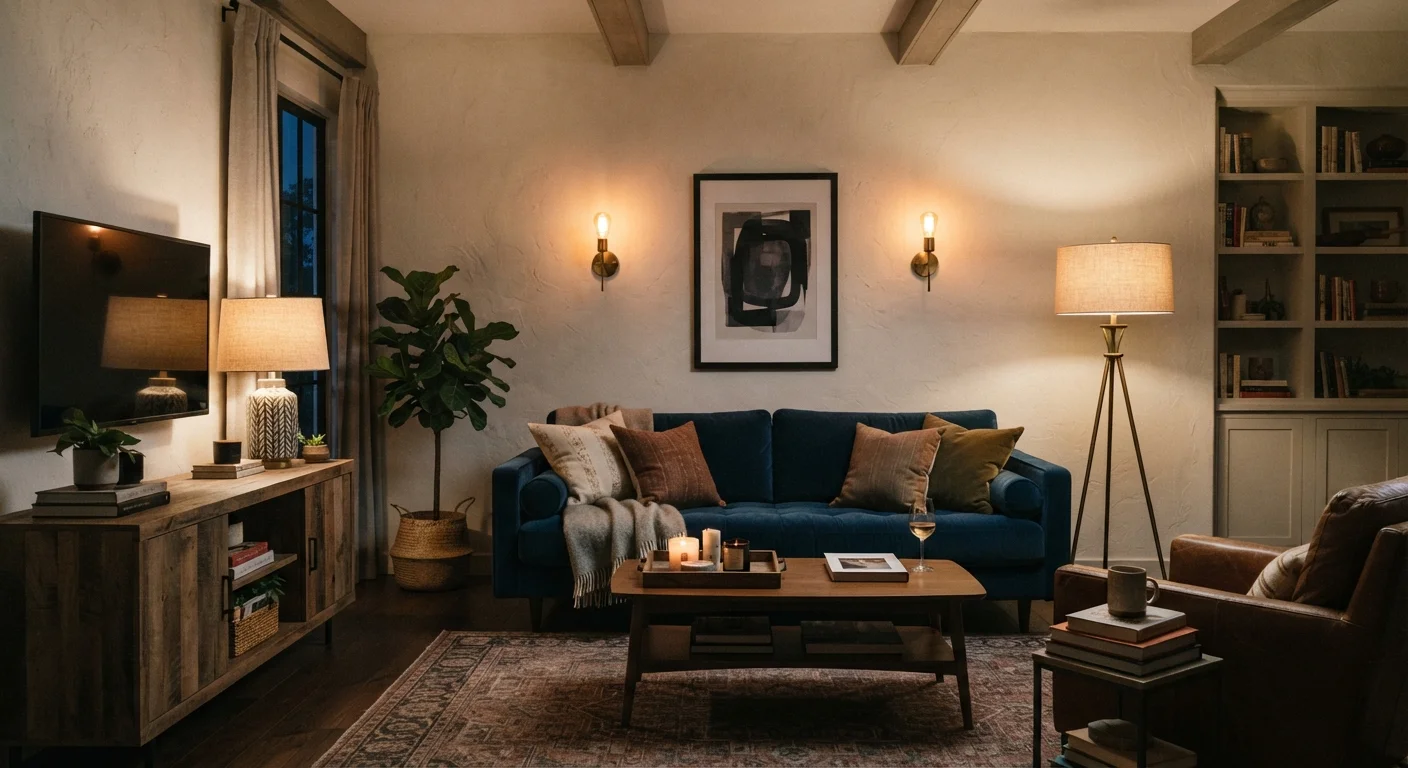
Lighting layers refers to the practice of combining three distinct types of light sources - ambient, task, and accent - within a single room. Rather than relying on one overhead fixture to do all the work, layered lighting uses multiple sources at different heights and intensities to create depth, warmth, and flexibility. The result is a space that feels finished and adaptable to different activities and moods.
In lighting design, the three-layer model is sometimes extended to include a fourth category - decorative lighting - which prioritizes visual interest over function (e.g., a sculptural pendant used as a focal point).
Why One Overhead Light Is Never Enough
Walk into most rooms and you'll find the same setup: a single ceiling fixture switched on when someone enters and switched off when they leave. It works in a purely functional sense - the light is on, visibility exists - but it rarely makes a room feel comfortable or complete.
The reason is simple: overhead light casts downward shadows, flattens texture, and illuminates everything at the same intensity. A sofa, a bookshelf, and a dining table all receive identical light treatment. There's no hierarchy, no warmth, and no variation that signals to the eye where to look or where to settle.
Interior designers address this with a concept called lighting layers - a structured approach to combining different light sources so that a room functions well and feels genuinely inviting. The good news is you don't need expensive fixtures or a renovation to apply it. Understanding the three-layer model is enough to start making meaningful changes.
Lighting Affects How Color Reads
The same paint color can look dramatically different under warm versus cool light. If you've ever chosen a wall color that looked perfect in the store but felt off at home, lighting temperature may be the culprit. Testing paint samples under your actual lighting conditions - not just in daylight - gives you a far more accurate preview of the final result.
The Three Layers Explained
Ambient Lighting
Ambient light is the base layer - the general illumination that fills a room. Ceiling fixtures, recessed lights, and flush-mount lights all fall into this category. Think of ambient lighting as setting the floor for visibility. It needs to be present, but it doesn't need to do everything.
Task Lighting
Task lighting is focused and purposeful. It goes where you need concentrated light to do something specific: reading, cooking, applying makeup, working at a desk. A table lamp beside an armchair, an under-cabinet light over a kitchen counter, or a swing-arm lamp above a workspace are all examples. Without task lighting, people end up straining in shadows or dragging furniture toward windows.
Accent Lighting
Accent lighting is directional light used to highlight something - a piece of art, an architectural detail, a shelf of objects, or a textured wall. It adds depth and visual interest by creating contrast between lit and unlit areas. Track lighting, picture lights, and small directional spotlights all serve this role.
Used together, these three layers create what the eye reads as a complete, dimensional room. Individually, each falls short in a different way. See how color and light interact in our guide to understanding color temperature and undertones.
3-5
Recommended light sources per average room
Lighting designers commonly recommend a minimum of three distinct sources across the ambient, task, and accent layers for most living spaces.
2700K
Warm white color temperature for living spaces
Bulbs rated around 2700 Kelvin produce the warm, incandescent-like tone most associated with comfortable home environments.
How to Build Layers Into Any Room
Start by auditing what you already have. Most rooms have ambient lighting. The gap is almost always task and accent. Before purchasing anything, identify the specific activities that happen in the space and where additional focused light would actually help.
In a living room, that might mean a floor lamp positioned over a reading chair and a small spotlight angled toward a gallery wall. In a bedroom, it could mean bedside table lamps (task) and a low-wattage lamp on a dresser for ambient warmth after the overhead is switched off.
Start With One New Source Per Room
You don't have to tackle lighting all at once. Add a single floor lamp or table lamp to a room that currently has only overhead light and live with it for a week. You'll quickly identify where the next source belongs. Building layers gradually is more sustainable - and often more intentional - than overhauling everything at once.
Height matters more than most people expect. Light sources placed at eye level or below - table lamps, floor lamps, candles - create warmth and intimacy in a way that ceiling-only light cannot replicate. Varying the height of your sources is one of the fastest ways to make a room feel more designed.
For rooms that feel smaller than they should, targeted lighting can also help with perceived scale - a topic covered in detail in our piece on design choices that make small rooms feel larger.
Dimmers, Bulbs, and Budget-Friendly Approaches
Layered lighting doesn't require replacing every fixture at once. Adding a dimmer switch to an existing overhead light gives you immediate range - the ability to shift from bright and functional to soft and ambient using a single control. This is often the highest-impact change for the lowest cost, though any electrical work should be performed by a licensed electrician if you're not confident doing it safely.
For renters or anyone working with a tight budget, plug-in options cover all three layers without any permanent changes. Plug-in floor lamps handle ambient and task. Battery-operated LED puck lights or plug-in picture lights can serve as accent sources. The principles behind decorating on a budget apply here too: spend on what the eye notices most, and lighting is near the top of that list.
When selecting bulbs, pay attention to color temperature (measured in Kelvins). Warmer bulbs (around 2700K) suit relaxed living spaces; cooler bulbs work better in task-heavy environments. Keeping bulb temperatures consistent across a room's layers prevents the jarring effect of mismatched light tones. Layered lighting pairs naturally with other finishing techniques - the same logic behind layering textiles for warmth and visual depth.