

Key Takeaways
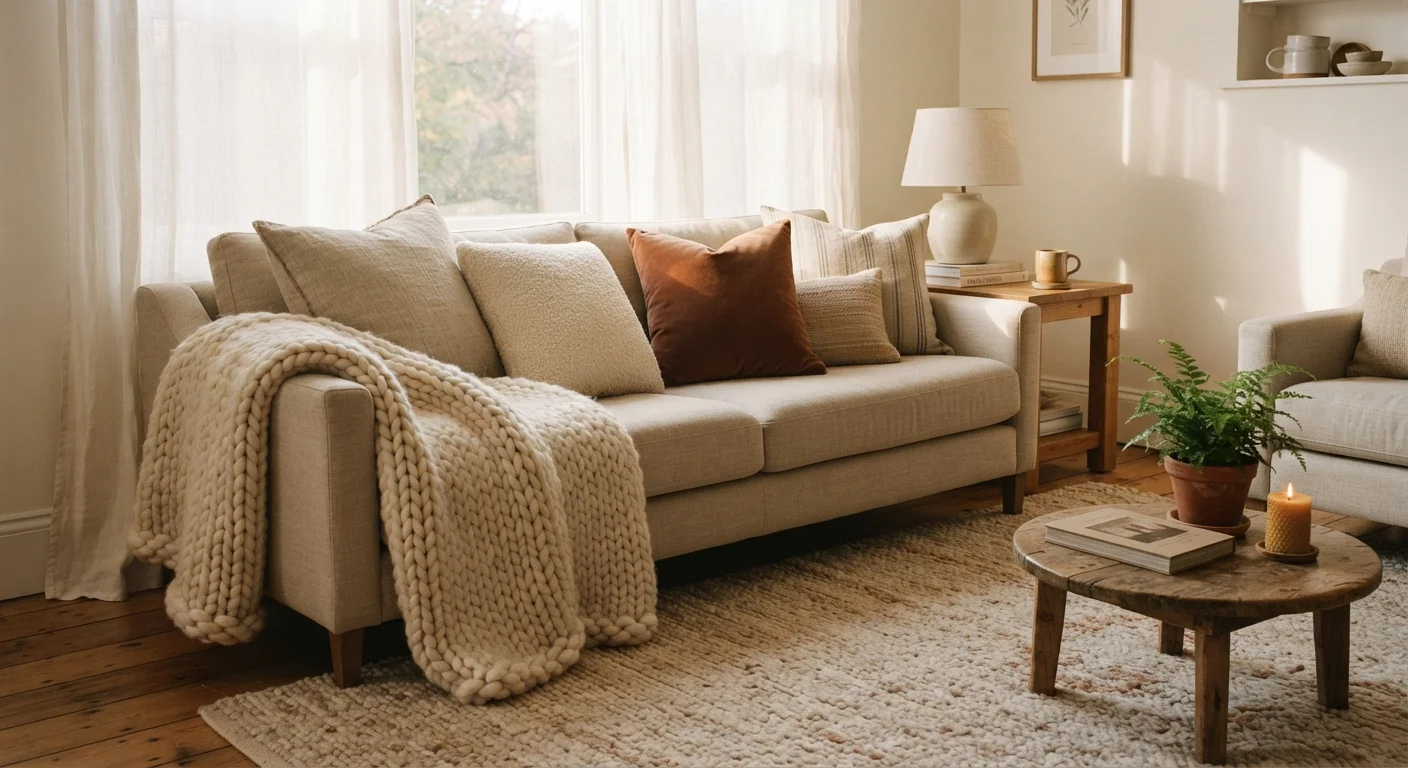
- Combining at least three textile types - rug, throw, and cushions - creates visual depth without clutter.
- Varying texture matters more than varying color: contrast is what makes layering feel intentional.
- Anchor the room with the largest textile first, then build lighter layers upward.
- Odd numbers of cushions and asymmetrical throws read as relaxed and natural rather than staged.
- Curtains serve as a soft architectural frame - their weight and length affect the whole room's proportion.
What you will need
Why Textile Layering Works
A room can be well-painted, well-lit, and furnished with pieces that individually look great - and still feel cold or unfinished. More often than not, the missing ingredient is textile depth. Rugs, throws, cushions, and curtains each absorb sound, soften edges, and signal comfort in ways that hard surfaces simply cannot. When they're chosen and arranged with some intention, the effect is a room that feels genuinely lived in.
The same logic that governs fabric layering in clothing applies here. Just as fabric weight and drape affect how an outfit sits, the weight and weave of a textile affects how it reads in a room. A thin cotton throw draped over a heavy wool sofa cushion creates contrast; two identical pillows in the same material create flatness. And much like layering light sources prevents a room from feeling flat, layering textiles creates dimension that a single statement piece never achieves alone.
The goal isn't to pile on more stuff - it's to create a considered progression from floor to sofa to window, with each textile playing a clear role.
Color Isn't the Hard Part - Texture Is
Most people focus on matching colors when layering textiles, but texture contrast does the heavier lifting. A room with five different shades of the same beige-neutral can still feel rich and complete if the surfaces vary between smooth, woven, nubby, and sheer. Think of color as the harmony and texture as the rhythm - both matter, but rhythm is what you feel first.
What You'll Need Before You Start
You don't need to replace everything at once. This process works just as well when you're refreshing a room with pieces you already own as when you're starting from scratch.
What you will need
Tape measure
Used to confirm rug size, curtain drop length, and cushion dimensions before purchasing.
Fabric swatches or samples
Allows you to compare textures and tones in your actual room lighting before committing.
Lint roller or fabric brush
Keeps textiles looking intentional rather than worn, especially for velvet or knit surfaces.
Step-by-Step: Building Your Textile Layers
Follow these steps in sequence. Each layer informs the next, so starting at the floor and working upward prevents you from making expensive choices at the top that clash with what's already anchored below.
Choose and place your area rug first
The rug is the foundation of the entire textile layer. Before picking cushion colors or curtain fabric, get your rug down. Choose a size large enough that at least the front legs of your main seating pieces rest on it. This visually collects the furniture into a zone rather than leaving pieces floating on bare floor.
For texture, natural fiber rugs - wool, jute, sisal - add the most tactile contrast against smooth flooring. A flatweave rug reads lighter and more graphic; a high-pile or hand-knotted rug reads warmer and more enveloping. Pick based on how much warmth the room needs, not just the color palette.
Set the curtain weight and length
Curtains frame the room vertically and have a disproportionate impact on how large and how warm a room feels. Hanging them high - close to the ceiling rather than just above the window frame - makes ceilings read taller. Letting them fall to the floor, or just graze it, adds elegance and helps a window feel like an architectural feature rather than a cutout in the wall.
For layering purposes, the curtain's fabric weight should contrast with your rug. A heavy wool or velvet curtain pairs well with a lighter flatweave rug. A sheer linen curtain works better alongside a chunkier, denser rug that provides the tactile weight the curtains intentionally lack.
Build your cushion grouping with texture contrast
This is where most of the creative decision-making happens. A good cushion grouping uses at least two different fabric textures - for example, a smooth velvet alongside a woven or boucle cover - and varies in size. Larger square cushions (around 20-22 inches) at the back, smaller rectangles or rounds in front, creates visual hierarchy.
Odd numbers almost always look more natural than even groupings. Three or five cushions typically reads as relaxed and considered; two or four can feel symmetrical in a way that looks staged. If you want a more formal arrangement, even numbers work - just be aware of the tone that sets.
Add a throw with deliberate placement
A throw does double duty: it adds another layer of texture and it makes the room feel usable rather than decorative. The way you place it matters. A throw folded too neatly on a sofa arm looks staged; one draped casually but intentionally - loosely folded lengthwise, then draped diagonally across one corner of the sofa - reads naturally.
In terms of weight, choose a throw that contrasts with your cushion fabrics. If your cushions are smooth velvet or cotton, a chunky knit or waffle-weave throw adds the tactile contrast that makes the arrangement feel rich. If your cushions are already heavily textured, a simple cashmere-blend or brushed cotton throw keeps things from becoming overwhelming.
Step back and edit
Once everything is in place, stand at the room's natural entry point and look at the full picture. The question to ask isn't "do I like each individual piece?" but "does it read as a cohesive whole?" If something looks too heavy, too uniform, or too busy, remove one element before adding another.
Common edits at this stage: removing one cushion from a grouping that feels crowded, swapping a patterned throw for a solid when the rug is already carrying print, or replacing a lightweight curtain in a room where the rug and sofa are both light-colored and the space needs more visual anchor at the window.
Avoid Layering Too Many Patterns at Once
Pattern mixing works best when one print is dominant (usually the rug or a large cushion) and others are subtle or solid. Introducing three or more distinct patterns at similar scales creates visual noise rather than depth. If you love pattern, let one piece lead and keep the others in supporting, quieter roles.
Common Mistakes That Make Layering Feel Overdone
The most frequent misstep is treating texture as decoration rather than structure. Piling cushions in many different prints without a tonal anchor, or using throws so bulky they overwhelm a small sofa, tips layering from curated into cluttered.
Matching everything too closely is the opposite problem. If every textile is the same weight and weave - say, smooth cotton throughout - the room reads as one flat tone regardless of color variation. Aim for at least one nubby or woven piece, one smooth piece, and one piece with natural variation (linen, jute, boucle) in any given grouping.
Scale matters too. A small area rug in a large room floats rather than anchors. As a general rule of thumb, the front legs of main seating pieces should sit on the rug - this visually pulls the furniture together into a defined zone. Room size, furniture arrangement, and personal preference all play a role, so use this as a starting point rather than a strict rule.
Rug Size Is the Most Common Costly Mistake
Undersized rugs are one of the most frequent - and expensive to fix - errors in home styling. A rug that's too small for the seating arrangement makes the furniture look unmoored and the room feel smaller than it is. Before ordering, tape out the rug dimensions on your floor to visualize the footprint. Most living rooms benefit from a rug considerably larger than what first instinct suggests.