

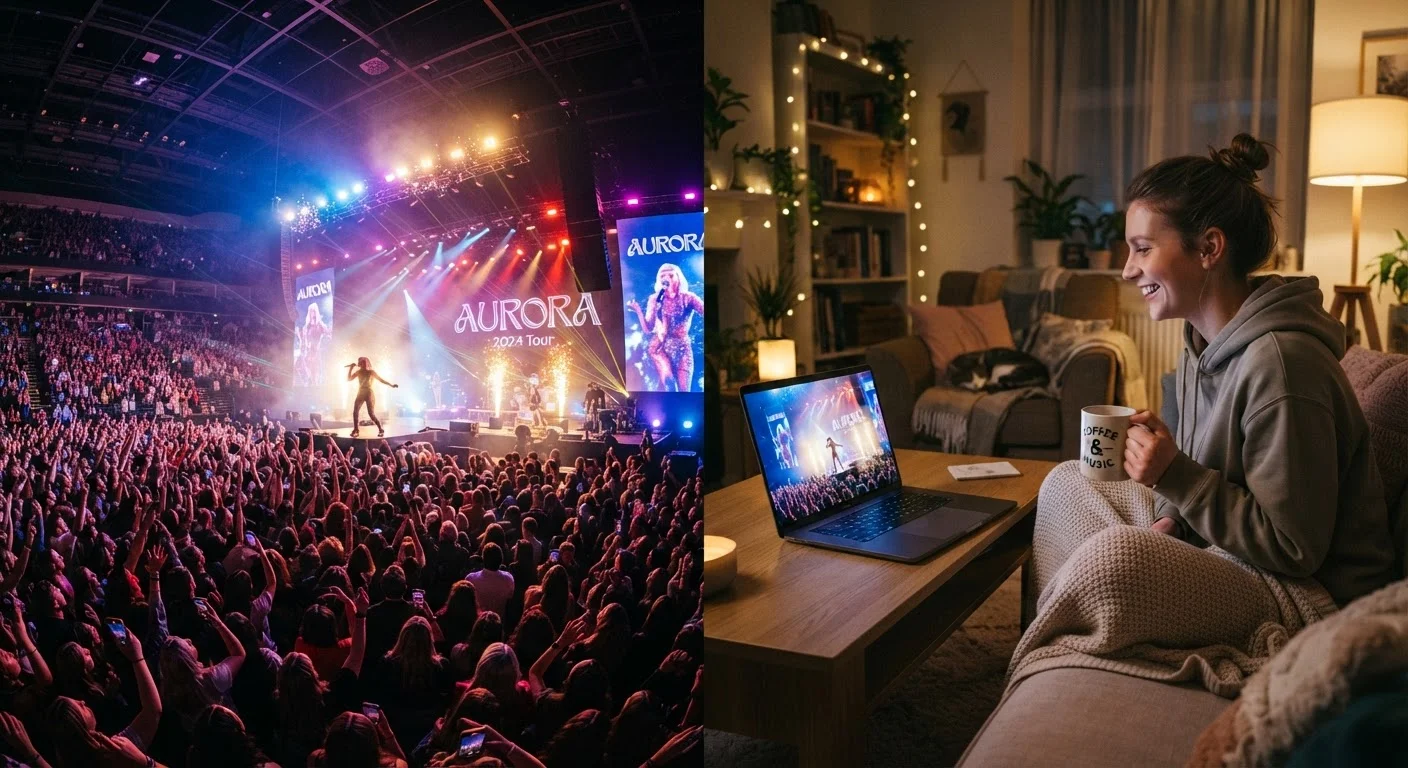
Key Takeaways
- In-person concerts deliver sensory immersion and crowd energy that no digital format can fully replicate.
- Livestreams remove geographic and financial barriers, making artists accessible to a global audience.
- Concert tickets, travel, and incidentals add up significantly compared to most livestream access costs.
- Livestream production quality varies widely - some feel like premium broadcasts, others like shaky phone footage.
- Both formats can coexist in a fan's life; they serve different needs rather than competing head-to-head.
- Artist revenue models differ between formats, which affects how each format is prioritized by the industry.
Option A
In-Person Concerts
The full-body, all-senses live music experience.
Best for: Fans who want communal energy, physical presence, and memories that a screen simply cannot replicate.
Option B
Livestreams
The accessible, flexible way to catch a performance anywhere.
Best for: Fans who face geographic, financial, or physical barriers to attending shows - or who just prefer watching from home.
If you want the defining, once-in-a-lifetime fan experience
In-Person Concerts
Nothing matches the physical energy of a crowd, the sound system vibrating through your chest, and standing in the same space as the artist you love.
If cost or location makes attending a show impractical
Livestreams
Livestreams democratize access - a fan in a rural town or another country can watch the same performance as someone in the front row.
If you want to follow a world tour without burning your budget
Livestreams
Skipping flights, hotels, and ticket markups makes livestreams a genuinely sustainable way to stay connected with touring artists.
If you're a casual listener curious about an artist's live presence
Livestreams
A low-stakes livestream is a great way to gauge whether an artist's live show is worth investing in before committing to a full concert experience.
If community and shared moments matter most to you
In-Person Concerts
Singing in unison with thousands of strangers, the pre-show buzz, the post-show conversation - these social layers only happen live and in-person.
What You Actually Get at a Live Concert
Walking into a concert venue carries a charge that's hard to articulate but impossible to miss. The combination of crowd noise, stage lighting, and sound pressure - bass frequencies you feel in your sternum - creates a physiological experience that is categorically different from anything a speaker system at home can produce. That sensory totality is the concert's core offering.
Beyond the physics, there's the social dimension. Concerts are communal rituals. Whether it's a 500-person club show or a 70,000-seat stadium, the shared act of experiencing music together generates a sense of connection that fans consistently describe as one of the most meaningful parts of the event. That collective energy - the crowd knowing every word, the spontaneous singalongs, the ripple of excitement when the lights drop - is something a livestream audience can only approximate through a chat window.
The tradeoffs are real, though. Ticket prices for major tours have climbed substantially, and when you add transportation, accommodation, food, and merchandise, a single concert night can represent a significant financial commitment. Sightlines from certain sections can be poor. Queues are long. And not every tour stop is geographically convenient. For fans who want to follow a touring artist, understanding what touring demands of artists is equally illuminating - it's an expensive, exhausting endeavor from both sides of the stage.
| Criterion | In-Person Concerts | Livestreams |
|---|---|---|
| Sensory experience | Full-body sound, crowd energy, lighting | Audio/video through personal devices |
| Typical cost | High (tickets + travel + extras) | Low to moderate (access fee or free) |
| Geographic access | Limited to tour stops | Global (where available) |
| Community feel | Strong - shared physical space | Moderate - chat interaction only |
| Production control | Variable by venue and seat location | Variable by stream quality and platform |
| Replayability | One-time live event | Often recorded and replayable |
| Artist revenue share | Significant touring revenue | Varies by platform and deal structure |
What Livestreams Actually Deliver
The livestream format matured rapidly during the early 2020s out of necessity, and the technology and production values have improved meaningfully since then. At their best, professionally produced livestreams offer multi-camera switching, high-quality audio mixing, and real-time fan interaction through chat - a viewing experience that, in some ways, is editorially richer than being in a nosebleed seat.
Access and affordability are the format's strongest arguments. A fan who can't afford a ticket to a sold-out arena show, or who lives in a country that isn't on the tour itinerary, can still participate. That democratization of access reshapes the fan-artist relationship in genuinely meaningful ways, expanding an artist's audience beyond the limits of geography and income.
~50%
Fans citing cost as concert barrier
Surveys by music industry researchers have consistently found that ticket price is among the top reasons fans cite for not attending live shows.
Millions
Viewers for major virtual concerts
High-profile virtual performances during the early 2020s drew audiences in the tens of millions, demonstrating the global scale livestreams can achieve.
The weaknesses are worth naming honestly. Internet connectivity issues, buffering, and varying production quality can disrupt the experience. The communal energy of a crowd does not translate through a screen - watching thousands of people react in a chat feed is simply not the same as being among them. And many livestreams are time-limited or geo-restricted, meaning the convenience isn't always as universal as it seems. The shift from albums to streaming has already changed how fans relate to music - as explored in our piece on the streaming era vs. album era - and livestreams represent one more evolution in how performance itself is distributed and consumed.
Livestream Rights and Availability Vary
Not every concert is livestreamed, and those that are may have geographic restrictions based on licensing agreements. Some livestreams require a separate paid access ticket through a specific platform, while others are bundled with fan club memberships or offered free on social media. Always check the artist's official channels for accurate information on where and how to watch.
Choosing the Format That Fits Your Fan Life
The honest answer is that concerts and livestreams aren't really competing for the same thing - they're filling different roles. Attending a show is an event. A livestream is access. Depending on your budget, location, schedule, and what you're personally after from a musical experience, one or both can fit into your life without compromise.
If you're new to an artist and want to gauge their live energy before committing to a ticket purchase, a livestream is an excellent low-cost preview. If you're a dedicated fan who's followed an artist for years and wants that singular, irreplaceable moment of being in the room, saving up for a live show is likely worth it. And if you're interested in how fan perceptions of artists shape (and sometimes misrepresent) their public image, our coverage of how fans sometimes misread their favorite artists adds useful context to how parasocial the concert and livestream experiences can become.
Neither format is objectively superior. What matters is knowing what you're actually getting - and choosing accordingly.