
Streaming Era vs. Album Era: How Music Consumption Has Fundamentally Changed

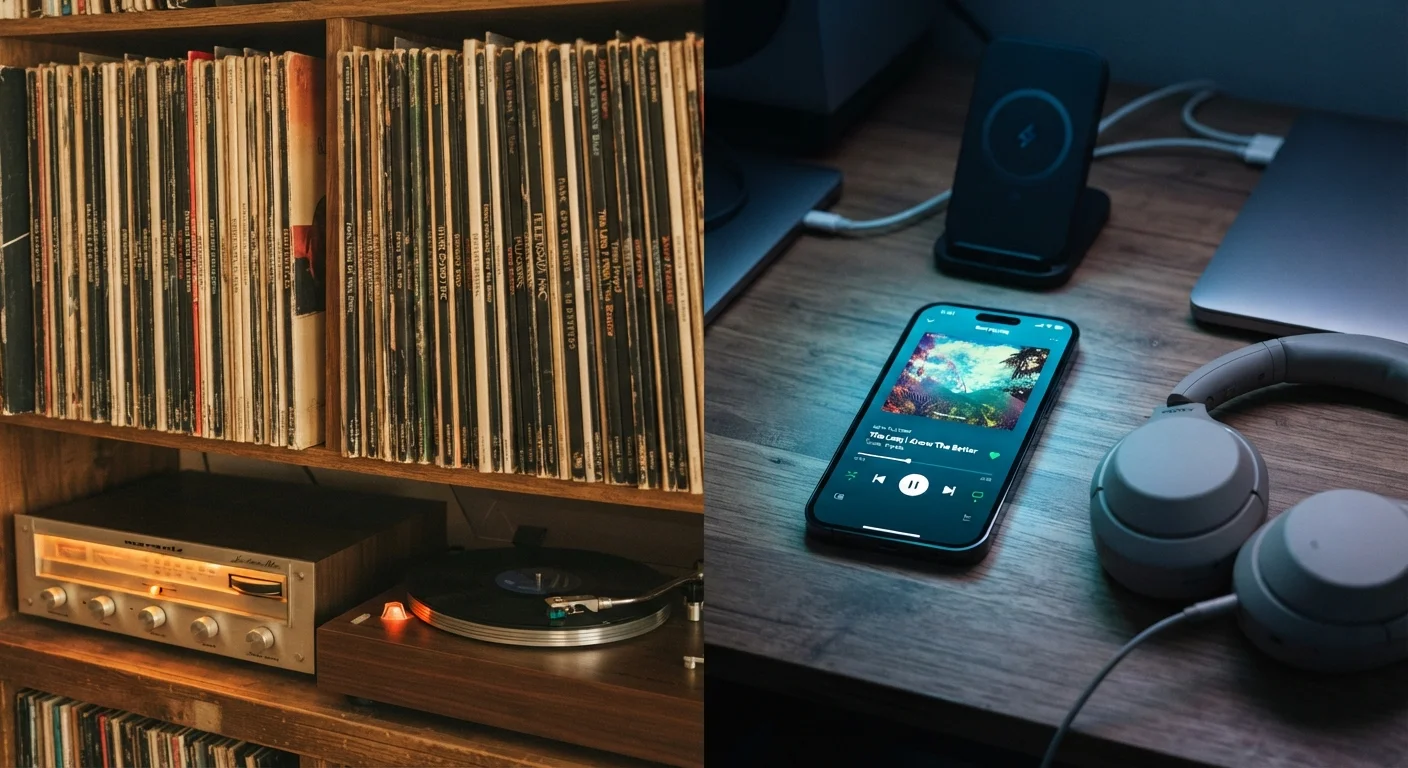
Key Takeaways
- The album era prioritized cohesive artistic storytelling; the streaming era prioritizes individual track performance.
- Streaming platforms have shifted power toward listener habits and algorithmic recommendations over artist-controlled release cycles.
- Revenue models changed dramatically - streams pay fractions of a cent per play compared to physical album sales.
- Artists now release music more frequently in shorter formats to maintain algorithmic visibility.
- Playlist placement has become as commercially significant as chart positioning once was.
- Both eras have produced landmark music, but they reward fundamentally different creative and business strategies.
Option A
The Album Era
The intentional, immersive listening experience built around a complete artistic statement.
Best for: Fans who want to experience music as a cohesive narrative, from opening track to closer, the way an artist intended.
Option B
The Streaming Era
The on-demand, playlist-first ecosystem where individual songs compete for seconds of attention.
Best for: Listeners who want instant access to virtually any song ever recorded, curated around mood, moment, or algorithm.
If you want deep, intentional engagement with an artist's vision
The Album Era
Albums were architected as complete experiences - track order, interludes, and thematic arcs all serve the listener willing to commit to the full ride.
If you want effortless discovery and a constantly refreshed listening experience
The Streaming Era
Algorithmic playlists and recommendation engines surface music you'd never find on your own, making it easier than ever to explore broadly across genres and eras.
If you're an emerging artist trying to build a global audience quickly
The Streaming Era
Streaming removes geographic and distribution barriers - a single viral moment on a playlist or social platform can introduce an unknown artist to millions overnight.
If you care about artists receiving fair compensation for their work
The Album Era
Physical and digital album sales historically returned more revenue per listener engagement than the fractional per-stream rates that dominate today's royalty structures.
What Each Era Actually Means
The Album Era - roughly spanning the 1960s through the early 2000s - was defined by the LP as the primary artistic unit. Artists spent months or years crafting records that were released in concentrated promotional windows: interviews, singles, music videos, and tour dates were all synchronized around a launch moment. Listeners bought the full product, physically or digitally, and experienced it largely on the artist's terms.
The Streaming Era, which took firm hold in the early 2010s with the rise of platforms like Spotify and Apple Music, dismantled that model almost entirely. Songs became the atomic unit of consumption. Listeners curate their own experiences through playlists, skip tracks freely, and discover music through recommendation algorithms rather than radio programmers or music press. The result is a fundamentally different relationship between artist and audience - one driven by data, velocity, and constant availability.
Understanding how streaming platforms actually work helps clarify just how much the infrastructure behind music changed, not just the listening habits on top of it.
Side-by-Side: How the Two Eras Compare
The differences between these two eras ripple across every dimension of music - from how it's made to how artists are paid.
| Criterion | Album Era | Streaming Era |
|---|---|---|
| Primary artistic unit | Full album (LP/CD) | Individual track or single |
| Release cadence | Every 1-3 years | Multiple drops per year |
| Discovery mechanism | Radio, press, word of mouth | Algorithms, playlists, social media |
| Revenue model | Per-unit sale (album/download) | Fractional per-stream royalty |
| Listener control | Limited - artist sets sequence | Total - skip, shuffle, curate freely |
| Geographic reach at launch | Label-dependent distribution | Instant global availability |
| Gatekeepers | Labels, radio, music press | Platform editors, algorithms |
One of the starkest contrasts is in release strategy. Album-era artists typically released music every one to three years, with each project carrying enormous weight. Streaming-era artists often drop singles, EPs, or loosies several times a year to maintain algorithmic relevance. Disappearing from playlists can feel like disappearing from public consciousness entirely.
84%
U.S. recorded music revenue from streaming
According to the RIAA's 2023 annual report, streaming accounted for approximately 84% of total U.S. recorded music revenue that year.
~$0.003-$0.005
Estimated per-stream royalty range
Industry analyses consistently place average per-stream payouts in this range, though exact figures vary by platform, territory, and contract structure.
30 sec
Threshold for a stream to count as paid
Most major streaming platforms require a track to be played for at least 30 seconds before it registers as a countable, royalty-generating stream.
The Artist Experience: Creative Freedom vs. Commercial Pressure
The album format gave artists something streaming struggles to replicate: interpretive control. A listener who bought a record engaged with it in sequence, absorbing transitions and thematic threads the artist deliberately built in. The album's closing track meant something precisely because the opening track existed. Genre-bending experiments, slow-burn deep cuts, and conceptual interludes all had a home in that structure.
Streaming's skip button changed the calculus. Data shows that listeners frequently skip tracks within the first 30 seconds if they aren't immediately engaged - and that behavior shapes how music gets made. Hooks arrive earlier, intros are shorter, and albums themselves sometimes feel like collections of potential singles rather than unified statements. This connects directly to why so many viral songs share similar sonic formulas - the algorithm rewards patterns that retain listeners, and producers respond accordingly.
That said, the streaming era has also democratized access to the industry in real ways. Artists no longer need a major label's distribution machinery to reach global audiences. Independent musicians can upload directly to platforms and, with the right moment of virality, compete on charts alongside major label releases.
The Fan Experience: Depth vs. Breadth
For listeners, the album era demanded a kind of patience and investment that streaming doesn't require. You bought something. You sat with it. Entire subcultures formed around debating track rankings, hidden lyrics, and liner note credits. That intimacy ran deep - fans often associate specific albums with specific chapters of their lives in a way that a shuffled playlist rarely replicates.
Streaming trades that depth for extraordinary breadth. The ability to access virtually any recorded song in history, instantly and on any device, is genuinely remarkable. Discovery has never been easier, which is part of why genre boundaries are dissolving faster than ever - listeners graze across styles without friction, and artists absorb wider influences as a result.
For fans who want to move beyond surface-level listening, there's still richness to uncover. Going deeper into an artist's catalog - beyond the algorithmically promoted singles - can recreate something close to the album-era experience even within a streaming environment.
The Album Isn't Dead - It's Evolved
Several major artists have continued releasing conceptually unified albums in the streaming era and seen enormous commercial and critical success. The format hasn't disappeared - but its cultural primacy has shifted. Some artists now use streaming data strategically, testing singles before finalizing album tracklists based on listener response. It's a hybrid approach that neither era alone would have made possible.
The Economics: Who Wins, Who Loses
The financial restructuring between these two eras is perhaps the most consequential shift. Physical album sales and digital downloads generated revenue that scaled with the size of the purchase - buy an album, the artist and label receive a fixed amount. Streaming replaced that with a royalty pool model where per-stream payouts are fractions of a cent, with exact rates varying by platform, territory, and contract terms.
For superstars with hundreds of millions of streams, the math can work. For mid-level and independent artists with dedicated but smaller audiences, the economics remain challenging. Many artists have responded by leaning heavily into live performance, merchandise, and direct fan relationships as primary income sources - which is part of why the conversation around concerts versus livestreams as fan experiences has become so commercially significant.
Playlist placement now functions similarly to what radio play once did: a coveted spot on a major editorial playlist can drive millions of streams and launch careers. That gatekeeping role has shifted from DJs and program directors to a combination of platform editors and algorithmic systems - a change with real consequences for which artists get heard.