

Key Takeaways
- Data is broken into small packets before transmission, then reassembled at the destination.
- Physical infrastructure - fiber cables, routers, and cell towers - carries all internet traffic.
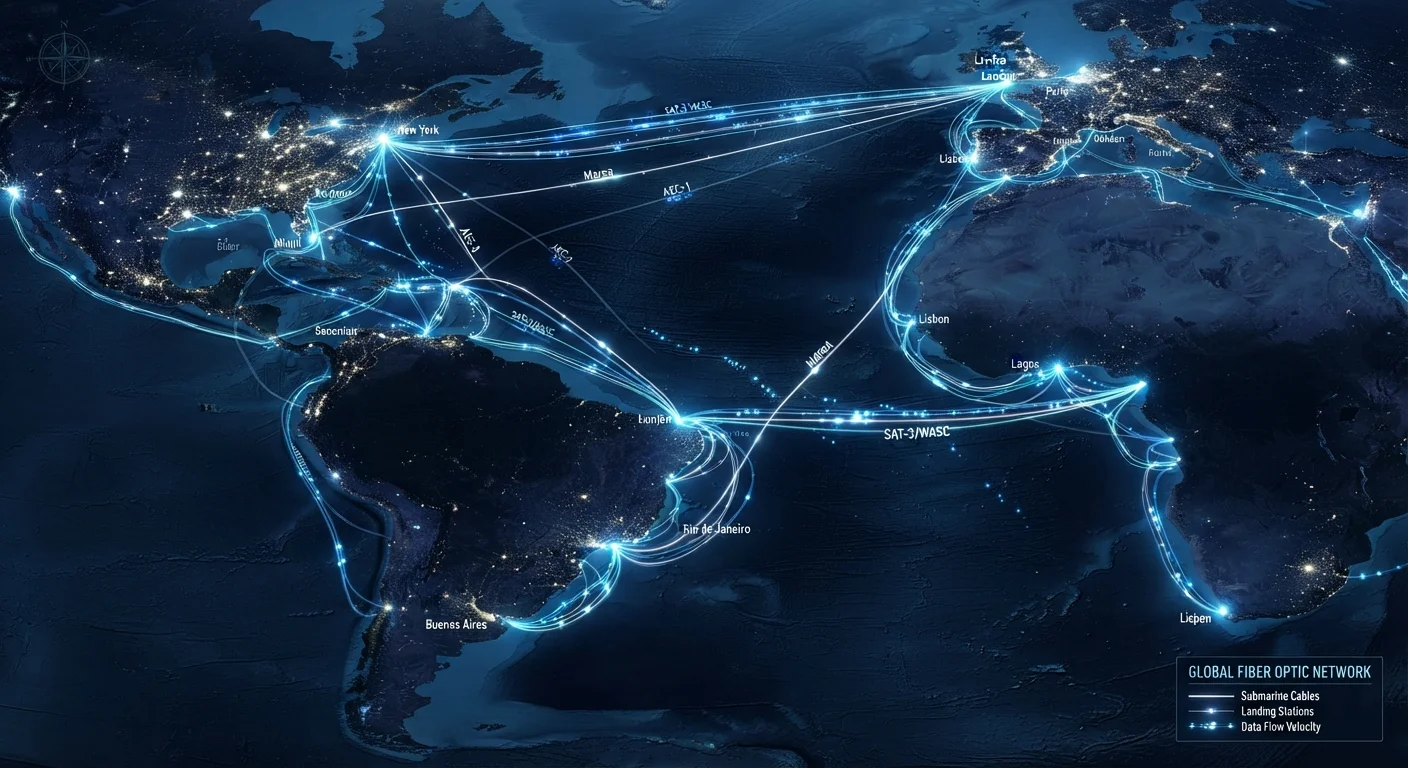
- Submarine fiber optic cables connect continents and carry the vast majority of international data.
- Your data typically passes through multiple network "hops" before reaching its destination.
- Wireless connections are only the final link; the rest of the journey is almost always wired.
Internet Data Transmission
Internet data transmission is the process of breaking information into small chunks called packets, sending them across a physical network of cables and wireless links, and reassembling them at the destination. Every webpage, video, and message you access follows this same fundamental path. The infrastructure that carries this data spans fiber optic cables on the ocean floor, cell towers in your neighborhood, and routers in buildings worldwide.
Data travels using the TCP/IP protocol suite - a standardized set of rules that governs how packets are addressed, routed, and verified across heterogeneous networks.
Everything Starts with Packets
When you load a webpage or send a message, the internet doesn't transmit that information as one continuous stream. Instead, it breaks the data into small, manageable chunks called packets. Each packet contains a fragment of your data along with addressing information - essentially a label showing where it came from and where it needs to go.
Those packets don't all have to take the same route. They travel independently across the network, often arriving out of order, and are reassembled at the destination by your device or the receiving server. This approach, known as packet switching, makes the internet remarkably resilient: if one path is congested or broken, packets simply take a different route.
To understand the addressing system that makes this work, see our article on IP addresses and DNS - the invisible directory the internet uses to route every request.
95%
International internet traffic carried by submarine cables
According to the International Cable Protection Committee, undersea fiber optic cables carry the overwhelming majority of global internet and voice traffic.
400+
Submarine cable systems currently in service worldwide
The TeleGeography Submarine Cable Map tracks active and planned undersea cable routes connecting every inhabited continent.
~200ms
Typical round-trip latency across the Atlantic Ocean
Network measurements consistently show transatlantic round-trip times in the range of 70-200 milliseconds depending on routing and server location.
The Physical Infrastructure Underneath
The internet feels wireless and invisible, but it runs on a vast and very physical network. The backbone of global internet traffic is fiber optic cable - thin strands of glass that carry pulses of light encoding data. These cables crisscross continents buried underground, and stretch across ocean floors in bundles called submarine cables.
More than 400 submarine cable systems are currently in service worldwide, carrying roughly 95% of all international internet traffic. When you load a website hosted on another continent, your request almost certainly travels through one of these undersea cables - a journey of thousands of miles completed in milliseconds.
On land, data passes through a hierarchy of networks. Large internet service providers (ISPs) operate high-capacity backbone networks that connect cities and regions. Smaller ISPs and local networks connect to these backbones at facilities called Internet Exchange Points (IXPs), where different networks hand traffic off to one another.
“The internet is not a cloud - it is a very physical thing. It is copper, it is fiber, it is buildings full of servers, and it is people maintaining all of it around the clock.”
— Andrew Blum, Author of 'Tubes: A Journey to the Center of the Internet'
Routers: The Traffic Directors
Throughout this journey, devices called routers make the real-time decisions about where each packet goes next. Every router maintains a routing table - a constantly updated map of the network - and uses it to forward each incoming packet toward its destination via the most efficient available path.
A single data request from your browser might pass through a dozen or more routers before reaching the target server. Each stop is called a hop. Network diagnostic tools can actually reveal this path, showing you each router the data touches and how long each leg of the journey takes.
This is also why geographic distance affects performance. A server physically located closer to you generally means fewer hops and lower latency. That's the core logic behind Content Delivery Networks (CDNs), which place copies of popular content in data centers around the world so that your nearest copy is never far away.
The Last Mile: How Data Reaches Your Device
The final stretch of the journey - from your ISP's local equipment to your home - is called the last mile. This segment uses a variety of technologies depending on where you live and what service you subscribe to: fiber to the home, coaxial cable, DSL over phone lines, fixed wireless, or mobile cellular networks.
If you're on Wi-Fi, the data arrives at your router via a physical cable, and your router then broadcasts it wirelessly to your devices. The wireless portion of the trip is typically only the last few feet or meters. For a deeper look at how those two delivery methods compare, see wired vs. wireless internet.
Understanding this full path - from packet creation, through submarine cables, past dozens of routers, and across the last mile - also helps explain concepts like bandwidth and data speed, and what happens when you upload a file to the cloud.
Test Your Own Data's Path
Most computers include a built-in tool called 'traceroute' (or 'tracert' on Windows) that shows each router hop your data takes to reach a destination. Running it for a website hosted abroad can reveal just how many countries your data passes through. It's a useful, hands-on way to make this invisible infrastructure visible.