

| eSIM availability | Supported by most flagship phones sold in the US since 2021 |
| Common 5G bands in the US | Sub-6 GHz (wide coverage) and mmWave (very fast, short range) |
| NFC range | Typically less than 4 cm (about 1.5 inches) |
| Wi-Fi 6 max theoretical speed | Up to 9.6 Gbps (shared across connected devices) (IEEE 802.11ax standard) |
| IP68 water depth (typical test) | Up to 1.5 meters for 30 minutes (IEC standard 60529) |
Why Spec Sheet Jargon Matters
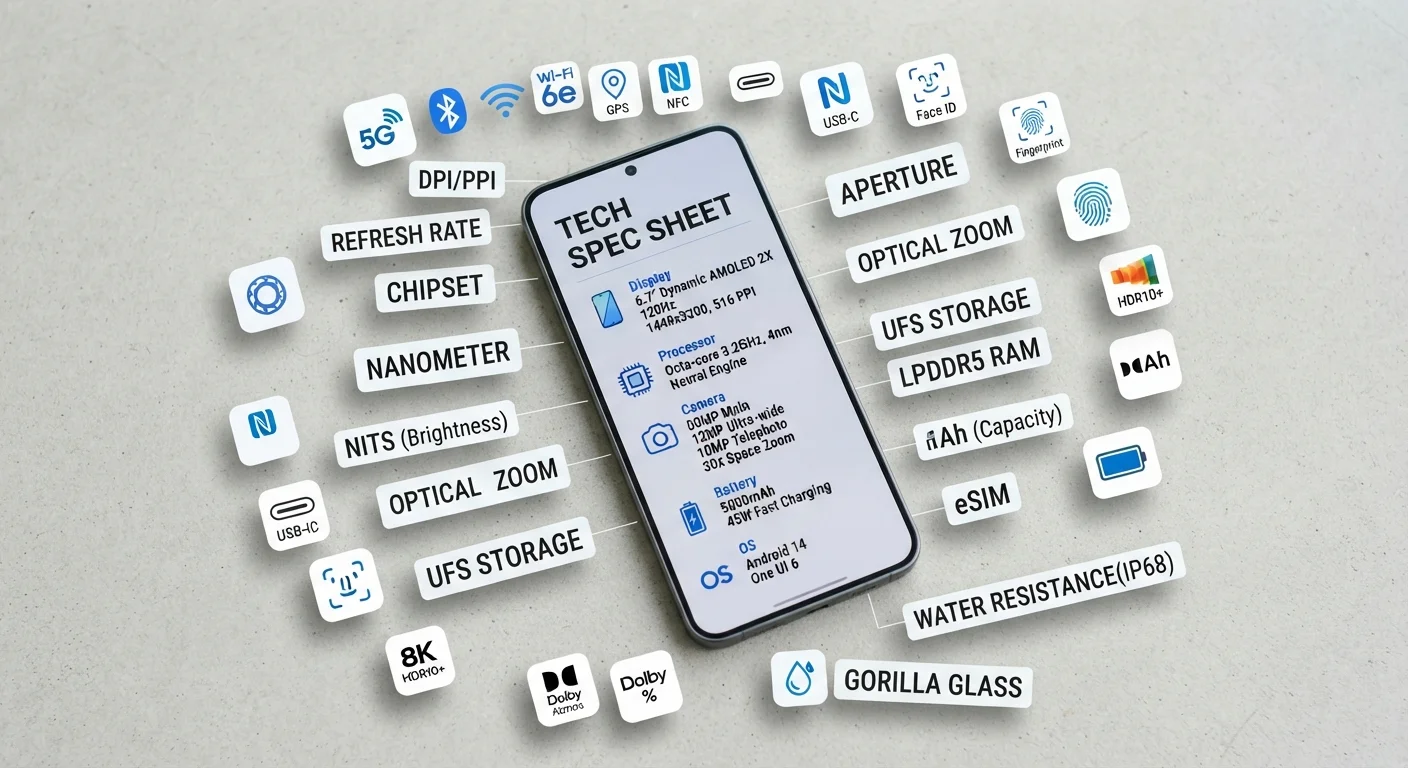
Every smartphone listing comes loaded with abbreviations and technical shorthand - SoC, AMOLED, NFC, IP68, eSIM. These aren't just marketing filler. They describe real features that affect how a phone performs, how long it lasts, and what it can actually do. Understanding them puts you in control of your decisions, rather than relying on vague claims like "powerful" or "long-lasting."
This reference covers the core terms that appear on nearly every spec sheet, grouped by category for easier scanning. Bookmark it and return whenever a new term stops you cold.
SoC (System on a Chip)
An integrated circuit that combines a phone's processor, graphics unit, modem, and other key components into a single package. The SoC is the primary driver of performance, efficiency, and capability across tasks.
eSIM
An embedded SIM that is built directly into a phone's hardware, replacing or supplementing a physical SIM card. It allows users to activate and switch carriers digitally without swapping cards.
Refresh rate
The number of times per second a phone's display updates its image, measured in hertz (Hz). Higher refresh rates produce smoother motion and more responsive scrolling, at the cost of additional battery consumption.
NFC
Near Field Communication - a short-range wireless standard that enables contactless payments, pairing with accessories, and small data transfers when two devices are held within a few centimeters of each other.
IP Rating
A standardized measure of a device's resistance to solid particles (dust) and liquids (water). IP68, the most common high-end rating, indicates full dust protection and water resistance under defined submersion conditions.
OIS
Optical Image Stabilization - a hardware feature that physically moves the camera lens or sensor to compensate for hand shake, reducing motion blur in photos and smoothing out video footage.
RAM
Random Access Memory - the short-term working memory a smartphone uses to run active apps. More RAM allows the phone to keep more applications open simultaneously without needing to reload them.
mAh
Milliamp-hour - the unit used to describe a battery's energy capacity. A higher mAh value indicates a larger battery, though actual battery life depends on how efficiently the phone uses that energy.
Connectivity and Network Terms
Network and wireless terms can be especially confusing because they overlap in everyday use.
| eSIM availability | Supported by most flagship phones sold in the US since 2021 |
| Common 5G bands in the US | Sub-6 GHz (wide coverage) and mmWave (very fast, short range) |
| NFC range | Typically less than 4 cm (about 1.5 inches) |
| Wi-Fi 6 max theoretical speed | Up to 9.6 Gbps (shared across connected devices) (IEEE 802.11ax standard) |
| IP68 water depth (typical test) | Up to 1.5 meters for 30 minutes (IEC standard 60529) |
- 5G / LTE: These are cellular network standards. LTE (Long-Term Evolution) is widely available and handles most everyday tasks with ease. 5G is the newer generation, offering higher potential speeds in supported areas. For a plain-language breakdown of how they compare, see 5G, LTE, and Wi-Fi Calling explained.
- eSIM: A digital SIM built into the phone's hardware - no physical card slot required. It allows you to switch carriers digitally. eSIM vs. Physical SIM explores what this shift means in practice.
- NFC (Near Field Communication): Short-range wireless technology that enables contactless payments, data sharing, and pairing with accessories at very close range.
- Wi-Fi 6 / Wi-Fi 6E: Newer Wi-Fi standards that improve speed and reduce congestion, especially on crowded networks. The "E" variant adds a 6 GHz band for even less interference.
Display and Camera Terms
Display and camera specs are where marketing language gets most creative - and most confusing.
- OLED / AMOLED: Display panel technologies that produce true blacks by turning off individual pixels. AMOLED is a Samsung-coined variant; both offer vibrant contrast compared to LCD screens.
- Refresh rate (Hz): How many times per second the display redraws the image. Higher refresh rates (90Hz, 120Hz) produce smoother scrolling and animation.
- Resolution (FHD+, QHD+): The number of pixels on screen. FHD+ (1080p) is crisp on most phone sizes; QHD+ (1440p) adds more detail on larger displays.
- Megapixels (MP): The number of pixels a camera sensor captures per image. More megapixels don't automatically mean better photos - sensor size, lens quality, and software processing all matter equally.
- Aperture (f/number): Describes how much light the camera lens allows in. A lower f-number (e.g., f/1.8) means a wider opening and better low-light performance.
- OIS (Optical Image Stabilization): A hardware mechanism that physically shifts the lens or sensor to reduce blur from hand movement during photos and video.
Megapixels Don't Tell the Whole Story
A 200MP camera sensor does not automatically produce better photos than a 50MP sensor. Image quality depends heavily on pixel size, lens aperture, sensor dimensions, and the phone's image processing software. When evaluating camera specs, look at the full picture rather than the megapixel count alone.
Performance and Battery Terms
Under the hood, a few key terms determine day-to-day speed and stamina.
- SoC (System on a Chip): The main processor package that combines the CPU, GPU, modem, and other components onto one chip. It's the single most important factor in a phone's overall performance. What a smartphone processor actually does covers this in depth.
- RAM (Random Access Memory): Temporary memory the phone uses to keep apps running in the background. More RAM generally means smoother multitasking.
- Storage (UFS): The permanent space where your files, apps, and photos live. UFS (Universal Flash Storage) is the common standard; higher UFS versions offer faster read/write speeds.
- mAh (Milliamp-hour): The unit used to express battery capacity. A higher number indicates a larger energy reservoir, though actual battery life also depends on the SoC's efficiency and screen brightness.
- Fast charging (wattage): Rated in watts (W), this describes how quickly a charger can replenish the battery. Higher wattage means shorter charge times, but the phone and charger must both support the same standard.
Durability and Security Terms
These terms describe how a phone holds up in the real world and how it protects your data.
- IP rating (e.g., IP68): An international standard measuring dust and water resistance. The first digit rates dust protection (6 = fully sealed); the second rates water resistance (8 = submersion beyond 1 meter). Note that IP ratings are tested under controlled lab conditions and don't cover every real-world scenario.
- Gorilla Glass / ceramic shield: Trade names for reinforced glass used on screen surfaces to resist scratches and drops. Performance varies by generation and version.
- Biometric authentication: Security methods using physical characteristics - fingerprints, face recognition, or iris scans - to unlock the device or authorize transactions.
For related terminology covering other consumer electronics, see the Consumer Electronics Glossary. If you're just getting started with a new device, the First-Time Smartphone Owner's Guide is a practical next step.
120Hz
Refresh rate now common on mid-range and flagship phones
What was once a premium-only feature has become widely available across price tiers as of recent product generations.
IP68
Most common top-tier water resistance rating on flagship phones
The IP68 designation appears on the majority of premium smartphones sold in the US, though exact submersion depth and duration vary by manufacturer.