

Key Takeaways
- An eSIM is a chip soldered into your phone that stores carrier credentials digitally, with no physical card required.
- Physical SIMs remain widely supported globally and are easier to move between compatible devices.
- eSIMs allow multiple carrier profiles on one device, which is a meaningful advantage for international travelers.
- Not all carriers or countries fully support eSIM activation yet, so check before assuming availability.
- Some newer US devices ship without a physical SIM tray at all, making eSIM the only option.
Option A
eSIM (Embedded SIM)
The built-in, software-driven standard gaining rapid ground.
Best for: Travelers, frequent carrier switchers, and users with newer flagship devices who value convenience over physical portability.
Option B
Physical SIM Card
The familiar, universally supported hardware option.
Best for: Users in regions with limited eSIM carrier support, those who frequently share SIMs between devices, or anyone who prefers tangible control.
If you travel internationally and want flexible carrier access
eSIM (Embedded SIM)
eSIM lets you activate a local carrier plan digitally without swapping cards, saving time and reducing the risk of losing a tiny chip abroad.
If you frequently switch between older devices or share SIMs
Physical SIM Card
A physical SIM can be moved from phone to phone instantly without any carrier app or QR code, provided the devices use the same SIM format.
If you're on a newer flagship phone in the US and want a simpler setup
eSIM (Embedded SIM)
Most major US carriers support eSIM activation fully, and the digital process is often faster than visiting a store for a physical card.
If you're in a region where eSIM carrier support is limited or inconsistent
Physical SIM Card
Physical SIM infrastructure is mature everywhere, making it the safer default when eSIM availability cannot be confirmed in advance.
What Each Technology Actually Is
A physical SIM card - short for Subscriber Identity Module - is a small removable chip that stores your carrier credentials: essentially, proof of who you are on the network. You slot it into a tray on the side of your phone, and the carrier recognises your device. The format has shrunk over generations from mini to micro to nano, but the principle has stayed the same since the 1990s.
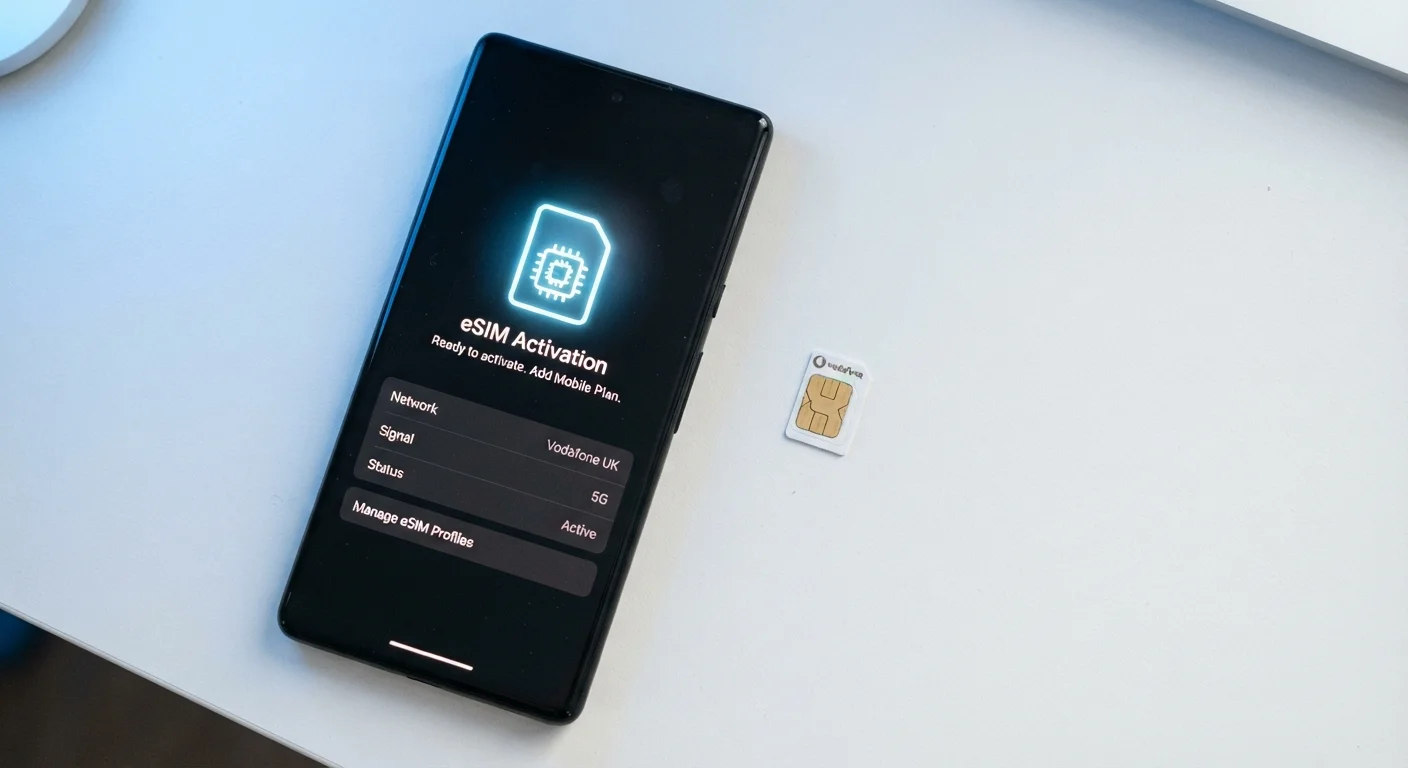
An eSIM (embedded SIM) performs the exact same function, but the chip is soldered directly onto the phone's circuit board at manufacture. There's nothing to insert or remove. Instead, your carrier credentials are written to it digitally - usually by scanning a QR code, using a carrier app, or completing an online activation. The GSMA, the industry body that sets mobile standards, defined the eSIM specification to allow multiple carrier profiles to be stored and switched without any hardware change.
For a plain-language breakdown of terms that appear on every phone spec sheet, see the Smartphone Glossary.
| Criterion | eSIM | Physical SIM |
|---|---|---|
| Hardware required | None - built into device | Removable nano-SIM card |
| Carrier activation | Digital (QR code or app) | Physical card from carrier |
| Multiple profiles | Yes - store several, switch digitally | No - one carrier per slot |
| Device compatibility | Newer mid-range to flagship only | Nearly universal |
| Global carrier support | Growing but uneven | Mature and widespread |
| Moving to another phone | Requires carrier transfer process | Instant - pop out and insert |
| Risk of physical loss | None | Possible - small chip |
Practical Differences That Actually Matter
Carrier switching: With a physical SIM, changing carriers means waiting for a new card in the mail or visiting a store. With eSIM, the process is often completed entirely online in minutes - a meaningful convenience, though it still depends on your carrier's specific process.
International travel: This is where eSIM's advantage is most tangible. Rather than hunting for a local SIM at an airport kiosk, travelers with compatible devices can purchase and activate a short-term local plan digitally before boarding. Some phones support running a domestic and an international eSIM profile simultaneously. For context on how your connection type affects real-world performance, see 5G, LTE, and Wi-Fi Calling.
Device switching: Moving a physical SIM to another phone is instant - pop it out, slot it in. Transferring an eSIM profile to a new device requires going through your carrier's transfer process, which varies by provider. If you're planning a device switch, the Switching Phones guide covers what to prepare in advance.
300+
Carriers globally supporting eSIM
According to GSMA intelligence tracking, over 300 mobile operators worldwide had launched commercial eSIM services as of recent reporting periods.
2 profiles
Typical simultaneous eSIM profiles on consumer phones
Most consumer eSIM-capable smartphones support at least two active profiles, enabling dual-SIM functionality without a second physical tray.
Security: Because an eSIM cannot be physically removed, certain types of SIM-swap fraud become harder to execute. However, digital activation processes introduce their own security considerations, and no system is entirely risk-free.
Limitations and Honest Trade-offs
eSIM adoption is accelerating in the United States and Western Europe, but global carrier support remains uneven. Travelers heading to parts of South Asia, Africa, or rural regions should verify eSIM compatibility with local networks before departure - physical SIM fallback may still be necessary.
Some users also report that eSIM carrier transfers can be complicated when a device is lost or damaged, since the profile exists only on the device. Carriers typically have recovery procedures, but the process can require more steps than simply moving a physical card to a replacement phone.
Check Your Carrier Before Assuming eSIM Works
Even if your phone supports eSIM, your carrier must also support digital activation for it to function. Prepaid plans and smaller regional carriers have been slower to adopt eSIM provisioning than the major national networks. If you're planning to rely on eSIM - especially while traveling - confirm support directly with the carrier before departure rather than assuming compatibility.
It's also worth noting that the device itself must support eSIM - not all phones do, particularly budget and mid-range models. Conversely, select newer US-market devices have removed the physical SIM tray entirely, making eSIM non-optional. Checking a specific device's specifications before purchase is the only reliable way to know which options are available. The Android vs. iOS ecosystem guide can help you weigh broader platform factors that interact with connectivity choices.