

Key Takeaways
- Dark colors can make small rooms feel cozy and intentional, not cramped, when used correctly.
- Mirrors only create a sense of space when placed to reflect light or a meaningful view.
- Oversized furniture is not always the enemy - one well-scaled anchor piece can help a room read larger.
- Matching everything to one color does not automatically make a room look bigger.
- Small rooms benefit most from deliberate choices about light, proportion, and clutter - not rigid rules.
Why Small-Space Decorating Advice Gets Repeated - and Gets It Wrong
Decorating advice for small rooms tends to travel fast and stick hard. Rules like "always use light colors" or "mirrors make any room feel bigger" get passed from design blogs to social media captions until they start to feel like physics - universal laws that apply to every 400-square-foot apartment or narrow bedroom alike.
The problem is that context almost always matters more than the rule. What works in a bright, south-facing studio may actively hurt a dark, low-ceilinged room. Understanding why a technique works - not just that it supposedly works - is what separates genuinely useful guidance from recycled myths. The sections below take six of the most commonly repeated pieces of small-space advice and examine what the evidence and design logic actually support.
For a broader look at why visual perception plays such a big role, see why small rooms feel smaller than they are.
Myths and Facts About Small-Space Decorating
Each myth below reflects a piece of advice you've likely encountered. The correction isn't about dismissing the original idea entirely - it's about understanding when and why it breaks down.
Myth
Dark colors make small rooms feel smaller and should always be avoided.
Fact
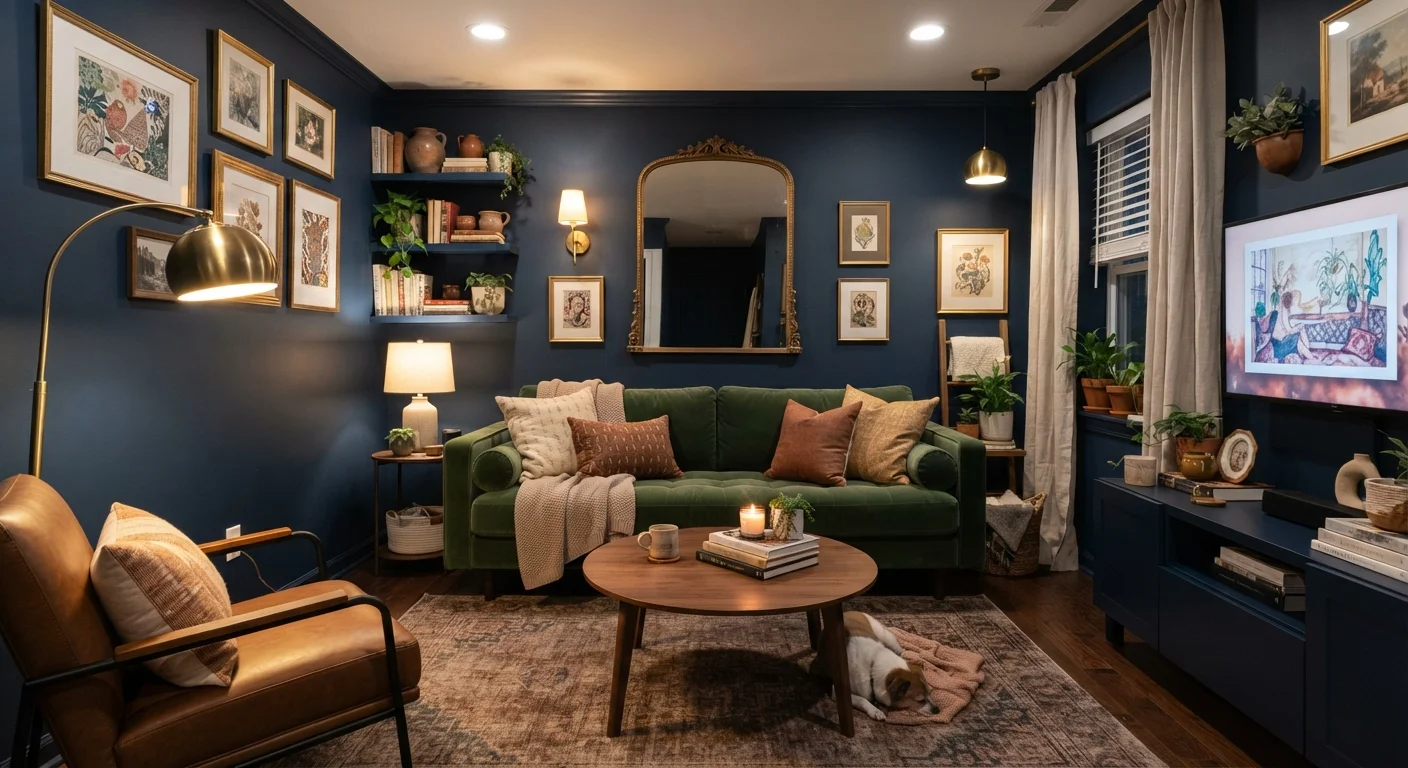
Dark colors can actually make a small room feel more intentional, cozy, and even larger when applied correctly.
The instinct to reach for white or pale gray in a small room is understandable - light colors do reflect more light. But a room painted in a deep, consistent tone (such as a saturated navy, forest green, or charcoal) can visually dissolve its boundaries. When walls, trim, and ceiling share a close or identical hue, the eye stops tracking where surfaces begin and end, which can reduce the sense of confinement.
The key variable is consistency. A single dark accent wall in an otherwise white room often highlights how small the room is by creating a hard visual stop. A fully committed deep-color palette tends to work better. Natural light levels matter too - a dark room with no windows is a different situation than one with good southern exposure.
Myth
Hanging a mirror anywhere in a small room will automatically make it feel bigger.
Fact
Mirrors only create a meaningful sense of space when they reflect something worth doubling - like natural light or an appealing view.
A mirror that reflects a blank wall, a cluttered corner, or a dark hallway doesn't expand a room visually - it just duplicates the problem. The placement logic matters enormously. Mirrors positioned across from windows bounce natural light deeper into a space and can create the impression of a second opening. Mirrors on interior walls, facing other interior walls, often produce a flat or disorienting effect instead.
Scale is another consideration. A small decorative mirror on a large wall can feel like an afterthought and draw attention to empty space rather than resolving it. A larger mirror, or a grouped arrangement treated as a single unit, tends to read with more purpose.
Myth
All furniture in a small room should be small and low-profile to avoid overwhelming the space.
Fact
One or two appropriately scaled anchor pieces often read better than a room full of undersized furniture that looks tentative.
When every piece of furniture is diminutive, the overall effect can make a room look uncertain - as if nothing quite belongs. Interior designers frequently recommend choosing one or two pieces that fit the room's proportions with intention (a proper sofa, a real dining table) and then editing supporting pieces to stay lightweight and minimal.
The other issue with all-small furniture is that it can multiply the number of legs, frames, and visual edges in a room, which increases clutter for the eye. Fewer, bolder pieces with clean lines and visible floor space beneath them often achieve a more open feel than a collection of small items competing for attention. See room-by-room decorating guidance for how furniture function should shape these choices by space type.
Myth
Matching everything to one color makes a small room look seamless and larger.
Fact
Monochromatic schemes can help, but without tonal variation they often produce a flat, lifeless result that makes the room's limitations more obvious.
There's a version of monochromatic decorating that works well in small spaces: using varying tones, textures, and finishes within a single color family creates depth without visual noise. A room where the sofa, walls, rug, and curtains are all the exact same flat shade, however, can look sterile and understyled - drawing attention to the absence of dimension rather than concealing it.
Texture becomes the substitute for color contrast in well-executed tonal rooms. A linen throw against a velvet cushion against a matte wall all in similar warm tones reads as layered and intentional. The same shades in flat, matching finishes tend to look unfinished.
Myth
Open shelving is always better than cabinets in small spaces because it keeps things from looking bulky.
Fact
Open shelving can increase visual clutter significantly; closed storage often creates a cleaner, more spacious feel.
Open shelving is popular partly because it avoids the visual mass of cabinet doors - but it trades one problem for another. Every item on an open shelf becomes part of the room's visual landscape. Unless shelves are styled with careful restraint, they tend to accumulate visual noise faster than closed cabinets do.
In kitchens and bathrooms especially, where everyday items are rarely display-worthy, closed or semi-closed storage typically produces a cleaner result. Floor-to-ceiling cabinetry in a kitchen, for instance, can make the room feel taller while keeping clutter fully contained. The decision should be based on how disciplined a household realistically is about maintaining open displays - not on a blanket assumption that open always reads as lighter.
What Actually Makes a Small Room Work
Across every myth above, one theme emerges: the most effective small-space strategies are about managing perception, not following blanket rules. Proportion, light quality, and visual complexity all shape how a room feels more than square footage alone.
~500 sq ft
Average size of a US studio apartment
According to U.S. Census Bureau residential data, studio apartments typically range from 400 to 600 square feet, making design efficiency a practical necessity for millions of renters.
3x
Impact of clutter on perceived room size
Environmental psychology research consistently finds that visual complexity and clutter are among the strongest factors reducing a room's perceived spaciousness, often outweighing actual square footage.
A few reliable principles stand up across most small rooms:
- Reduce visual fragmentation. The more unrelated objects, colors, and patterns compete for attention, the more cramped a space reads. Editing ruthlessly often does more than any single design trick.
- Use vertical space intentionally. Drawing the eye upward - through tall shelving, floor-to-ceiling curtains, or a bold ceiling treatment - can create the impression of greater volume.
- Let light do the heavy lifting. Layered lighting (ambient, task, and accent sources) prevents the flat, shadowless look that makes small rooms feel like boxes.
If you're decorating within a tight budget, decorating without the space looking cheap covers how to prioritize the changes that the eye notices most. Renters working with restrictions on paint and fixtures can also find practical options in rental-friendly décor changes that actually make a difference.
Small spaces reward thoughtful decision-making more than large ones do - because every choice is more visible. That's a challenge, but it's also an opportunity to create rooms that feel genuinely considered rather than assembled by accident.