

Key Takeaways
- Memes are reusable cultural templates that carry meaning through shared recognition, not just humor.
- A meme's format (the template) and its content (the specific joke) work together to create layered meaning.
- Memes evolve rapidly - overuse leads to saturation, and most formats eventually become ironic or fade out.
- Niche communities often originate meme formats that later reach mainstream audiences in diluted forms.
- Understanding memes is increasingly useful for reading how people express emotion, solidarity, and social commentary online.
Internet Meme
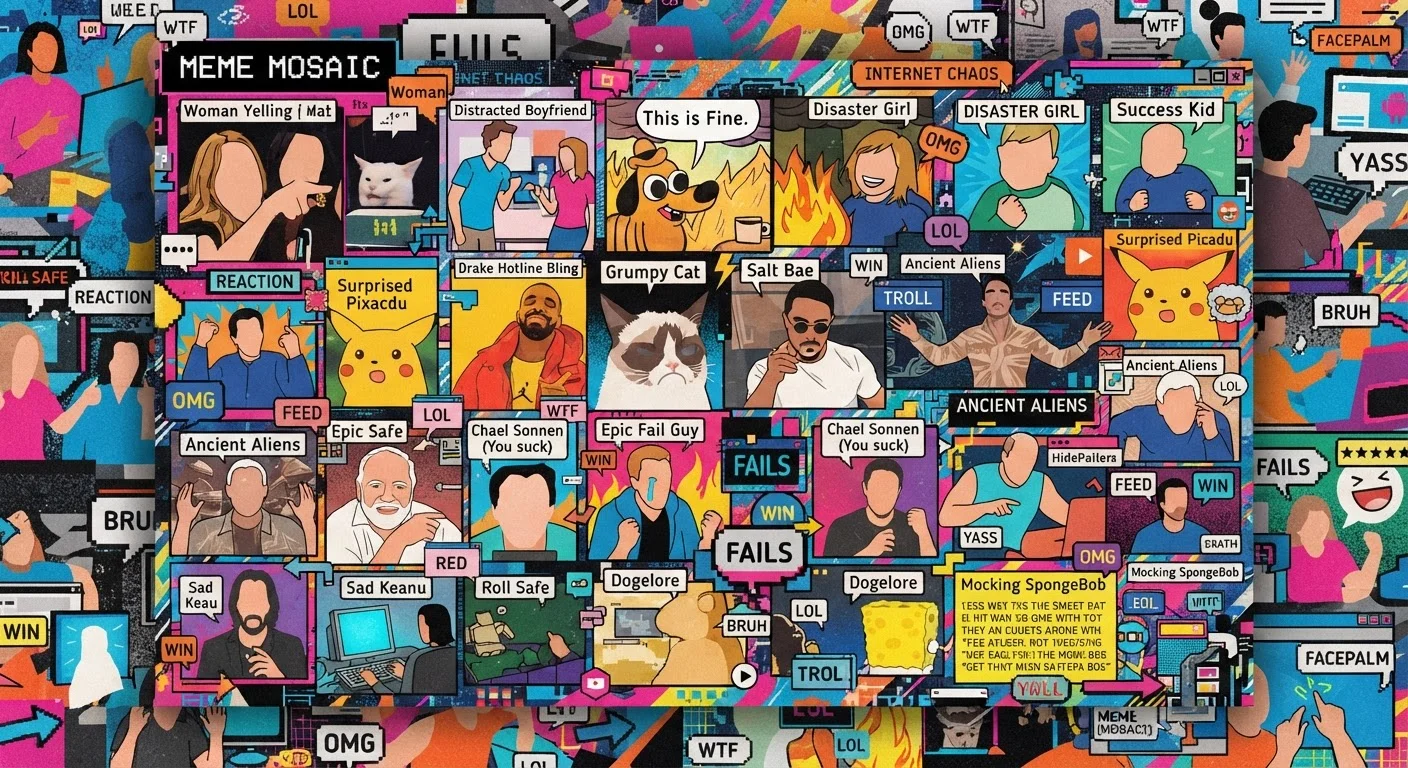
An internet meme is a piece of media - typically an image, video clip, or phrase - that spreads rapidly online and is remixed or adapted by many different users to express a shared idea, emotion, or joke. The format stays recognizable while the specific content changes, allowing the meme to carry meaning across wildly different contexts. Memes function as a kind of visual shorthand: you don't have to explain the reference if your audience already knows the template.
The word 'meme' was coined by evolutionary biologist Richard Dawkins in his 1976 book 'The Selfish Gene' to describe any cultural unit that replicates and evolves - long before the internet gave it its current, image-based meaning.
More Than a Joke: What Memes Actually Do
At first glance, a meme looks like a throwaway gag - a distracted boyfriend, a side-eying kid, a dramatic chipmunk. But look closer and you'll find something more sophisticated: a communication system built on shared visual memory. Memes work because they carry pre-loaded emotional and conceptual meaning from every previous use of the same format. When you slap new text on a familiar template, you're not just making a joke - you're invoking a whole history of how that image has been used before.
This is what separates memes from ordinary humor. A one-liner stands alone. A meme is a reference, a remix, and a signal all at once. It tells the viewer: I know you know this image, and I'm doing something specific with it. That layering is where the real communication happens.
Memes are also deeply communal. Sharing or creating one is a way of saying, "I'm part of this cultural moment." They build in-group identity, signal shared values, and often carry meaning that would be clumsy to express in plain language. As internet slang migrates from subcultures to the mainstream, meme formats follow a strikingly similar path.
55%
US adults who share memes regularly
According to Pew Research Center data on social media behavior, more than half of US adults report regularly sharing humorous or meme-style content online.
~2 weeks
Average lifespan of a trending meme format
Digital culture researchers studying platform data have observed that most meme formats peak in usage within roughly two weeks of going mainstream before declining sharply.
6x
Higher engagement for image-based posts vs. text-only
Social media platform studies consistently show that image and video content generates significantly higher engagement rates than plain-text posts across major platforms.
Anatomy of a Meme: Format vs. Content
Every meme has two layers: the format (the template) and the content (the specific text or image swap). The format does most of the heavy lifting - it brings a pre-established emotional register. The "This Is Fine" dog sitting in a burning room signals resigned acceptance of chaos. The "galaxy brain" format signals escalating, absurd logic. You don't need to explain the emotional tone; the template carries it.
The content layer is where creativity lives. Users apply the template to a new situation - a frustrating workplace policy, a plot twist in a TV show, a trending news story - and the humor comes from how well (or how unexpectedly) the new content maps onto the template's emotional logic.
This structure makes memes extraordinarily efficient. A single image with two lines of text can compress a nuanced, emotionally specific observation into something instantly readable. That's a genuinely impressive communication feat - and it's why memes have become a go-to format for reading pop culture as social commentary.
The Lifecycle: How Memes Are Born, Peak, and Die
Meme formats rarely last forever. They move through a predictable arc: origin, spread, saturation, ironic reuse, and eventual retirement. Understanding this cycle helps explain why some memes feel fresh and sharp while others land with a painful thud.
Most formats originate in tight-knit online communities where shared context is assumed and specificity is valued. As a meme travels outward to broader platforms and audiences, that specificity gets sanded down. The format becomes legible to more people but loses the nuance that made it resonate in the first place.
Saturation is the real killer. When a format appears in brand social media posts, political campaign ads, or your least-online relative's Facebook wall, it has officially peaked. What follows is usually ironic deployment - using the format in deliberately clunky or self-aware ways - before the format fades into irrelevance or becomes a nostalgic artifact. This mirrors exactly how micro-trends differ from lasting style movements: viral intensity doesn't equal longevity.
How to Read a Meme's Context
When you encounter an unfamiliar meme format, look up the template's origin before interpreting the content - sites like Know Your Meme document the history and typical usage of most major formats. Understanding where a template comes from tells you a lot about the emotional register it's meant to carry, and helps you spot when a format is being used sincerely versus ironically.
Memes as Emotional and Political Language
Not all memes are purely comedic. Some of the most widely shared formats function as containers for grief, collective anxiety, or political frustration. The humor framing gives people permission to share feelings that might feel too raw or too confrontational to state directly. "This is fine" isn't just a joke about chaos - it's a way to express burnout and helplessness in a socially acceptable, even bonding, way.
Political memes operate similarly, using visual shorthand to make arguments, mock opponents, or signal allegiance. They travel fast and bypass the need for lengthy explanation - which makes them powerful and, at times, oversimplified. A meme can reduce a complex policy debate to a single punchy image, which is both its strength and its limitation.
Understanding what it really means for content to go viral matters here: virality amplifies a meme's reach but doesn't validate its accuracy. Knowing how to read a meme's template, tone, and origin community is increasingly a form of media literacy - one worth developing in an era when visual humor shapes as much of our cultural conversation as any op-ed or broadcast.
“Memes are the political cartoons of the digital age - compressed, emotionally direct, and often more effective at capturing a cultural mood than a thousand words of analysis.”
— Limor Shifman, Professor of Communication and Media Studies, author of 'Memes in Digital Culture'