

Key Takeaways
- Pop culture texts - films, songs, memes - often encode anxieties and values held by the broader society that created them.
- Anyone can develop a critical reading practice; it doesn't require an academic background.
- Context matters enormously: who made something, when, and for whom all shape its meaning.
- Critical engagement and genuine enjoyment are not mutually exclusive.
- Trending moments frequently reveal fault lines around class, identity, and power that deserve closer examination.
Start here
Why Pop Culture Carries Social Meaning
Build vocabulary
Key Concepts for Reading Cultural Texts
Apply it
A Practical Framework for Analysis
Explore examples
Where Pop Culture Commentary Shows Up
Stay balanced
Engaging Critically Without Losing the Joy
Why Pop Culture Carries Social Meaning
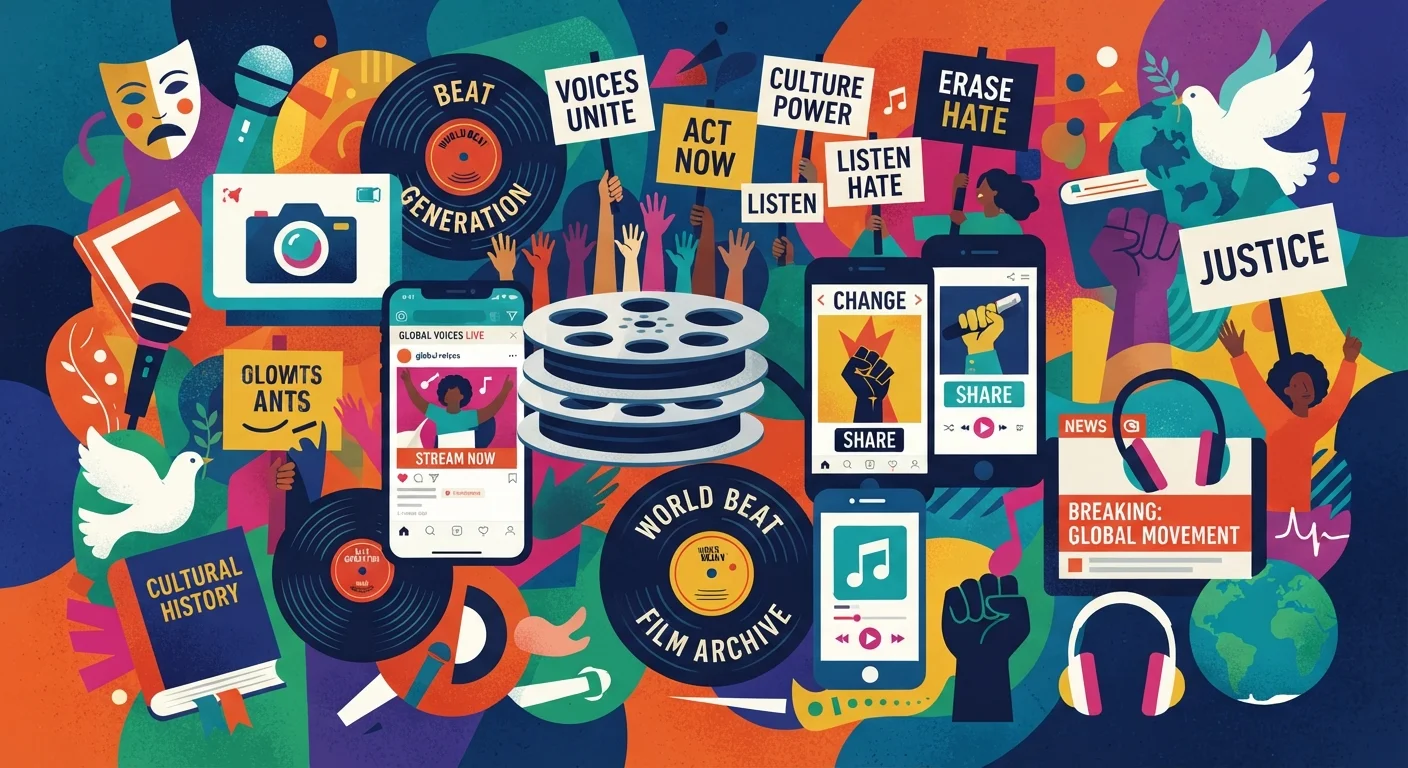
The blockbuster you watched last weekend didn't emerge from a vacuum. Every film green-lit by a studio, every song that dominates streaming, and every hashtag that trends for 72 hours is shaped by the social moment that produced it - and shapes that moment right back. Pop culture is both a mirror and a lens: it reflects collective anxieties, desires, and fault lines, while also influencing how millions of people understand the world.
This feedback loop is why cultural critics, sociologists, and ordinary engaged viewers have long treated entertainment as something worth reading carefully. A horror film released during a period of economic uncertainty tends to look different than one made during relative stability. A chart-topping anthem about self-determination lands differently depending on whose voice is singing it and who is buying it. Understanding these dynamics doesn't require a PhD - it just requires slowing down and asking why.
For a vivid sense of how much a single cultural moment can carry, explore our look at the pop culture moments that defined the past decade, which traces how shared flashpoints shaped collective experience across ten years.
Key Concepts for Reading Cultural Texts
Before diving into analysis, a handful of terms give you useful scaffolding. You don't need to memorize academic jargon - just enough vocabulary to articulate what you're noticing.
Cultural text
Any artifact - a film, song, meme, or trend - that can be 'read' for meaning within a particular culture. Calling it a text signals that you're analyzing it, not just consuming it.
Subtext
The implied or underlying meaning beneath a work's surface story. A film about alien invasion might have subtext about immigration anxiety; a pop song about heartbreak might carry commentary on gender expectations.
Hegemony
The way certain ideas, values, or power structures come to feel 'natural' or 'common sense' within a culture, often benefiting dominant groups. Pop culture can reinforce or challenge hegemonic norms.
Representation
Who gets depicted in media, and how. Representation analysis looks at which groups are shown, which are absent, and whether portrayals are complex or stereotyped.
Reception
How audiences actually respond to a cultural product - what they take from it, argue about, remix, or reject. Reception can differ wildly from a creator's stated intentions.
Intertextuality
The way a cultural work references, borrows from, or responds to other works. Recognizing these connections helps reveal what a creator is saying and to whom.
With these concepts in hand, you're equipped to move from passive viewing to active reading.
A Practical Framework for Analysis
Critical reading doesn't have to be laborious. A straightforward three-step loop works for almost any cultural text, whether it's a prestige drama or a viral dance trend.
- Contextualize the source. Who created this, when, and under what conditions? A studio film carries different pressures than an independent release; a song produced during a social movement carries different stakes than one made in quieter times. Context is never irrelevant.
- Identify the assumptions. What does the text take for granted about its audience - their values, fears, aspirations, or demographics? Whose perspective is centered, and whose is absent or marginalized? These gaps are often as telling as what's explicitly shown.
- Read the reception. How did audiences respond, and why did that response take the shape it did? Viral outrage, passionate defense, and widespread indifference are all data points. Fan communities in particular can illuminate what a work means to different groups - our piece on stan culture and fandoms explores how devoted audiences actively shape cultural meaning.
Keep a running list of questions
When something in a film, song, or trending moment catches your attention, jot it down before moving on. Even a quick note - 'Why did this scene feel uncomfortable?' or 'Who is this obviously not made for?' - gives you a thread to pull later. Small observations compound into sharper analysis over time.
This loop is iterative. Running through it once gives you an entry point; revisiting it after reading other perspectives almost always deepens the picture.
Where Pop Culture Commentary Shows Up
Social commentary isn't confined to prestige films or serious literary fiction. It turns up in places that might surprise you.
- Genre entertainment. Science fiction and horror have historically carried sharp commentary on race, class, technology, and government - often precisely because genre trappings gave creators cover to explore ideas that more 'respectable' formats couldn't. The Movies & Streaming hub regularly surfaces films worth watching on exactly these terms.
- Chart music. A number-one album is a cultural event, not just a sales milestone. The stories an album tells - and the stories told about it - reveal what a society is celebrating, mourning, or arguing about. Our piece on the cultural weight of a number-one album unpacks why chart position and cultural impact don't always overlap. The Music & Artists hub tracks these moments as they happen.
- Memes and viral moments. Far from throwaway jokes, memes function as compressed social shorthand. Their formats encode shared frustrations, ironies, and observations that spread because they're immediately recognizable to large groups. Understanding the language of memes is increasingly essential to reading online culture.
Commentary isn't always intentional
A creator doesn't have to consciously intend social commentary for it to be present in their work. Cultural assumptions and social tensions seep into texts whether or not the people making them are aware of it. This is why reception and context matter as much as stated intent - meaning is made in the encounter between a work and its audience, not locked inside a creator's mind.
Engaging Critically Without Losing the Joy
One persistent misconception is that critical analysis ruins enjoyment. In practice, the opposite tends to be true: understanding the layers beneath a film or song usually deepens appreciation rather than deflating it. Knowing that a director drew on specific historical anxieties, or that a lyric is in dialogue with a long genre tradition, adds texture rather than subtracting pleasure.
The real risk isn't overthinking pop culture - it's engaging with it so reactively that you miss what it's actually doing. The skills covered in film criticism as a practice apply broadly: slow down, notice your assumptions, and ask why something landed the way it did.
If the sheer volume of trending content makes critical engagement feel overwhelming, it helps to be selective. Our guide to following pop culture without getting swept up in the drama offers a practical framework for staying informed on your own terms - without letting the noise crowd out the signal.
Start small. Pick one thing you already care about. Ask why it matters, who it speaks to, and what it might be saying about the moment that produced it. That curiosity, applied consistently, is what separates a passive consumer from an engaged reader of culture.