

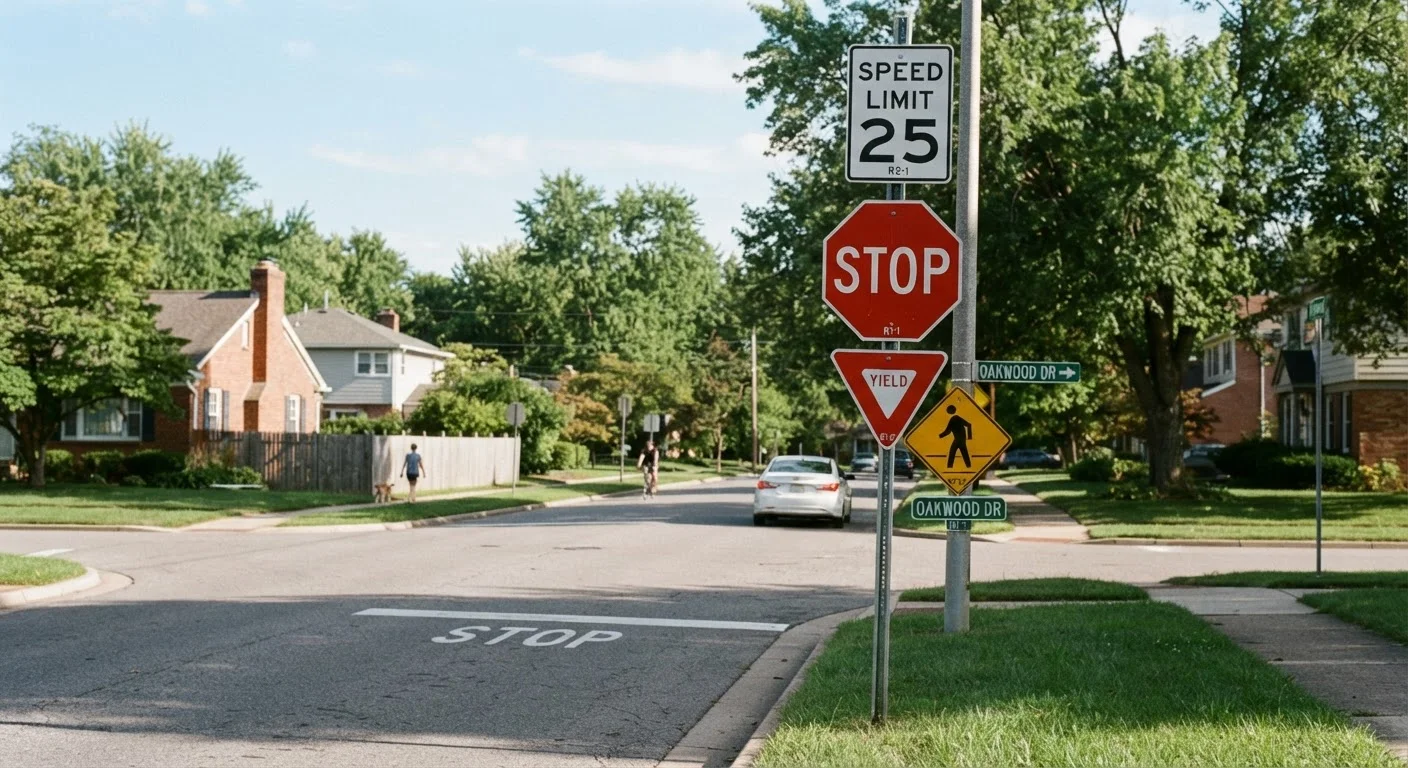
The System Behind the Signs
Every road sign in the United States follows a standardized system governed by the MUTCD - the Manual on Uniform Traffic Control Devices, published by the Federal Highway Administration. This federal standard ensures that a driver in Maine reads the same signs the same way as a driver in Arizona. The system uses shape and color as the primary communication tools, meaning even a partially obscured sign can often be identified by its outline alone.
Understanding this underlying logic transforms individual signs from memorized symbols into a readable language. Confident sign-reading is a foundational element of defensive driving - the ability to anticipate road conditions before they become hazards.
Shape and Color: The First Layer of Meaning
Before you read the text on a sign, its shape and color already carry legal weight. Here's what each communicates:
- Octagon (red): Stop - mandatory full stop required by law.
- Inverted triangle (red and white): Yield - slow and give right-of-way to conflicting traffic.
- Round (yellow or black): Railroad crossing advance warning.
- Pentagon (yellow-green or yellow): School zone or school crossing warning.
- Diamond (yellow or orange): Warning - hazard ahead. Orange indicates a work zone.
- Rectangle (vertical, white): Regulatory - states a rule you must follow, such as speed limits.
- Rectangle (horizontal, green or blue): Guide or informational sign.
Color reinforces this further. Red always means prohibition or stop. Yellow signals general warnings. Orange marks construction and work zones. Green provides directional guidance. Blue indicates services such as fuel, food, or hospitals. Brown marks recreational areas and cultural sites.
MUTCD
The Manual on Uniform Traffic Control Devices, the federal standard that governs the design, placement, and meaning of all traffic signs, signals, and road markings in the United States.
Regulatory sign
A sign that communicates a legal requirement drivers must follow, such as speed limits, stop signs, or turn restrictions. Violations can result in traffic citations.
Warning sign
A diamond-shaped sign that alerts drivers to an upcoming hazard or change in road conditions, such as a sharp curve or pedestrian crossing. These are advisory rather than legally mandatory.
Guide sign
An informational sign - typically green, blue, or brown - that provides directional, distance, or service information to help drivers navigate.
Flashing yellow arrow
A traffic signal indication that permits a left turn but requires the driver to yield to oncoming vehicles and pedestrians before proceeding.
Work zone sign
An orange sign indicating active construction or road maintenance ahead. Fines for traffic violations are typically doubled in work zones.
Regulatory, Warning, and Guide Signs Explained
Road signs fall into three primary functional categories, each with distinct legal implications:
Regulatory Signs
These signs communicate legal requirements. Ignoring them constitutes a traffic violation. Common examples include speed limit signs, no-turn signs, one-way markers, and lane-use controls. Speed limit signs, for instance, post the maximum legal speed under ideal conditions - not a target or a suggestion. For a deeper look at how those numbers are determined, see how speed limits are actually set.
Warning Signs
Diamond-shaped yellow signs alert drivers to upcoming road features or hazards: sharp curves, merging lanes, pedestrian crossings, animal crossings, or slippery surfaces. They are advisory, not regulatory - but ignoring them is risky. Warning signs typically appear 100-500 feet before the condition they reference, giving drivers reaction time. Understanding warning signs is especially important when approaching intersections where merging and right-of-way rules come into play.
Guide Signs
Green highway signs, blue service signs, and brown recreation signs are informational. Interstate route markers use a distinctive shield shape. Exit signs on interstates show distances in advance - typically at one mile, one-half mile, and at the exit ramp itself. Reading these signs well in advance reduces last-second lane changes, one of the more common causes of highway incidents.
State Supplements to Federal Standards
While the MUTCD sets the national baseline, individual states may add supplemental signs or modify certain designs within federal guidelines. When driving in an unfamiliar state, especially in rural or less-traveled areas, you may encounter signs that look slightly different or include regional text. Your state's Department of Transportation website typically publishes a current driver handbook with any state-specific variations.
Signs Drivers Commonly Misread
Even experienced drivers misinterpret certain signs. A few worth reviewing:
- "Signal Ahead" vs. "Stop Ahead": Both are diamond warning signs, but confusing them affects how aggressively you decelerate.
- Flashing yellow arrow: Means a permitted left turn - you may turn, but must yield to oncoming traffic. It is not the same as a green arrow, which grants the right-of-way.
- White regulatory signs with a red circle and slash: The slash means the action depicted is prohibited. A bicycle inside that circle means no bicycles; a truck means no trucks.
- "Road Closed" vs. "Road Closed to Through Traffic": The second allows local access; the first does not.
Before a long drive, taking a few minutes to review unfamiliar signs is worthwhile - especially when traveling through areas with road construction or rural highways. A pre-trip safety checklist is one practical way to build this review into your routine.
This article provides general educational information about US road sign standards. Always refer to your state's current driver handbook and applicable traffic laws for authoritative guidance specific to your jurisdiction.