
Wired vs. Wireless Headphones: Audio Quality, Latency, and Everyday Tradeoffs

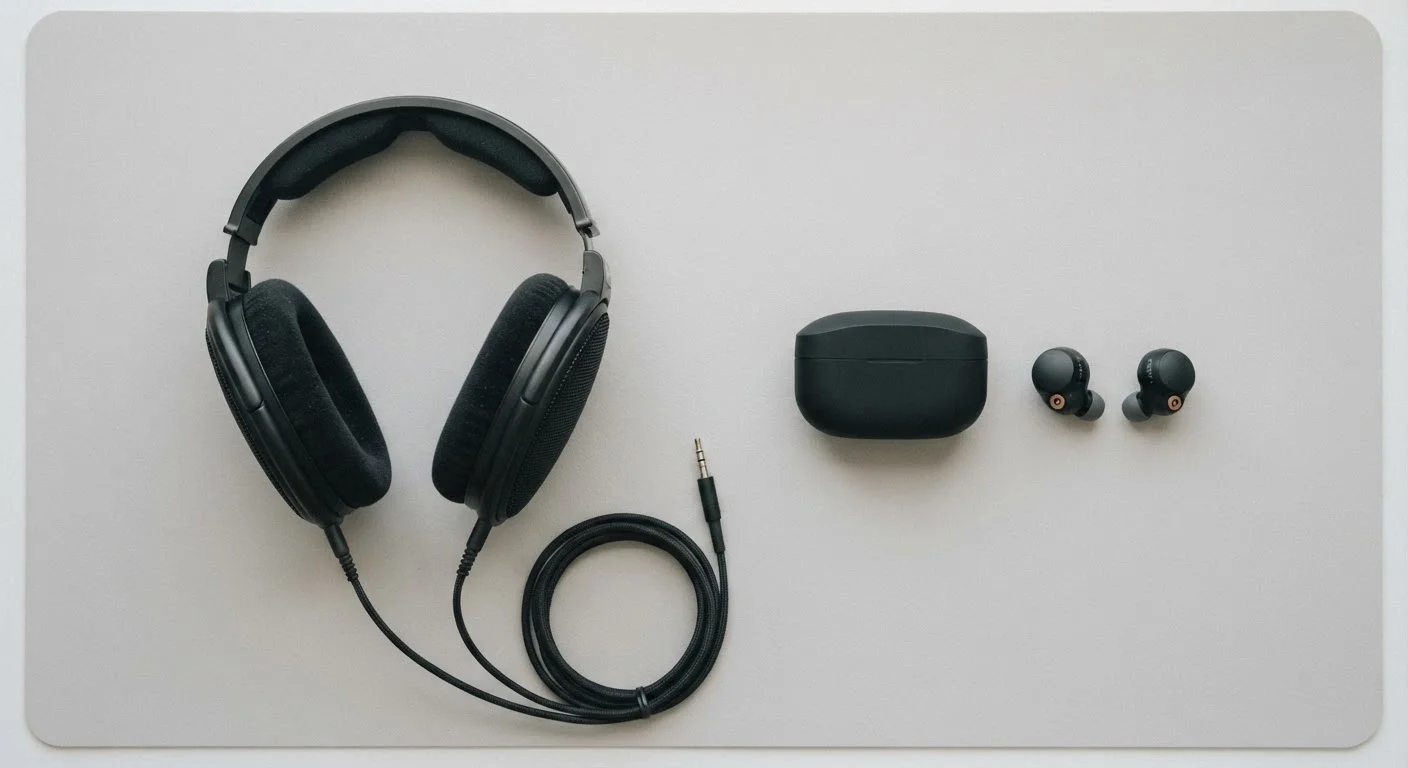
Key Takeaways
- Wired headphones deliver audio without compression, giving them a fidelity edge in critical listening scenarios.
- Wireless headphones introduce latency and audio compression, though modern codecs have narrowed the gap considerably.
- Battery life and connection reliability are the two biggest practical limitations of wireless options.
- The right choice depends heavily on how and where you listen - not on one being universally superior.
Our Verdict
Wired headphones hold a measurable advantage in audio fidelity and latency, making them the preferred choice for studio work, gaming, or audiophile listening. Wireless headphones have closed the gap substantially for casual listeners, offering freedom of movement and convenience that wired connections simply cannot match. Neither format is universally better - the tradeoffs are real on both sides.
| Best for | Recommended |
|---|---|
| Audiophiles and critical listeners who prioritize sound fidelity | Wired headphones |
| Commuters, gym-goers, and those valuing cable-free convenience | Wireless headphones |
| Gamers and video editors where audio sync matters | Wired headphones |
| Everyday music listening and calls at home or the office | Wireless headphones |
How Each Connection Type Works
Wired headphones transmit audio as an analog electrical signal through a physical cable - typically via a 3.5mm or 6.35mm jack, or a balanced XLR connector on professional models. The signal travels directly from the source device to the driver in the headphone cup, with no conversion step in between.
Wireless headphones - most commonly using Bluetooth - convert that audio signal into a digital radio transmission. The headphone receives the signal, decodes it using a codec (the algorithm that compresses and decompresses audio data), and then converts it back to sound. That multi-step process introduces both compression and a small but measurable delay. If you want a broader look at how wireless transmission works in other contexts, the same tradeoffs appear in internet connections as well.
Audio Quality: The Fidelity Gap Explained
Wired connections pass audio without any lossy compression, which means the signal reaching your ears is as close to the original recording as the headphone's drivers allow. This is why professional studios and audiophile listeners have historically favored wired setups.
Wireless audio is limited by Bluetooth's bandwidth and the codec used. Standard SBC codec - the baseline that every Bluetooth device must support - compresses audio noticeably. Higher-quality codecs like aptX HD, LDAC, and AAC transmit significantly more data per second, shrinking the quality gap. LDAC, developed by Sony, can transmit up to 990 kbps, approaching CD-quality audio in favorable conditions.
The critical caveat: both the transmitting device and the headphone must support the same codec. Mismatches default to SBC regardless of what either device is capable of. For more on why Bluetooth audio sometimes underperforms expectations, see why Bluetooth audio quality can degrade.
| Wired Headphones | Wireless Headphones | |
|---|---|---|
| Audio Compression | None - lossless analog signal | Codec-dependent; SBC to LDAC |
| Latency | Under 5ms - imperceptible | 40ms-200ms depending on codec |
| Battery Required | No | Yes - 5 to 40 hours typical |
| Freedom of Movement | Limited by cable length | Full wireless range (~30 feet) |
| Device Compatibility | Requires headphone jack or dongle | Bluetooth - broad compatibility |
| Setup Required | Plug in and play | Pairing required; codec negotiation |
| Best Use Case | Studio, gaming, critical listening | Commuting, workouts, casual use |
Latency: When Milliseconds Actually Matter
Latency - the delay between audio leaving a source and reaching your ears - is negligible over a wire. Wired headphones typically measure under 5 milliseconds, which is imperceptible to human hearing.
Bluetooth latency varies by codec and implementation, commonly ranging from 40ms to over 200ms with standard SBC. aptX Low Latency targets around 40ms; aptX Adaptive can push closer to 30ms. For music listening, most people won't notice. For gaming, video editing, or watching video, even 80-100ms of delay creates a visible lip-sync mismatch that becomes distracting quickly.
Check Codec Compatibility Before Buying
A wireless headphone advertising aptX HD or LDAC only delivers that quality when paired with a device that also supports the same codec. Check your phone or laptop's Bluetooth codec support before assuming high-quality wireless audio. Mismatched codecs default to standard SBC, regardless of what the headphones are capable of.
Everyday Tradeoffs: Battery, Durability, and Convenience
Wireless headphones introduce a battery into the equation - a component that degrades over time and runs out at inconvenient moments. Most full-size wireless models offer between 20 and 40 hours of playback per charge; earbuds typically provide 5-8 hours before needing the charging case. A dead battery is a silent pair of headphones.
Wired headphones have no battery and no pairing process. They work the moment they're plugged in, on any device with a compatible port. The tradeoff is the cable: it snags, tangles, and limits movement. Many modern laptops and phones have dropped the 3.5mm headphone jack, requiring a dongle for wired use - an added inconvenience that shifts the convenience calculus.
40ms-200ms
Typical Bluetooth audio latency range
Standard SBC codec can introduce over 200ms of delay; aptX Low Latency targets approximately 40ms.
990 kbps
Maximum LDAC Bluetooth bitrate
Sony's LDAC codec can transmit up to 990 kbps, compared to SBC's typical ceiling of around 320 kbps.
Durability considerations also differ. Wired headphones are vulnerable at the cable termination points; wireless models have more electronic components that can fail. Neither is inherently more fragile, but failure modes differ in cost and repairability.
Which Approach Fits Which Listener
The decision between wired and wireless comes down to use case more than any single spec. Critical listeners, studio musicians, and those using headphones for synchronized audio work - video editing, gaming - will find wired connections more reliable and technically accurate. For more on audio format quality in home settings, surround sound format comparisons offer a useful parallel for thinking about fidelity tradeoffs.
Commuters, exercisers, and people who want to move freely without managing a cable will find wireless headphones more practical - especially as Bluetooth codecs continue to improve. Neither format is stagnant; wireless audio quality has improved significantly and is likely to keep improving.
The smartest approach for many listeners is to understand what tradeoffs they're actually making, then choose accordingly - rather than assuming one type is universally superior.