
Risk Tolerance and Time Horizon: Two Concepts That Shape Every Investment Decision

Key Takeaways
- Risk tolerance reflects both your financial capacity and emotional comfort with market swings.
- Time horizon - how long until you need the money - is often the stronger driver of portfolio structure.
- Longer time horizons generally allow for more exposure to growth-oriented, higher-volatility assets.
- Short time horizons call for more stable, lower-risk holdings to protect capital you'll need soon.
- Both factors should be reassessed as your life circumstances change over time.
Risk Tolerance & Time Horizon
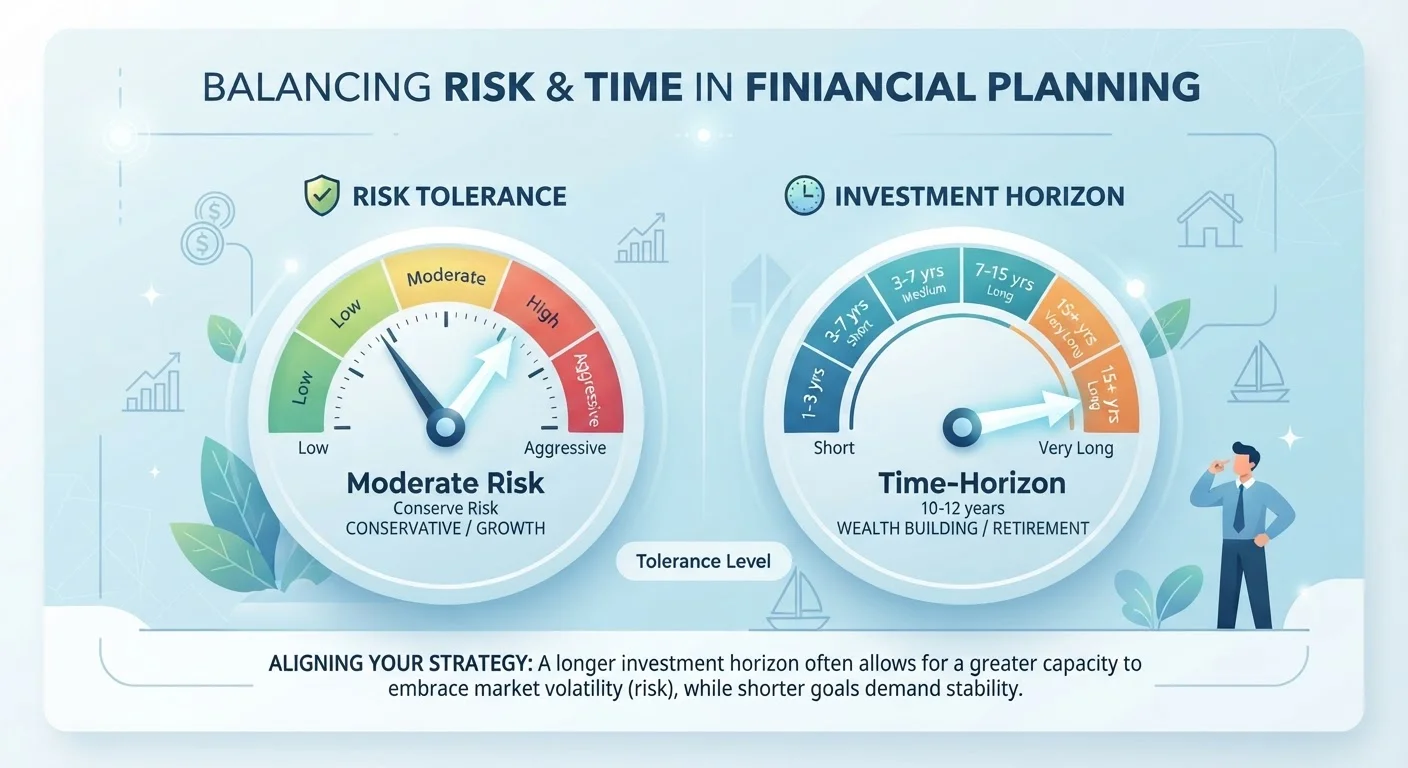
Risk tolerance is how much fluctuation in your investment's value you can accept - both financially and emotionally - without abandoning your strategy. Time horizon is the length of time you expect to keep your money invested before you need to use it. Together, these two factors form the foundation of any sound investment plan.
Financial advisers typically assess both factors through questionnaires and cash-flow analysis before recommending an asset allocation strategy.
Why These Two Concepts Come First
Before choosing any investment - a stock, a bond, a mutual fund - there are two questions worth answering: How much volatility can you handle? And how long do you have before you need this money? The answers shape virtually every other decision that follows.
Many beginners focus on which assets to pick. But without a clear sense of your risk tolerance and time horizon, even a well-researched choice can backfire - not because the investment was wrong in isolation, but because it wasn't right for your situation. Understanding these two concepts first is the foundation. For a broader look at the vocabulary you'll encounter, see this plain-language glossary for new investors.
40+ years
Typical retirement time horizon for a 25-year-old
A worker starting at 25 and planning to retire at 65 has one of the longest common investment horizons, according to general retirement planning frameworks.
~100%
Advisers citing time horizon as a core allocation factor
Time horizon and risk tolerance are the two variables cited in virtually every mainstream portfolio construction framework used in financial planning education.
Understanding Risk Tolerance
Risk tolerance has two layers: emotional and financial. Emotional risk tolerance is your gut reaction when your portfolio drops 15% in a month. Do you stay the course, or do you feel a strong urge to sell? Financial risk tolerance - sometimes called risk capacity - is about whether your actual financial situation can absorb a loss without damaging your goals.
Both layers matter. Someone might have the income and savings to handle volatility in theory, yet find themselves unable to sleep during a market downturn. That emotional dimension is real and worth acknowledging. Conversely, someone who feels perfectly calm about market swings might not actually be able to afford a significant loss given their financial situation.
A Simple Self-Check for Emotional Risk Tolerance
Ask yourself: if your portfolio dropped 20% in value over three months, what would you do? If the honest answer is 'sell everything,' your emotional risk tolerance may be lower than you assumed. Being honest about this tendency - rather than aspirational about it - leads to a more realistic and durable investment strategy.
Broadly speaking, investors with higher risk tolerance tend to hold more assets with growth potential - like stocks - while those with lower tolerance often lean toward more stable, income-producing assets like bonds or money market instruments. For more on how this plays into choosing between account types, see how savings and investment accounts serve different goals.
Understanding Time Horizon
Your time horizon is simply how long you expect to keep your money invested before you need to access it. A 25-year-old saving for retirement at 65 has roughly a 40-year horizon. A 45-year-old saving for a down payment in three years has a very short one.
Time horizon matters because markets fluctuate. Over short periods, a portfolio heavy in stocks can lose significant value. Over longer periods, markets have historically had more opportunity to recover and grow - though this is not a guarantee of future results. This is why financial education consistently links longer time horizons with the ability to take on more risk, and shorter ones with the need for capital preservation.
It's also worth noting that you may have multiple time horizons at once - one for retirement, one for a child's education, one for an emergency fund. Each goal deserves its own planning lens. You can explore this further in our article on starting to invest with a small amount of money.
How the Two Work Together
Risk tolerance and time horizon interact constantly. In general:
- Long time horizon + higher risk tolerance: Allows for a growth-oriented portfolio with more exposure to equities.
- Long time horizon + lower risk tolerance: May still allow for some growth assets, but with more stabilizing elements included.
- Short time horizon + higher risk tolerance: Even comfortable investors typically scale back risk when they'll need the money soon - there isn't enough time to recover from a large loss.
- Short time horizon + lower risk tolerance: Points strongly toward capital preservation, with stable and liquid assets taking priority.
Neither factor operates in a vacuum. A licensed financial adviser can help you weigh both in the context of your full financial picture. This article provides general educational information and is not personalized financial advice.
“The single greatest edge an investor can have is a long-term orientation. Risk and time are the two levers most within an investor's control - and understanding them is where disciplined investing begins.”
— Financial Planning Education Principle, Widely cited concept in financial literacy and investment education curricula
For context on common misconceptions that affect how beginners think about risk, explore common investing myths that hold beginners back.
This article is for general informational and educational purposes only and does not constitute personalized investment, financial, tax, or legal advice. Consult a licensed financial professional before making investment decisions based on your individual circumstances.