

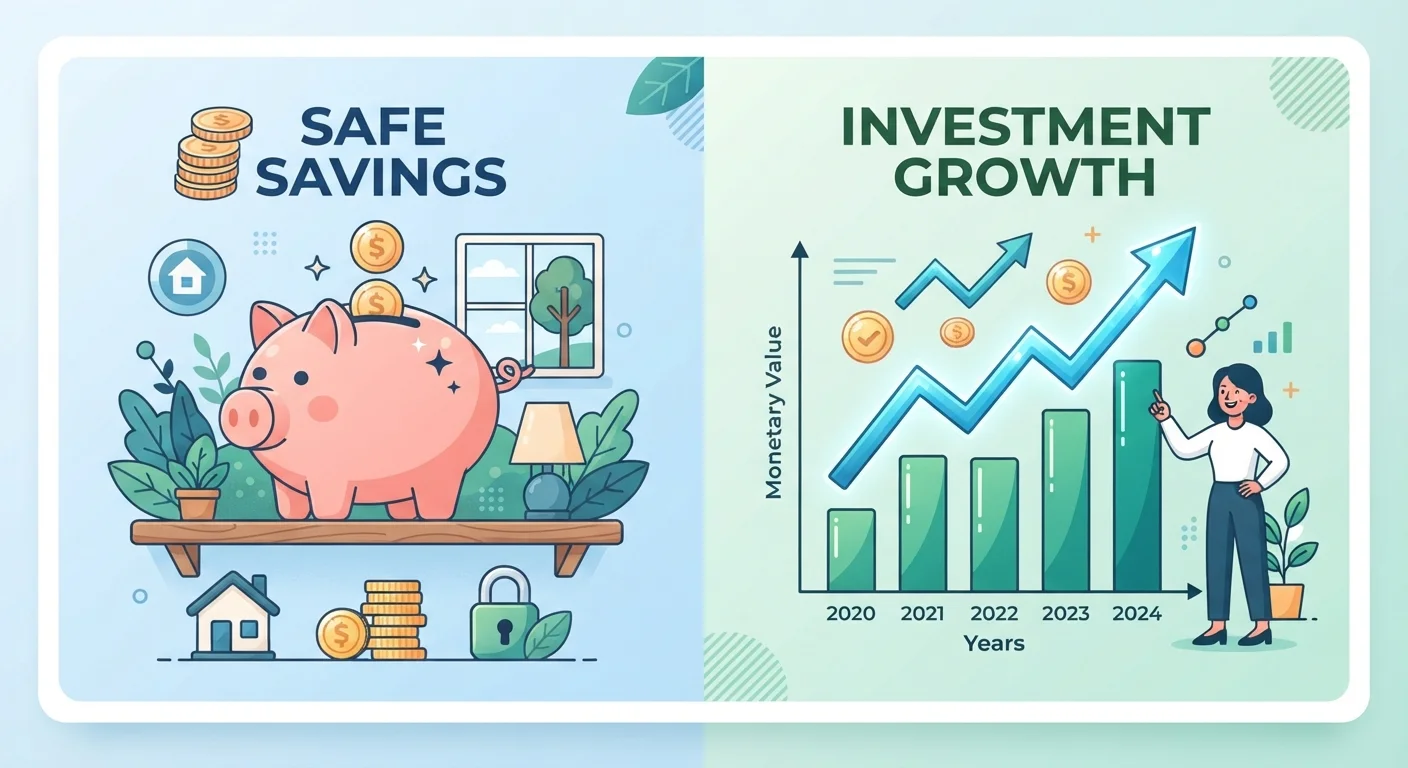
Key Takeaways
- Savings accounts protect principal and are federally insured up to $250,000 per depositor at FDIC-member banks.
- Investment accounts offer higher long-term growth potential but carry the risk of losing some or all principal.
- Your time horizon is the single most important factor when deciding which account type to use.
- Most financial educators recommend building an emergency fund in a savings account before investing.
- Both account types can coexist - they serve different goals and work best together as part of a broader plan.
Option A
Savings Account
The secure, accessible home for short-term money.
Best for: Best for emergency funds, near-term goals, and money you cannot afford to lose.
Option B
Investment Account
The growth-oriented vehicle for long-term wealth building.
Best for: Best for money you won't need for several years and can leave exposed to market fluctuations.
If you need the money within one to three years
Savings Account
Short time horizons leave little room to recover from a market downturn. A savings account keeps your principal intact and accessible when you need it.
If you are building toward a goal five or more years away
Investment Account
Longer time horizons allow your money to ride out volatility and benefit from compounding returns over time, which savings account yields rarely match.
If you do not yet have three to six months of expenses set aside
Savings Account
An emergency fund is the financial foundation everything else rests on. Invest only after that cushion is firmly in place.
If you want to grow wealth for retirement decades away
Investment Account
Tax-advantaged investment accounts such as IRAs and 401(k)s are specifically designed for long-run retirement accumulation, offering advantages no savings account provides.
If market losses would cause you significant stress or hardship
Savings Account
Risk tolerance matters as much as time horizon. Keeping money you cannot afford to lose in an insured savings account removes that emotional and financial pressure.
What Each Account Actually Does
A savings account is a deposit account held at a bank or credit union. It earns interest - typically a fixed or variable annual percentage yield (APY) - and the balance is federally insured up to $250,000 per depositor at institutions backed by the FDIC or NCUA. The core promise: the money you put in will be there when you need it, plus a modest amount of interest.
An investment account - such as a brokerage account, IRA, or 401(k) - holds financial assets like stocks, bonds, mutual funds, or exchange-traded funds (ETFs). These assets can grow significantly over time, but their value also fluctuates with markets. There is no federal insurance on investment balances, and returns are never guaranteed. Past performance does not predict future results.
Understanding this distinction is not a technicality - it is the foundation of sound financial decision-making. For a practical look at how to structure your saving before you invest, see our guide to building a personal savings plan.
| Criterion | Savings Account | Investment Account |
|---|---|---|
| Principal protection | Yes - federally insured | No - market risk applies |
| Typical return potential | Low to moderate (APY-based) | Higher over long term (not guaranteed) |
| Best time horizon | Short term (under 3 years) | Long term (5+ years) |
| Liquidity | High - funds readily accessible | Varies - selling assets may take time |
| Tax treatment | Interest taxed as ordinary income | Varies; tax-advantaged options available |
| Risk level | Very low | Low to high, depending on assets |
| Ideal use case | Emergency fund, near-term goals | Retirement, long-term wealth building |
The Role of Time Horizon and Risk Tolerance
Two variables should drive almost every account-type decision: when you need the money and how much loss you can absorb.
Money earmarked for a goal within one to three years - a down payment, a wedding, a planned car purchase - belongs in a savings account. Even a short-lived market correction could cut an investment account's value at exactly the wrong moment. Savings accounts eliminate that timing risk.
Money you won't touch for five years or more has time to weather market downturns and recover. Historically, diversified investment portfolios have outpaced savings account interest rates over long periods - though that outcome is never guaranteed for any individual investor or time frame.
$250,000
Federal insurance limit per depositor
The FDIC insures deposits up to $250,000 per depositor, per insured bank, per ownership category - a protection investment accounts do not carry.
3-6 months
Recommended emergency fund size
Most personal finance educators recommend covering three to six months of essential expenses in a liquid savings account before directing money toward investments.
5+ years
Suggested minimum investment time horizon
A longer time horizon gives investment portfolios more opportunity to recover from downturns; shorter timelines increase the risk of needing to sell at a loss.
Risk tolerance is equally personal. If seeing your balance drop 20% in a market downturn would push you to sell in a panic - locking in losses - an investment account may not be the right tool yet, regardless of your timeline. Honest self-assessment matters here. Our article on common mistakes new savers make covers how conflating saving and investing can derail early financial progress.
When to Use Both - and in What Order
For most beginners, the recommended sequence is straightforward:
- Build an emergency fund first. Most financial educators suggest three to six months of essential living expenses in an accessible savings account before putting money at risk in markets.
- Capture any employer retirement match. If your employer offers matching contributions to a 401(k), contributing enough to capture the full match is widely considered a high-priority step - it is effectively a guaranteed return on that portion of your contributions.
- Then broaden your investment strategy based on your goals and timeline.
This order matters because investing money you might need in an emergency can force you to sell at a loss - erasing the very benefit investing is meant to provide.
High-Yield Savings Accounts: A Middle Ground
If your savings account interest feels too low but you are not ready to invest, a high-yield savings account (HYSA) may be worth exploring. These accounts, often offered by online banks, typically pay meaningfully higher APYs than traditional savings accounts while maintaining the same federal deposit insurance. For a deeper look at how they compare to another common option, see our article on high-yield savings accounts vs. money market accounts.
If you are ready to explore investment accounts for the first time, our brokerage account readiness checklist walks through the financial foundations to confirm before you begin. And if you are wondering whether a small starting balance disqualifies you, see how to start investing with a small amount of money.
This article is for general informational and educational purposes only and does not constitute personalized financial, investment, or tax advice. Consult a licensed financial professional before making decisions specific to your situation.