

Key Takeaways
- Compound interest grows your money by adding earned interest back to the principal balance repeatedly.
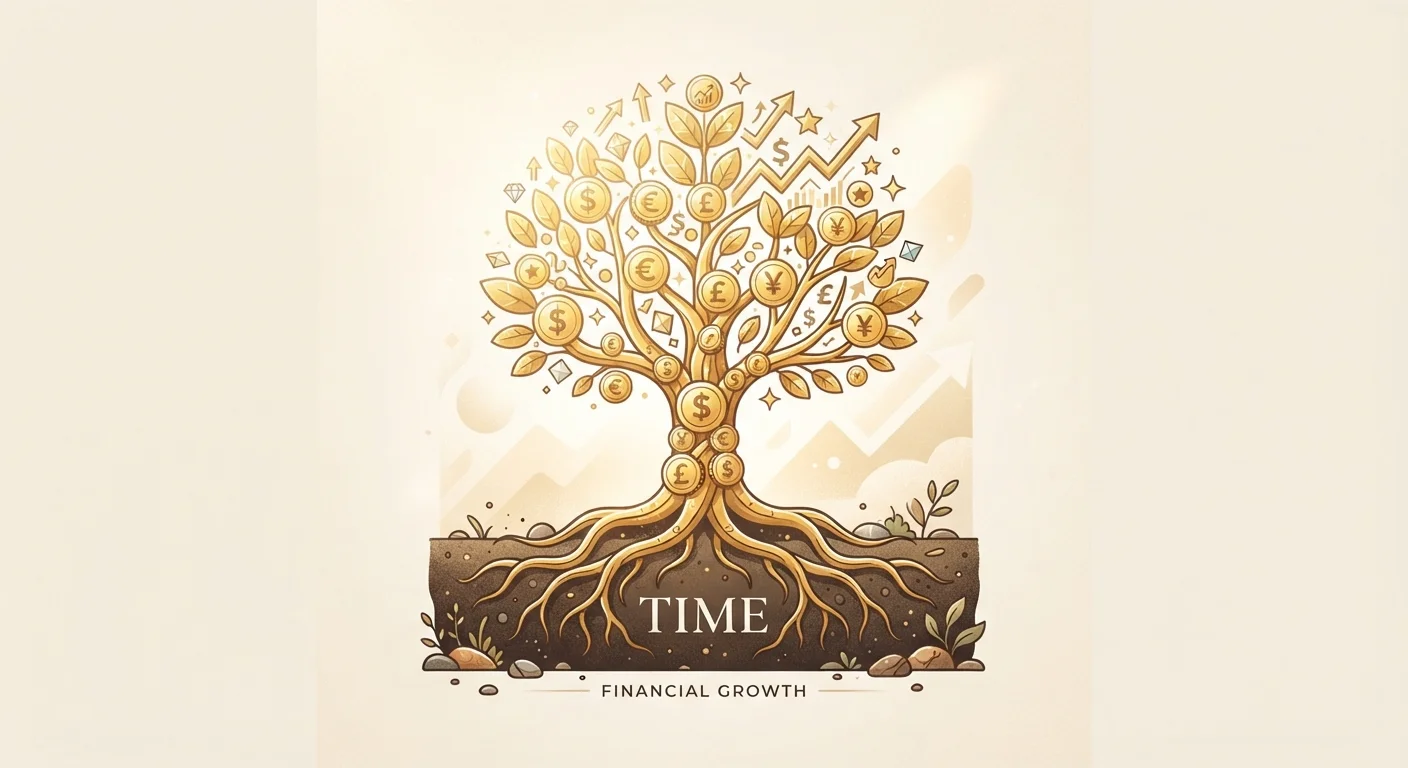
- Time is the most powerful variable - starting earlier amplifies compounding far more than increasing contribution size later.
- Compounding works against you when applied to debt, making high-interest balances grow rapidly.
- Regular, consistent contributions combined with compounding can significantly accelerate long-term wealth building.
- APY (Annual Percentage Yield) reflects compounding frequency and is a more accurate measure of growth than the stated rate alone.
Compound Interest
Compound interest is interest calculated not only on the original amount of money you saved or invested, but also on the interest that has already accumulated. Over time, this creates a self-reinforcing cycle where your balance grows faster and faster. It is often described as 'earning interest on interest,' and it applies equally to savings accounts, investment returns, and - in reverse - to debt.
Compounding frequency matters: interest can compound daily, monthly, quarterly, or annually. More frequent compounding produces slightly higher effective returns for a given nominal rate, expressed formally as the Annual Percentage Yield (APY).
How Compound Interest Actually Works
At its core, compound interest is a simple idea with a profound long-term effect. Imagine you deposit $1,000 in a savings account earning 5% annual interest. After year one, you earn $50 - straightforward enough. But here is where compounding changes the picture: in year two, that 5% is calculated on $1,050, not $1,000. You earn $52.50. In year three, you earn interest on $1,102.50. Each cycle, the base grows.
This pattern accelerates over time. The longer the money stays invested, the more the accumulated interest itself contributes to future growth. That is why the concept is often compared to a snowball rolling downhill - it gathers mass as it moves, and the longer the hill, the larger it gets by the bottom.
The formula behind this is straightforward: A = P(1 + r/n)nt, where A is the final amount, P is the principal, r is the annual interest rate, n is the number of compounding periods per year, and t is time in years. You do not need to memorize the formula - the key insight is that time (t) has an exponential effect on the outcome.
Rule of 72
Years to double money at a given rate
Divide 72 by your annual interest rate to estimate how many years it takes to double your investment. At 6%, money roughly doubles every 12 years - a widely used rule of thumb in financial education.
10x+
Potential growth over 40 years at 6% compounded annually
A single $10,000 principal growing at 6% compounded annually for 40 years reaches approximately $102,000 - illustrating how compounding produces non-linear, accelerating growth over long horizons.
Why Starting Early Matters More Than Starting Big
One of the most consistent lessons in personal finance is that when you start saving often outweighs how much you start with. This is a direct consequence of compounding. Consider two savers: one invests $3,000 per year starting at age 25 and stops at 35 - contributing for just 10 years. The other starts at 35 and invests $3,000 per year until age 65 - 30 full years of contributions. Assuming similar long-term average annual returns, the early starter frequently ends with a larger balance despite contributing far less money, simply because their investments had more time to compound.
This counterintuitive outcome illustrates what financial educators call the time value of compounding. Early dollars are more valuable than later dollars because they have more compounding periods ahead of them.
Automate Contributions to Maximize Time
Setting up automatic transfers to a savings or investment account - even a modest amount each pay period - removes the temptation to skip a month and ensures consistency. Because compounding rewards time above all else, maintaining a regular cadence of contributions, however small, is generally more effective than making occasional large deposits. Explore the habits of consistent long-term savers for evidence-backed approaches to staying on track.
This is also why delaying the start of a savings or investment habit carries a measurable long-term cost. Waiting five years to begin contributing to a retirement account does not set you back five years - it sets you back the compounded growth of five years of contributions across the entire remaining investment horizon. See our step-by-step savings plan guide for practical ways to start, even with limited funds.
Compounding in Investment Accounts
Compounding applies beyond savings accounts. In investment contexts, it operates through reinvested returns. When dividends from stocks or distributions from funds are reinvested rather than withdrawn, they purchase additional shares. Those additional shares then generate their own future dividends or gains - compounding the investment base rather than just a stated interest rate.
This is a central reason why index funds are frequently discussed in beginner investing conversations: they are often structured to automatically reinvest dividends, and their long-term, low-cost design is well-suited to a compounding-focused strategy. It is important to note that investment returns are not guaranteed - unlike bank interest, market returns fluctuate, and past performance does not predict future results.
Tax-advantaged accounts like 401(k)s and IRAs add another dimension: because gains are not taxed each year (or, in the case of Roth accounts, potentially never), the full compounding amount remains in the account to grow. This tax deferral can meaningfully increase the compounding effect over decades. For a broader foundation, see our comprehensive beginner's guide to personal finance.
“Compound interest is the eighth wonder of the world. He who understands it, earns it; he who doesn't, pays it.”
— Widely attributed to Albert Einstein, Quote commonly cited in financial education contexts - original attribution is unverified, but the principle it captures is well-established in personal finance.
The Other Side: Compounding and Debt
Compound interest is not always your ally. On the liability side of the ledger - credit cards, payday loans, and some personal loans - it works in the lender's favor and against the borrower. A $5,000 credit card balance at a high annual percentage rate (APR), left with only minimum payments, can take years to pay off and cost significantly more than the original balance in interest charges. The reason is compounding: unpaid interest is added to the principal, and the next month's interest is calculated on that larger balance.
Understanding this dynamic is not meant to cause alarm - it is meant to help readers make informed decisions. Paying more than the minimum, targeting high-interest debt first, and understanding your APR are all practical steps that counteract compounding working against you. The Debt & Credit resource hub covers these strategies in greater depth.
Interestingly, this mirrors a pattern seen in other areas of personal finance. Just as a car loses value over time through depreciation, high-interest debt erodes financial position through compounding interest charges - both are slow, ongoing processes that reward proactive awareness.
This article is for general educational purposes only and does not constitute personalized financial, investment, or tax advice. Readers should consult a qualified financial professional before making decisions based on their individual circumstances.