

Key Takeaways
- Engineered hardwood has a real wood veneer bonded to layered plywood, making it more moisture-resistant than solid hardwood.
- Solid hardwood is a single piece of wood throughout and can typically be refinished three to five times over its lifespan.
- Engineered hardwood can be installed below grade (basements) or over radiant heat; solid hardwood generally cannot.
- Both look nearly identical after installation - the difference lies in long-term behavior and where each can be used.
- Cost varies by species and finish grade, so neither type is universally cheaper than the other.
Option A
Engineered Hardwood
The dimensionally stable, versatile modern option.
Best for: Homeowners installing flooring in moisture-prone spaces, over concrete subfloors, or in climates with significant humidity swings.
Option B
Solid Hardwood
The traditional, fully refinishable classic.
Best for: Homeowners in stable, dry environments who want a floor that can be sanded and refinished multiple times over decades.
If you're installing in a basement or over a concrete slab
Engineered Hardwood
Concrete holds residual moisture that causes solid hardwood to warp and buckle. Engineered hardwood's layered core resists that movement far better.
If longevity and repeated refinishing matter most
Solid Hardwood
A thick solid plank can be sanded down and refinished several times, effectively giving you a new-looking floor every decade or so.
If you have radiant underfloor heating
Engineered Hardwood
The cross-ply construction tolerates the temperature and humidity fluctuations that radiant heat creates, whereas solid hardwood can gap or cup.
If you're renovating a period home and want an authentic period look
Solid Hardwood
Solid hardwood matches the original construction of historic homes and can be matched to existing flooring for seamless repairs or extensions.
If you're working with a moderate renovation budget on a main floor
Engineered Hardwood
Engineered planks are often available at comparable or lower price points and can be floated rather than nailed, potentially reducing installation labor costs.
How Each Floor Is Actually Built
Understanding what's inside each plank explains almost every practical difference between these two flooring types.
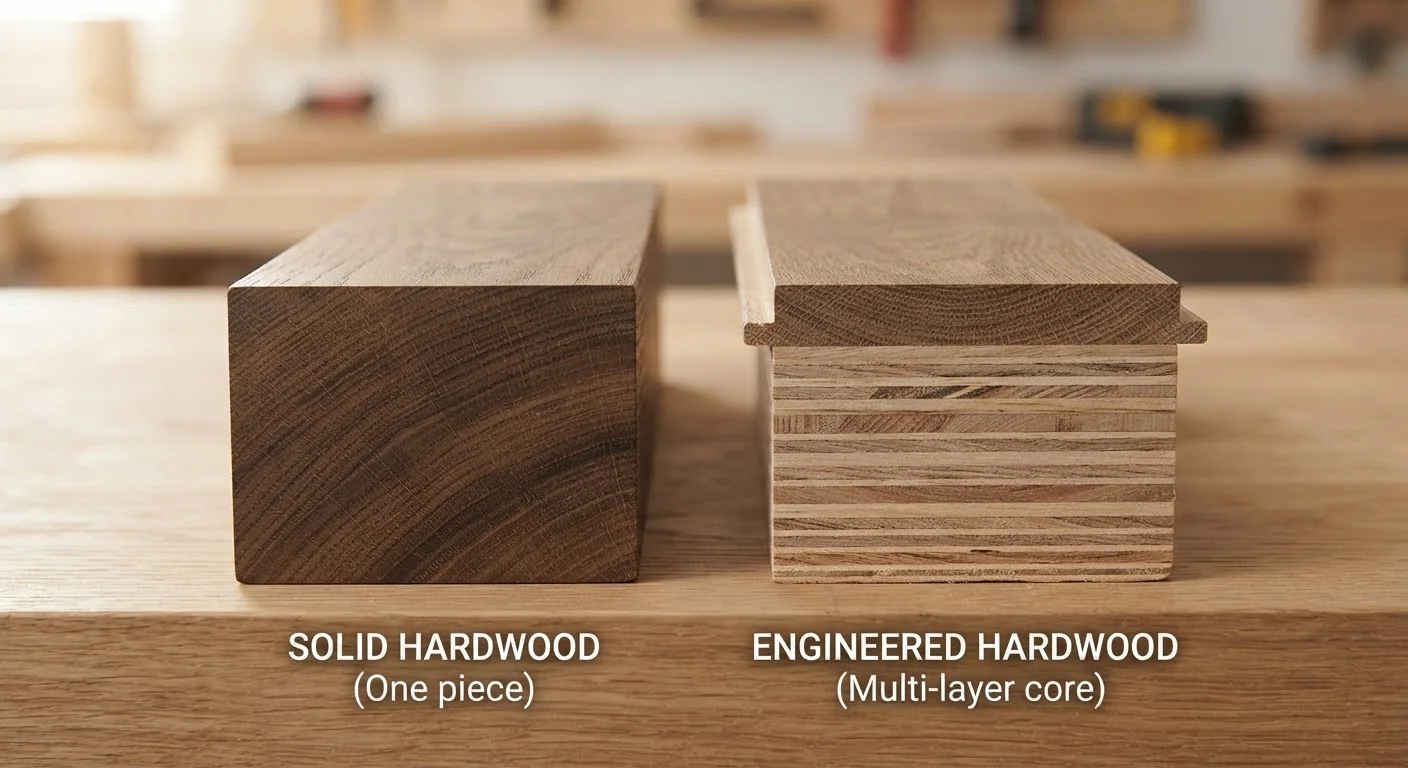
Solid hardwood is exactly what the name suggests - a single, uniform piece of wood milled from one species, typically three-quarters of an inch thick. Because it's homogenous throughout, it responds as a unified mass to changes in temperature and humidity: it expands when moisture rises and contracts when the air dries out. That movement is predictable and manageable in the right conditions, but it's a real constraint on where the floor can go.
Engineered hardwood is a layered composite. A genuine hardwood veneer - usually between 2mm and 6mm thick - is bonded to a core of cross-layered plywood or high-density fiberboard (HDF). Those alternating grain directions counteract each other's tendency to swell or shrink, making the plank significantly more dimensionally stable. Critically, the top surface is still real wood - not a photograph or a vinyl print - so it looks, sounds, and feels like hardwood underfoot.
| Criterion | Engineered Hardwood | Solid Hardwood |
|---|---|---|
| Core construction | Real wood veneer + cross-ply core | Single solid wood piece throughout |
| Moisture resistance | Higher - more dimensionally stable | Lower - prone to expansion/contraction |
| Installation locations | Above, on, or below grade | Above grade only |
| Compatible with radiant heat | Generally yes (check manufacturer specs) | Rarely recommended |
| Refinishing potential | 1-3 times (veneer-dependent) | 3-5 times or more |
| Installation methods | Nail, glue, or float | Nail or staple only |
| DIY-friendly | Yes, especially floating method | Moderate - requires specialty tools |
| Typical lifespan (well-maintained) | 25-50 years | 50-100+ years |
Where Each Type Can Be Installed
Installation location is often the deciding factor for homeowners who genuinely like both products.
Solid hardwood should only be installed above grade (above ground level) and requires a wood subfloor with controlled humidity levels - typically between 35% and 55% relative humidity. It can't go in basements, directly over concrete, or in rooms with persistent dampness like sunrooms or three-season porches. It also isn't compatible with most radiant heating systems, because the heat cycling causes repeated expansion and contraction that leads to gapping or cupping over time.
Engineered hardwood, by contrast, can be installed above, on, or below grade. It works over concrete slabs, over radiant heat systems (verify the manufacturer's specific temperature limits), and in rooms with moderate humidity variation. That flexibility makes it the default choice for basements, open-concept spaces that extend to a slab, and homes in regions with dramatic seasonal humidity swings. If your renovation involves the kind of layout rethinking described in open-plan vs. defined room decisions, engineered hardwood's cross-floor continuity makes it easier to run one material through varying subfloor conditions.
A Note on Acclimation
Both solid and engineered hardwood should be acclimated to your home's temperature and humidity before installation. Most manufacturers recommend leaving unopened boxes in the installation room for 48 to 72 hours. Skipping this step is one of the most common causes of post-installation gapping, cupping, or buckling - regardless of which type you choose.
Refinishing, Lifespan, and Long-Term Value
How many times a floor can be refinished depends directly on how much solid wood sits above the tongue-and-groove edge or adhesive layer.
A three-quarter-inch solid hardwood plank can typically be sanded and refinished three to five times across its life - sometimes more, depending on how aggressively it's sanded each time. With proper care, a solid hardwood floor can last 80 to 100 years in a stable environment, which is part of why it commands a premium in period-home renovations and resale contexts.
Engineered hardwood's refinishability depends on the veneer thickness. Thin-veneer products (around 2mm) may only tolerate one light sanding. Thicker-veneer versions (5mm to 6mm) can typically handle two or three refinishes. That's a real limitation compared to solid hardwood, but for many homeowners it's sufficient - particularly if the floor will be replaced during a future renovation anyway.
2mm-6mm
Typical engineered hardwood veneer thickness range
Veneer thickness directly determines how many times the floor can be sanded and refinished over its lifespan.
¾ inch
Standard solid hardwood plank thickness
This depth allows for multiple refinishes and is the industry-standard dimension for nail-down installation over plywood subfloors.
35-55%
Recommended indoor relative humidity for hardwood floors
The National Wood Flooring Association (NWFA) cites this range as the standard for maintaining dimensional stability in wood flooring.
Both types carry warranties that vary widely by manufacturer, so compare veneer thickness and warranty terms rather than relying on product category alone when evaluating engineered options.
Installation Methods and Subfloor Requirements
Solid hardwood must be nailed or stapled to a wood subfloor - typically three-quarter-inch plywood. It cannot be glued to concrete or floated (laid without fastening). This limits who can install it: the process requires specialized pneumatic flooring nailers and experience managing expansion gaps at walls and transitions.
Engineered hardwood offers three installation methods: nail-down (same as solid, over wood subfloors), glue-down (using flooring adhesive directly over concrete or plywood), and floating (planks click or glue to each other without attaching to the subfloor). The floating method, in particular, is accessible to confident DIYers because it doesn't require specialty tools and allows the floor to be removed if needed. That said, glue-down and nail-down installations tend to feel more solid underfoot - floating floors can have a slight flex or hollow sound in some areas.
Regardless of method, both flooring types require a flat, clean, and dry subfloor. Deflection (bounce) in the subfloor must also meet the flooring manufacturer's specifications - typically no more than 3/16 inch over a 10-foot span - to prevent joint stress and squeaking over time.