
Cancel Culture vs. Accountability Culture: Is There a Real Difference?

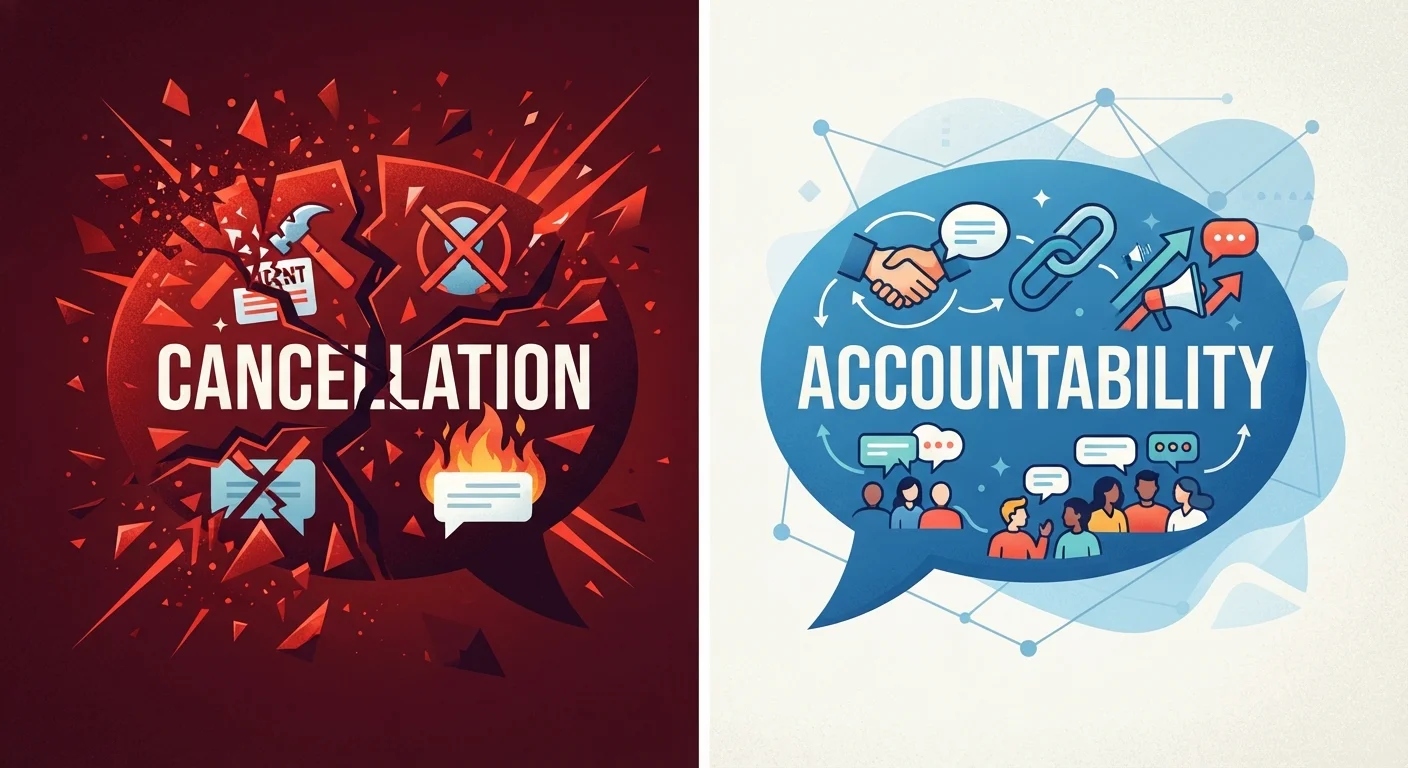
Key Takeaways
- Cancel culture and accountability culture describe overlapping but meaningfully distinct social responses to wrongdoing.
- The term 'cancel culture' is frequently contested - critics say it overstates harm while defenders say it names real social dynamics.
- Accountability culture emphasizes consequences paired with the possibility of learning and repair, not just punishment.
- Both concepts are deeply tied to how social media amplifies and accelerates public reactions.
- The distinction matters for how communities decide what justice, consequence, and redemption look like online.
Option A
Cancel Culture
The charged, contested term for collective social rejection.
Best for: Describing rapid, often social-media-driven withdrawal of support from a public figure or brand following perceived wrongdoing.
Option B
Accountability Culture
The reframed push for meaningful consequences and growth.
Best for: Describing a process-oriented approach that centers consequences, reflection, and the possibility of change over permanent social exile.
If you want a shorthand for social-media-driven public backlash
Cancel Culture
The term is widely recognized and immediately communicates the dynamic of rapid, collective withdrawal of support, even if its precise meaning is disputed.
If you're more interested in frameworks for meaningful consequence and repair
Accountability Culture
Accountability culture centers process, proportionality, and the possibility of growth rather than a binary of platforms-or-exile.
If you're trying to describe or analyze online discourse critically
Accountability Culture
It's a more precise and less politically loaded term, making it easier to discuss specific situations without triggering reflexive debate about the phrase itself.
Two Terms, One Very Hot Debate
Few phrases generate more immediate heat in online spaces than cancel culture. Depending on who you ask, it's either a dangerous mob mentality that silences people unfairly or an overblown label used to avoid accountability. Meanwhile, accountability culture has emerged as an alternative framing - one that its proponents argue better captures what healthy communal responses to harm actually look like.
But are these genuinely different things, or just the same phenomenon with better PR? The answer is more layered than either camp usually admits - and the distinction is worth understanding if you want to engage with online discourse without getting swept up in the spin. Engaging with pop culture on your own terms is harder than it sounds when the vocabulary itself is contested.
| Criterion | Cancel Culture | Accountability Culture |
|---|---|---|
| Primary focus | Withdrawal of support or platform | Meaningful consequence and repair |
| Tone | Often punitive, permanent | Process-oriented, proportional |
| Role of the harmed party | Often peripheral to discourse | Central to the response framework |
| Room for change | Rarely built in | Explicitly considered |
| Political associations | Highly polarized term | Less loaded, more analytical |
| Origin context | Social media pile-ons, pop culture | Restorative justice traditions |
What Cancel Culture Actually Means (and Why It's Disputed)
The phrase cancel culture rose to mainstream visibility around 2019-2020, though the underlying behavior - publicly withdrawing support from someone who has done something harmful or offensive - has existed far longer. Critics argue the term dramatizes what is often just social consequence: people choosing not to support someone whose actions conflict with their values.
Skeptics of the phrase point out that truly "cancelled" celebrities rarely disappear permanently. Many return to prominence after a period out of the spotlight. On the other hand, less powerful individuals - those without publicists or platforms of their own - can face disproportionate, lasting damage from pile-ons that began over far smaller infractions.
49%
Americans who see cancel culture as a threat
A 2021 Pew Research Center survey found 49% of U.S. adults said cancel culture had a somewhat or very negative effect on society.
58%
Who believe holding people accountable is the goal
In the same Pew study, 58% of respondents said the practice is more about holding people accountable for their actions than silencing speech.
The term has also become politically polarized. Its use now often signals a broader ideological stance, which makes nuanced conversation harder. When the word "cancel" does most of the argumentative work, it can short-circuit the specific questions worth asking: Was the response proportionate? Did it allow for any engagement or change?
What Accountability Culture Offers Instead
Accountability culture reframes the conversation around three elements: acknowledging harm, facing meaningful consequences, and creating space - however cautiously - for repair or change. Where cancel culture discourse often focuses on the person being called out and whether the backlash is fair, accountability culture focuses on those who were harmed and what an appropriate communal response looks like.
This framing draws on traditions from restorative justice - a practice used in legal and educational settings that prioritizes repairing harm over purely punitive outcomes. It doesn't mean consequences are soft. It means consequences are tied to the nature and scale of the harm, rather than to how loud or viral the reaction happened to get.
That said, accountability culture is not without its own complications. It can sometimes be used to demand that harmed parties accept or facilitate reconciliation before they are ready - which shifts the burden in ways that aren't always fair either.
The way fan communities and stan culture engage with these moments adds another layer: devoted fandoms can mobilize rapidly in defense of a favorite figure, sometimes actively working against accountability processes entirely.
Context: Restorative Justice vs. Punitive Models
Restorative justice is a well-established framework used in schools, courts, and communities that prioritizes repairing harm over punishment alone. It doesn't mean consequences are avoided - it means they're shaped by the nature of the harm and the needs of those affected. Accountability culture borrows this language, though applying it to online public discourse involves complications that formal restorative processes are specifically designed to manage.
Why the Language We Choose Matters
Words shape perception. Calling something cancellation tends to center the person facing consequences and implies disproportionality. Calling it accountability tends to center those who were harmed and implies reasonableness. Neither framing is automatically neutral.
What's more useful than picking a team is developing a habit of asking better questions when something blows up online: What actually happened? Who was harmed and how? Is the response proportionate to the harm? Is there any mechanism for engagement, repair, or change - or is this purely about removal? These questions don't have automatic answers, but they move the conversation past slogan-level debate.
The real difference between cancel culture and accountability culture may ultimately be less about what happens and more about the intent, proportionality, and framework guiding it. As online communities continue to wrestle with how to hold each other and public figures to standards, getting precise about these terms isn't just semantic - it shapes what we think justice actually looks like.