

Key Takeaways
- Checking for injuries and moving to safety is always the first priority after any collision.
- You are legally required to call police and exchange information in most US states after an accident.
- Thorough documentation at the scene - photos, witness contacts, officer details - is critical for insurance claims.
- Never admit fault or make informal payment agreements at the scene.
- Notify your insurer promptly; most policies require timely reporting regardless of who caused the crash.
What you will need
Why a Clear Plan Matters More Than You Think
Most drivers will be involved in at least one collision during their lifetime. In the immediate aftermath, shock and adrenaline can make even straightforward tasks feel overwhelming. Without a clear mental framework, it is easy to make errors that complicate insurance claims, create legal exposure, or leave injuries unaddressed.
Understanding the steps in advance - before you ever need them - dramatically improves your ability to act calmly and protect yourself and others. This guide walks through each phase of the post-accident process, from the first seconds at the scene through filing your insurance claim. For a focused look at the very first moments after impact, the immediate post-accident priorities guide covers the scene-level steps in greater depth.
What you will need
What You'll Need Before You Start
Having the right items on hand makes every step smoother. Keep these basics accessible in your vehicle at all times - not buried in your trunk.
Smartphone with camera
Photograph vehicle damage, license plates, the scene layout, and any visible injuries.
Proof of insurance card
Required to exchange with the other driver and to provide to law enforcement.
Pen and notepad
Record driver and witness information if your phone battery is low or camera fails.
Reflective warning triangles or road flares
Alert oncoming traffic that vehicles are stopped on or near the roadway.
Step-by-Step: What to Do After a Collision
Follow these steps in order. The sequence matters - securing safety comes before documentation, and documentation comes before insurance notification.
Stop and Secure the Scene
Pull your vehicle to the nearest safe location - the shoulder, a parking lot, or a side street - without blocking traffic. Turn on your hazard lights immediately. If you have warning triangles or flares, place them behind your vehicle to alert approaching drivers.
Leaving the scene of an accident is a criminal offense in all US states, even in minor collisions. Stay put.
Check for Injuries and Call 911
Check yourself, your passengers, and the occupants of the other vehicle for injuries. If anyone is hurt - or if there is any doubt - call 911 immediately. Describe the location clearly and follow the dispatcher's instructions.
Even if no injuries are apparent, many states require a police report when property damage exceeds a threshold (commonly $500-$1,000). A police report also creates an official record that is valuable for insurance purposes.
Exchange Information with the Other Driver
Collect and share the following with every driver involved:
- Full name and contact information
- Driver's license number and issuing state
- License plate number and vehicle make, model, and color
- Insurance company name and policy number
Be polite and factual. Do not discuss fault, make promises, or offer informal settlements.
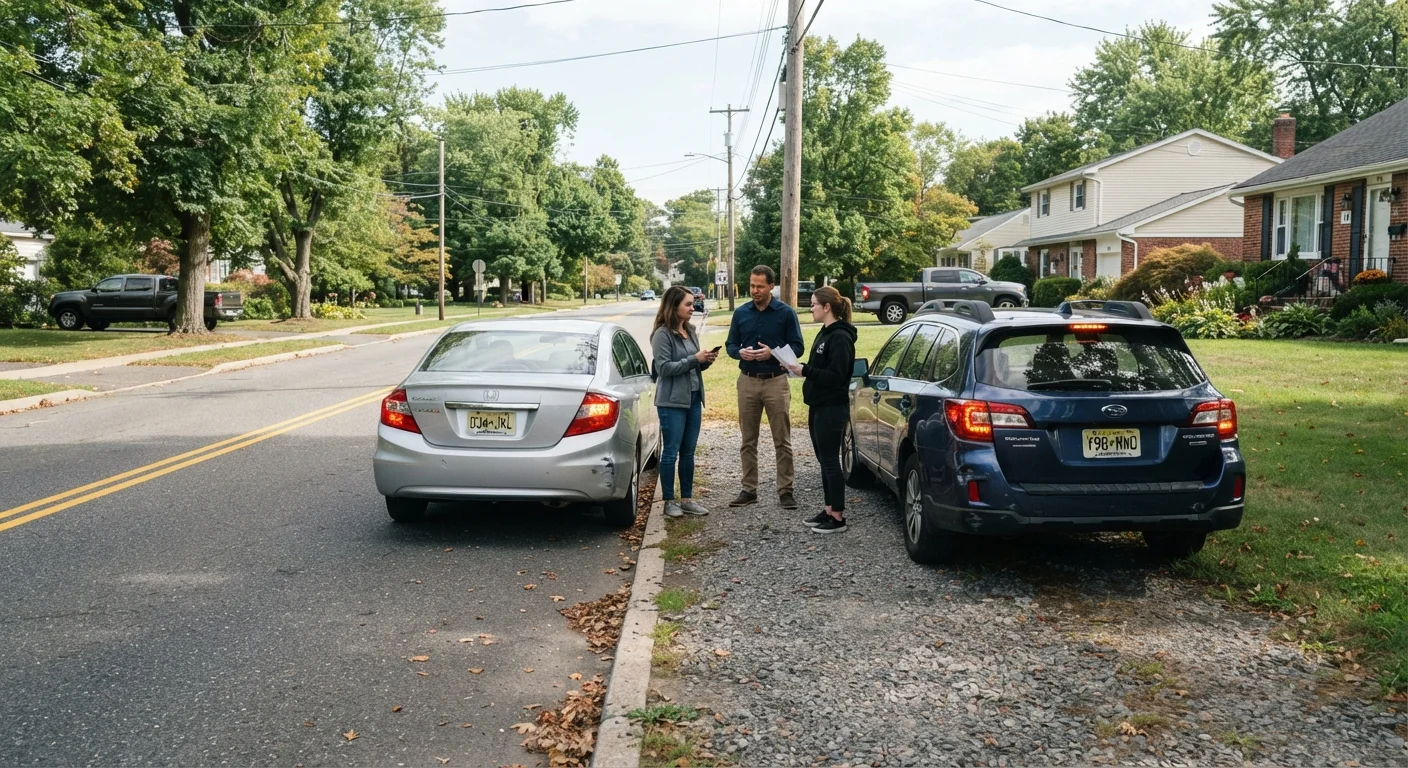
Document the Scene Thoroughly
Before vehicles are moved (if it is safe to do so), photograph and note:
- All vehicles involved from multiple angles, including close-ups of damage
- The overall scene - road conditions, traffic signs, skid marks, debris
- The position of vehicles relative to each other and lane markings
- Any visible injuries
- Weather and lighting conditions
If witnesses are present, ask for their names and phone numbers - a neutral third-party account can be decisive in disputed claims.
File a Police Report and Get the Report Number
When officers arrive, provide an accurate, factual account of what happened. Avoid speculation or estimating speeds if you are uncertain. Ask the responding officer for the incident or report number - you will need it when filing your insurance claim.
If police do not come to the scene (common in very minor collisions in some jurisdictions), you may need to file a self-report with your local Department of Motor Vehicles or law enforcement agency within a set timeframe. Requirements vary by state.
Notify Your Insurance Company
Contact your insurer as soon as reasonably possible - ideally the same day. Most auto policies include a clause requiring prompt notification of any accident, regardless of who was at fault. Delaying can complicate or jeopardize your claim.
Provide your insurer with the documentation you collected: photos, the police report number, the other driver's information, and witness contacts. To understand what your policy covers in this situation, see our overview of what a standard auto insurance policy actually covers.
Seek Medical Evaluation and Keep Records
Visit a healthcare provider even if you feel fine. Some injuries - particularly soft-tissue injuries like whiplash - take hours or days to present symptoms. A timely medical record establishes a clear link between the accident and any injuries that emerge, which is important for both health and insurance purposes.
Keep copies of all medical bills, treatment notes, repair estimates, rental car receipts, and any other accident-related expenses. These documents support your claim and any subsequent legal process if fault becomes contested.
Never Admit Fault at the Scene
Even a casual apology - "I didn't see you" - can be interpreted as an admission of liability. Fault is a legal and insurance determination made after a full investigation. Stick to exchanging factual information and let the proper process play out.
Preventing Future Incidents: What the Data Suggests
Many collisions share common causes that are well-understood and largely preventable. Confusion over right-of-way, improper lane changes, and misjudged merging are among the most frequent contributing factors in urban and suburban crashes. Reviewing where drivers commonly go wrong with merging and right-of-way can help you identify and correct habits that increase collision risk.
For broader guidance on safe road behavior, the Driving & Safety hub covers defensive driving, situational awareness, and vehicle handling across a range of conditions.
Keep an Accident Checklist in Your Glove Box
Stress and adrenaline make it easy to forget important steps at the scene. Print a simple checklist covering safety, information exchange, and documentation steps, and store it with your insurance card. Many insurers provide one in their welcome packet or mobile app.