

Key Takeaways
- Dealer-arranged financing is convenient but may include a markup on the lender's base interest rate.
- Pre-approvals from a bank or credit union give you a concrete rate to benchmark against dealer offers.
- Credit unions often offer competitive rates, particularly for members with solid credit histories.
- Manufacturer-sponsored low-APR promotions through dealers can occasionally beat bank rates, but usually require strong credit.
- Getting pre-approved does not obligate you to use that loan - it simply strengthens your negotiating position.
- Your credit score significantly shapes the rates available through both channels.
Option A
Dealer-Arranged Financing
The all-in-one, single-stop financing option.
Best for: Buyers who want to handle the vehicle purchase and loan in one place, sometimes with manufacturer incentive rates.
Option B
Direct Lending (Bank or Credit Union)
The independent, pre-approved lending route.
Best for: Buyers who want to shop with a firm loan offer in hand and compare rates before entering the dealership.
If you want a streamlined, single-visit purchase experience
Dealer-Arranged Financing
Dealerships can process financing alongside the sale, which reduces the number of separate steps involved in buying a vehicle.
If you want to compare rates independently before committing
Direct Lending (Bank or Credit Union)
A pre-approval from your own bank or credit union gives you a concrete benchmark, making it easier to evaluate any financing offer at the dealership.
If a manufacturer is offering a special low-APR promotion
Dealer-Arranged Financing
Captive finance arms (lenders affiliated with automakers) occasionally offer promotional rates below what independent lenders charge, though these typically require excellent credit.
If you have existing credit union membership
Direct Lending (Bank or Credit Union)
Credit unions are member-owned and frequently offer rates and terms that compete favorably with dealer financing, especially for borrowers with good standing.
How Each Financing Path Works
When you finance a vehicle, you're borrowing money to cover the purchase price and repaying it - with interest - over an agreed term. The two most common paths to that loan differ in where the arrangement originates.
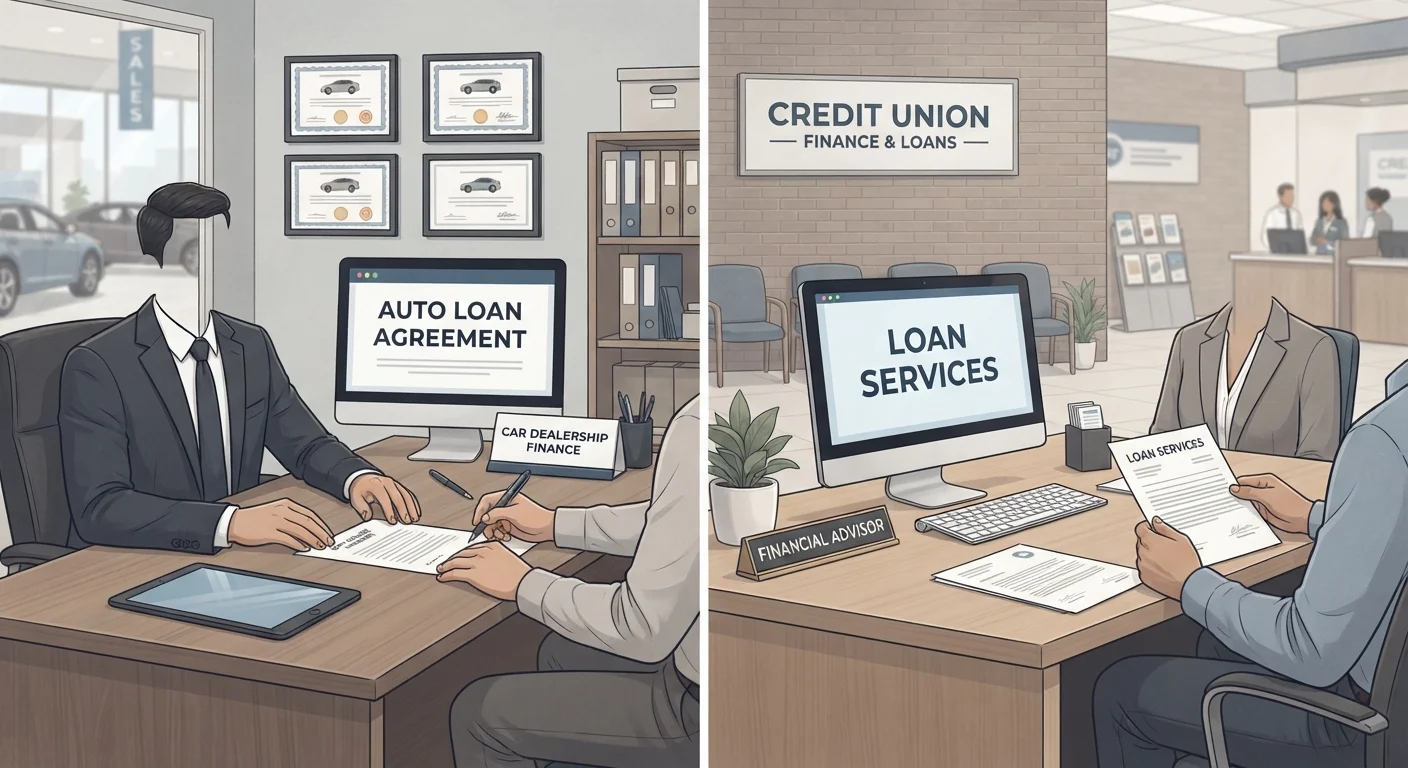
Dealer-arranged financing means the dealership acts as an intermediary. Their finance and insurance (F&I) office submits your application to a network of lenders - banks, finance companies, or the automaker's own lending arm - and presents you with an offer. The dealer may receive a fee for arranging the loan, which can take the form of a rate markup above what the lender originally quoted.
Direct lending means you go to a bank or credit union before visiting the dealership, apply for a loan independently, and receive a pre-approval that states your maximum loan amount and interest rate. You then use that offer when negotiating at the dealership. If the dealer can beat that rate, you can switch; if not, your pre-approval is ready to use.
Before diving deeper into either route, it helps to understand the core mechanics - our guide to auto loan basics covers APR, loan terms, and down payments in plain language.
| Criterion | Dealer-Arranged Financing | Direct Lending (Bank or Credit Union) |
|---|---|---|
| Where you apply | At the dealership, through F&I office | Directly with a bank or credit union |
| Timing | During or after vehicle selection | Before visiting the dealership |
| Rate transparency | Rate may include dealer markup | Rate quoted directly to borrower |
| Convenience | High - single-stop process | Moderate - extra step required upfront |
| Special promotions | Yes - manufacturer low-APR offers possible | No manufacturer promotions |
| Negotiating leverage | Lower - rate is presented, not pre-known | Higher - you have a benchmark rate |
| Lender relationship | With lender chosen by dealer | With your chosen institution |
Key Trade-Offs to Understand
Convenience is the clearest advantage of dealer financing. You handle the vehicle selection and loan in one appointment, which saves time. However, that convenience comes with a structural consideration: the dealership's F&I office typically earns compensation when they place a loan, which may mean the rate presented to you carries a markup. This doesn't make dealer financing inherently more expensive - it means you should verify the rate independently before agreeing.
Direct lending through a bank or credit union requires an extra step upfront, but it gives you pricing clarity. A pre-approval converts the loan rate from an unknown into a fixed reference point. You walk into the dealership knowing your ceiling, which changes the negotiating dynamic.
Credit unions, in particular, are worth considering. Because they are member-owned nonprofits, they often return value to members through competitive loan rates. Membership requirements vary by institution, but many are open to residents of a specific area or employees in certain industries.
Pre-Approval Does Not Lock You In
Receiving a pre-approval from a bank or credit union does not obligate you to use that loan. It functions as a ceiling and a benchmark. If the dealership arranges a lower rate, you're free to accept it instead. Think of pre-approval as a negotiating tool, not a commitment.
It's also worth noting that your credit profile shapes what either channel can offer you. How credit scores affect auto loan terms explains how lenders use your score to set rates and conditions.
Making an Informed Decision
There's no universal answer for which financing source is better - it depends on the specific rates available to you at a given time and your personal priorities.
A practical approach many buyers use: obtain a pre-approval from a bank or credit union first, then compare that offer against what the dealership arranges. If the dealer sources a lower rate - particularly through a manufacturer promotional offer - it can make sense to use their financing. If not, your pre-approval is ready to go.
~80%
New vehicle buyers who finance through a dealership
According to data from the National Automobile Dealers Association, a large majority of financed new-vehicle purchases are arranged at the dealership level.
0.5-2%
Typical dealer rate markup range above lender's base rate
Industry analyses and consumer advocacy sources suggest dealer markups on interest rates commonly fall within this range, though amounts vary by lender agreements and borrower profile.
Keep in mind that applying for pre-approval at multiple lenders within a short window (often cited as 14-45 days, depending on the scoring model) is typically treated as a single inquiry for credit scoring purposes, limiting the impact on your score.
If you're weighing broader ownership decisions - not just how to finance, but whether to finance at all - see our framework for comparing leasing and buying.
This article is for general informational and educational purposes only and does not constitute personalized financial or legal advice. Consult a qualified financial professional for guidance specific to your situation.