

Key Takeaways
- Larger sensors collect more light, which directly improves low-light and dynamic range performance.
- Full-frame sensors are the largest common format; Micro Four Thirds are significantly smaller.
- Bigger sensors enable shallower depth of field, making background blur (bokeh) easier to achieve.
- Sensor size affects lens compatibility, camera body size, and overall system cost.
- Megapixel count and sensor size are separate specs - a large sensor with fewer megapixels often outperforms a small one with more.
Camera Sensor Size
A camera sensor is the electronic chip that captures light and converts it into a digital image. Sensor size refers to the physical dimensions of that chip - larger sensors gather more light, which generally produces better image quality, especially in low-light situations. Common sensor sizes include full-frame, APS-C, and Micro Four Thirds, each representing a different trade-off between image quality and camera portability.
Sensor size is measured in millimeters (width × height) or by format name; it is distinct from megapixel count, which describes pixel density rather than the sensor's physical area.
Why Sensor Size Is the Spec That Matters Most
When comparing cameras, most consumers focus on megapixels. But the more consequential figure is sensor size. The sensor is where light becomes an image, and the amount of surface area available to collect that light determines how much information the camera can work with before any processing takes place.
Think of it like rainwater collection: a large bucket captures far more than a small cup in the same downpour. A larger sensor captures more photons per pixel, which reduces noise, preserves detail in shadows and highlights, and gives the camera more flexibility in difficult lighting.
For photo and video quality, sensor size shapes three key outcomes: low-light performance, dynamic range (the ability to hold detail in both bright and dark areas simultaneously), and depth of field control - how easily you can separate a subject from its background. These factors matter whether you're shooting portraits, landscapes, or video content.
864mm²
Approximate area of a full-frame sensor
Compared to roughly 224mm² for Micro Four Thirds, illustrating why sensor area has such a dramatic effect on light gathering.
2x
Crop factor of Micro Four Thirds vs. full-frame
A 25mm lens on a Micro Four Thirds camera frames a scene the way a 50mm lens would on a full-frame body, affecting composition decisions.
1-3 stops
Typical low-light advantage of full-frame over APS-C
In practical terms, a full-frame sensor can produce usable images at ISO levels that would show significant noise on smaller formats.
The Main Sensor Formats Explained
Camera sensors are commonly grouped into four tiers by physical size:
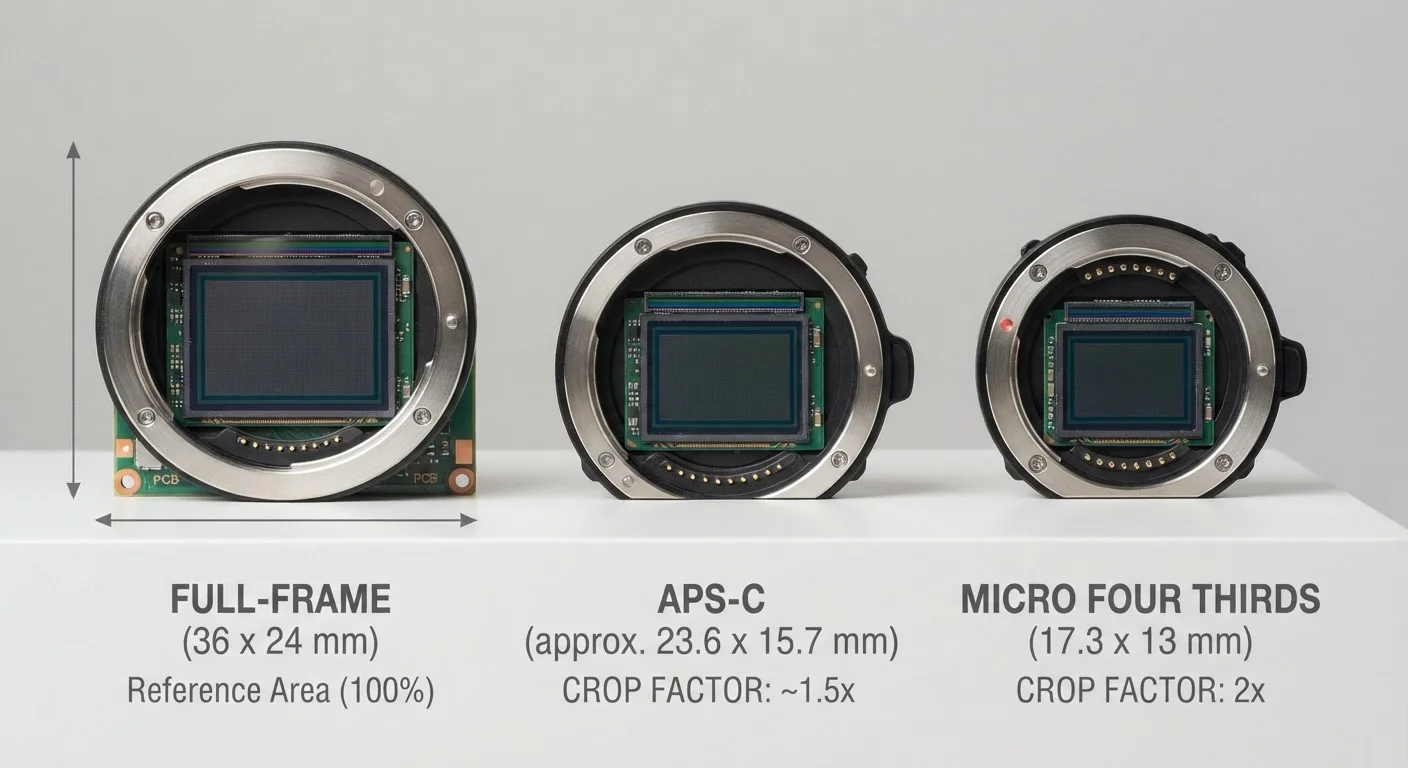
- Full-frame: Matches the dimensions of a 35mm film frame (approximately 36mm × 24mm). This is the largest widely available consumer format and delivers the highest baseline performance in low light and dynamic range. Cameras using this format are typically larger and more expensive.
- APS-C: Roughly 60-70% the area of a full-frame sensor (around 23mm × 15mm, with slight variation between manufacturers). APS-C cameras offer a strong balance between image quality and portability. They carry a crop factor of 1.5x or 1.6x depending on the manufacturer, which affects the effective focal length of lenses.
- Micro Four Thirds (MFT): Approximately half the area of full-frame (17.3mm × 13mm), with a 2x crop factor. These sensors are used in compact mirrorless systems, making them popular for travel and video work. Image quality is competitive with APS-C in good light, though low-light performance trails larger formats.
- 1-inch sensors: Found in some compact cameras and high-end smartphones, these sit below Micro Four Thirds but still outperform typical phone sensors by a meaningful margin.
For a broader look at how sensor size intersects with other phone camera specs, see our guide to megapixels, aperture, and sensor size.
Don't Confuse Megapixels With Sensor Size
A 24-megapixel full-frame sensor and a 24-megapixel APS-C sensor have the same pixel count, but the full-frame sensor's pixels are physically larger - meaning each one captures more light. More megapixels on a smaller sensor does not compensate for the light-gathering disadvantage. When evaluating cameras, check both the sensor size and the pixel dimensions to get a complete picture.
Depth of Field and the Bokeh Effect
One of the most visible differences between sensor sizes is depth of field - how much of a scene appears in focus at a given moment. Larger sensors produce shallower depth of field at equivalent settings, which is what creates that blurred-background effect (commonly called bokeh) seen in professional portraits and product photography.
This isn't magic; it's physics. A larger sensor requires a longer focal length lens to achieve the same field of view, and longer focal lengths combined with wider apertures naturally compress the focus plane. Smartphone manufacturers simulate this effect using computational photography, but the result differs from optically achieved bokeh in how edges and fine details are rendered.
If background separation is important to your shooting style - for portraits, video interviews, or product work - sensor size directly determines how naturally and consistently you can achieve it. This is one reason mirrorless and DSLR systems with larger sensors remain popular despite advances in smartphone camera processing.
The Real Trade-Offs: Size, Weight, and Cost
A larger sensor doesn't exist in isolation - it requires a larger lens mount, larger lenses, and a bigger camera body to house everything. Full-frame systems are the most capable but also the heaviest and most expensive. A full-frame body paired with a quality lens can weigh considerably more than an APS-C or Micro Four Thirds equivalent.
For everyday users, travel photographers, or videographers who prioritize mobility, this trade-off is meaningful. Micro Four Thirds systems in particular have built a strong following among documentary filmmakers and travel journalists precisely because the smaller sensor allows for a more compact and affordable overall kit without sacrificing professional-grade video capability.
Cost scales with sensor size at every level - body, lenses, and accessories. This is worth factoring in when evaluating which system makes practical sense for your specific use cases, rather than defaulting to the largest sensor available.
Sensor Size in Video: Same Rules Apply
The principles that govern sensor size in still photography apply equally to video. Larger sensors produce better dynamic range in video - preserving highlight and shadow detail in the same frame - and allow for shallower depth of field, which is a signature look in cinema and high-end commercial video production. Many dedicated video cameras use sensors equivalent in size to APS-C (sometimes called Super 35) for this reason.