

Key Takeaways
- The debt avalanche targets the highest-interest debt first, minimizing total interest paid over time.
- The debt snowball pays off the smallest balance first, generating psychological momentum.
- Both methods require making minimum payments on all other debts while directing extra funds to one target.
- Neither strategy is universally superior - the best method is the one you can consistently follow.
- Your personality, income stability, and number of accounts all influence which approach fits better.
- Consulting a nonprofit credit counselor can help you choose and implement a strategy suited to your situation.
Option A
Debt Avalanche
The mathematically optimal approach to eliminating debt.
Best for: Best for people motivated by minimizing total interest paid and comfortable staying the course without quick wins.
Option B
Debt Snowball
The behavior-driven method that builds momentum through small victories.
Best for: Best for people who need early motivation boosts and find it easier to stick with a plan when they see fast progress.
If you want to pay the least total interest
Debt Avalanche
By targeting high-interest balances first, the avalanche method reduces the overall cost of your debt - sometimes by hundreds or thousands of dollars compared to other approaches.
If you need early wins to stay motivated
Debt Snowball
Eliminating smaller balances quickly creates a real sense of progress that helps many people maintain momentum and avoid abandoning their plan.
If you have several accounts with similar interest rates
Debt Snowball
When rates are close, the interest savings of the avalanche shrink, making the snowball's motivational advantage the stronger deciding factor.
If you have one or two accounts with significantly higher rates
Debt Avalanche
A large gap between interest rates means the avalanche's mathematical benefit is substantial enough to outweigh the slower sense of visible progress.
If you have tried debt payoff plans before and quit
Debt Snowball
Research in behavioral economics consistently finds that visible progress is a strong predictor of follow-through, making the snowball a practical choice for those who have struggled with consistency.
How Each Strategy Works
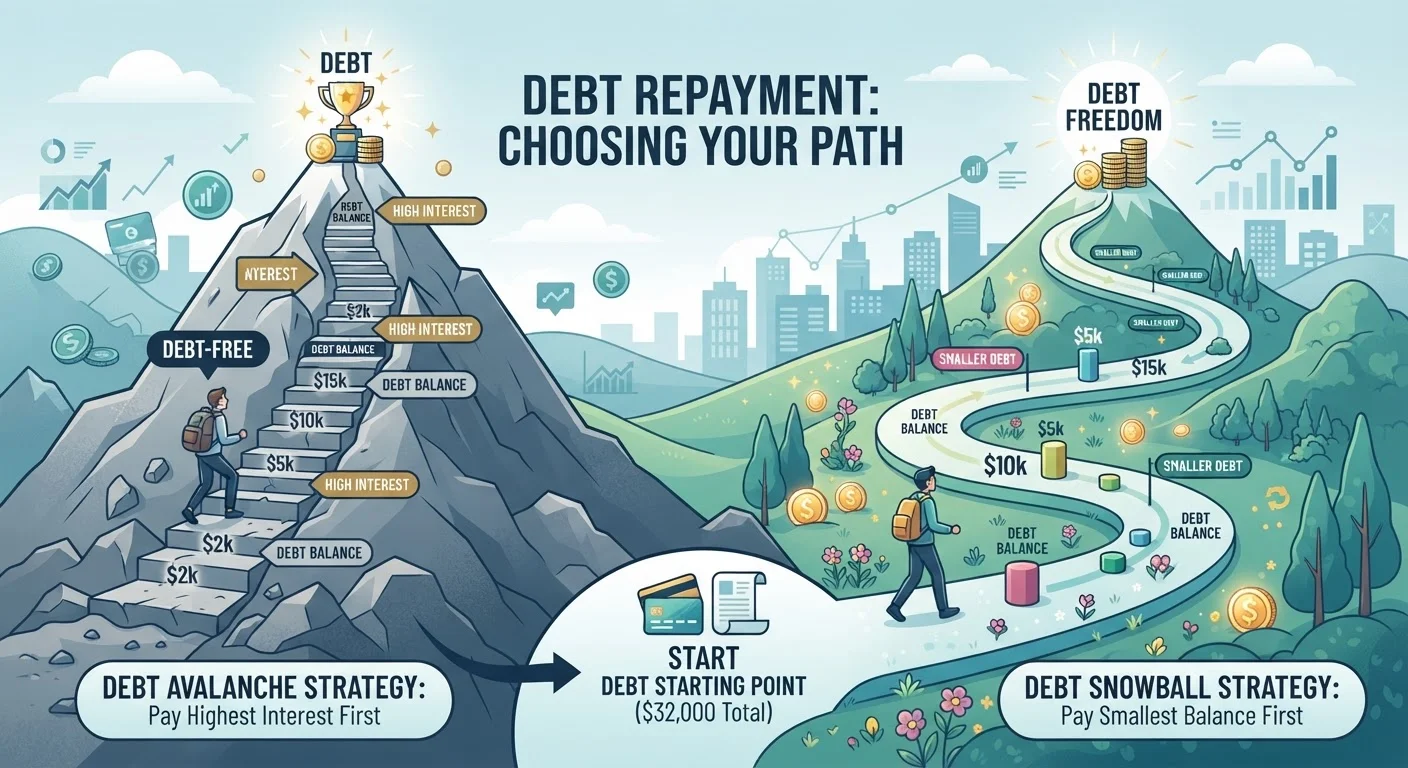
Both the debt avalanche and debt snowball share the same core mechanic: you make minimum payments on every account each month, then direct any extra money toward one specific target debt. What separates them is which debt gets that extra payment.
Debt Avalanche: List all your debts by interest rate, from highest to lowest. Apply extra funds to the highest-rate balance until it is eliminated, then roll that freed-up payment to the next highest rate. The name reflects how paying down the steepest cost first can feel like clearing a financial mountain.
Debt Snowball: List your debts by outstanding balance, from smallest to largest. Throw extra money at the smallest balance until it is gone, then move to the next. Each eliminated account adds its freed payment to what you direct at the next - growing like a snowball rolling downhill.
Both approaches benefit from a stable budget that consistently produces extra money each month. Before choosing a method, it helps to review how you currently allocate income - see our comparison of popular budgeting methods for a practical starting point.
| Criterion | Debt Avalanche | Debt Snowball |
|---|---|---|
| Payoff order | Highest interest rate first | Smallest balance first |
| Total interest paid | Lower (often significantly) | Potentially higher |
| Time to first payoff | Slower if high-rate debt is large | Faster - smallest balance cleared first |
| Psychological reward | Delayed - progress is financial, not visible | Immediate - accounts eliminated quickly |
| Best rate environment | Wide spread between account rates | Similar rates across accounts |
| Complexity | Simple to track by rate | Simple to track by balance |
| Minimum payment floor reduction | Slower reduction in minimum obligations | Faster reduction in minimum obligations |
The Interest Cost Difference
The avalanche method wins on math. Because high-interest debt accumulates charges fastest, eliminating it first stops the most expensive compounding. The real-world difference depends on your specific balances and rates, but the higher and more varied your rates are, the larger the avalanche's savings tend to be.
The snowball method may cost more in total interest, particularly when you have a small balance on a low-rate account sitting ahead of a large balance on a high-rate one. In that scenario, paying off the small low-rate account first delays the attack on the costly debt, allowing it to compound longer.
~$1,000+
Potential interest saved with avalanche method
The exact savings vary widely by balance and rates, but financial educators commonly illustrate scenarios where avalanche users save hundreds to over a thousand dollars compared to snowball users.
~$6,500
Average American credit card balance
According to Federal Reserve consumer credit data, revolving credit balances per borrower have remained in the several-thousand-dollar range in recent years, making payoff strategy choice financially significant.
67%
Adults who carry credit card debt month to month
Surveys by organizations such as the American Bankers Association have consistently found that a majority of cardholders carry a balance, underscoring the broad relevance of structured repayment strategies.
That said, the cheapest strategy on paper is only effective if you stick with it. Behavioral research consistently finds that people are more likely to abandon plans that feel slow or invisible - which is why some financial educators argue the snowball's psychological edge can outweigh its mathematical disadvantage for certain individuals.
Choosing the Right Fit for You
No formula can definitively tell you which method to use - the decision involves both numbers and self-awareness. Consider these factors:
- Motivation style: If checking a balance off a list energizes you, the snowball's quick wins may be worth any extra interest cost. If you are driven by efficiency and can tolerate delayed gratification, the avalanche suits you well.
- Rate spread: If your debts carry very similar interest rates, the avalanche's advantage shrinks. If one card sits at 24% APR while another is at 8%, the avalanche's math becomes hard to ignore.
- Number of accounts: Carrying many small accounts can create organizational stress; the snowball's account-elimination approach reduces that clutter quickly.
- Income stability: If your cash flow is unpredictable, the snowball's faster account closures reduce your minimum payment obligations sooner, giving you a lower monthly floor.
If your debt situation is complex - multiple creditors, missed payments, or collection accounts - a structured plan managed through a nonprofit credit counseling agency may offer additional support. Learn more about that option in our article on how debt management plans work.
Alternatively, if rolling multiple debts into a single payment appeals to you, review the trade-offs explained in our guide to debt consolidation before deciding.
This article is for general informational and educational purposes only and does not constitute personalized financial or legal advice. For guidance tailored to your situation, consult a qualified financial professional or nonprofit credit counselor.