

Key Takeaways
- The 50/30/20 rule divides after-tax income into needs, wants, and savings using broad percentages.
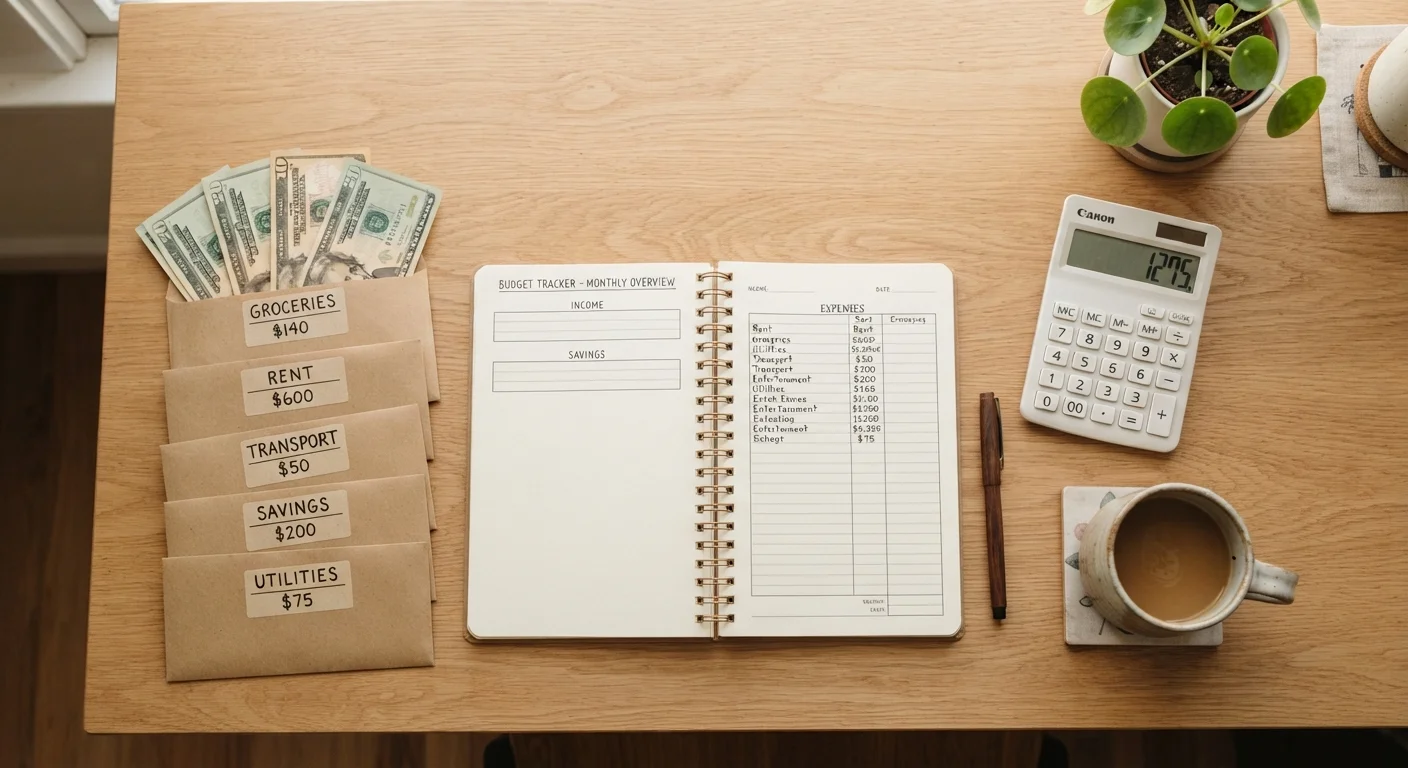
- Envelope budgeting assigns fixed cash amounts to specific spending categories each pay period.
- The 50/30/20 rule offers flexibility; envelope budgeting offers granular control.
- Either framework can be adapted for digital use, though envelope budgeting takes more setup.
- Your income variability, spending habits, and self-discipline level should guide your choice.
Option A
The 50/30/20 Rule
The flexible, percentage-based framework for modern budgeters.
Best for: People who want broad spending guardrails without tracking every individual purchase.
Option B
Envelope Budgeting
The hands-on, category-by-category cash control system.
Best for: People who need firm category limits and a tangible, tactile way to curb overspending.
If you have a stable income and want a low-maintenance budget
The 50/30/20 Rule
Its three broad categories require minimal tracking and work well when your monthly income is predictable and you have reasonable spending discipline.
If you consistently overspend in specific categories
Envelope Budgeting
Hard limits per category make it much harder to rationalize overspending - when the envelope is empty, that category is done for the month.
If you have irregular or variable income
Envelope Budgeting
Allocating actual dollars you have on hand each pay period adapts naturally to income fluctuations, unlike fixed percentage targets.
If you're new to budgeting and want to build the habit without overwhelm
The 50/30/20 Rule
Three categories are easy to understand and monitor, making it a practical first framework before moving to more detailed systems.
If you prefer a highly visual, physical money-management experience
Envelope Budgeting
Handling physical cash or labeled envelopes creates a concrete awareness of spending that digital tools and percentages often can't replicate.
How Each Framework Actually Works
The 50/30/20 rule - popularized by U.S. Senator Elizabeth Warren and her daughter Amelia Warren Tyagi in their 2005 book All Your Worth - divides your monthly after-tax income into three buckets: 50% for needs (rent, utilities, groceries, minimum debt payments), 30% for wants (dining out, subscriptions, entertainment), and 20% for savings and debt repayment beyond minimums. The appeal is simplicity: you check whether your spending roughly fits the ratios each month, then adjust as needed.
Envelope budgeting is older and more granular. At the start of each pay period, you divide your available cash into labeled envelopes - one for groceries, one for gas, one for dining out, and so on. You spend only what's in each envelope. When an envelope is empty, spending in that category stops (or you make a deliberate choice to borrow from another). Originally a physical-cash system, the method now has digital equivalents using apps or spreadsheet columns. See how different tools support budgeting styles for guidance on adapting the method to your preferred format.
| Criterion | 50/30/20 Rule | Envelope Budgeting |
|---|---|---|
| Core structure | 3 broad percentage buckets | Multiple fixed-dollar categories |
| Setup time | Low - calculate ratios once | Moderate - define and fund all envelopes |
| Ongoing effort | Low - monthly review of totals | Higher - track each category actively |
| Spending control | Flexible within buckets | Strict per-category limits |
| Best income type | Stable, predictable income | Works well with variable income |
| Digital-friendly | Very easy to adapt | Possible but requires more setup |
| Behavioral reinforcement | Moderate - abstract percentages | Strong - tangible cash limits |
Key Trade-Offs: Flexibility vs. Precision
The core tension between these two systems is flexibility versus control. The 50/30/20 rule leaves a lot of room for judgment - a $400 restaurant month still fits inside your 30% wants bucket if your other wants are low. That flexibility is its strength for people with good baseline discipline, but it can mask problem spending within broad categories.
Envelope budgeting removes that judgment. A $150 dining envelope is $150. Overspend it by $40 and you face an immediate, visible consequence. Research in behavioral economics consistently finds that people spend more when payment is abstract (credit cards, digital accounts) than when it's tangible. Physical cash envelopes exploit this effect directly.
~33%
Americans with a detailed household budget
Gallup polling has consistently found that fewer than one in three U.S. adults maintain a detailed written or tracked household budget.
2-3x
More spent with credit vs. cash
Multiple consumer behavior studies have found people tend to spend significantly more when using cards rather than physical cash, underscoring envelope budgeting's core mechanism.
The trade-off is setup time and ongoing effort. Envelope budgeting requires you to define meaningful categories, fund them deliberately each pay period, and reconcile balances regularly. The 50/30/20 rule, by contrast, can be reviewed in minutes with a bank statement. For a broader look at where these two sit among other approaches, see budgeting methods Americans actually use.
Adapting Either System to Your Real Life
Neither framework is a perfect fit straight out of the box - both reward some customization. With the 50/30/20 rule, the percentages are guidelines, not rules. In high cost-of-living cities, housing alone may consume 40% of take-home pay; adjusting the needs bucket upward and trimming wants accordingly is entirely reasonable. The goal is intentional allocation, not rigid adherence to ratios.
Envelope budgeting benefits most from honest category selection. Too many envelopes create administrative fatigue; too few defeats the precision advantage. Most practitioners find that 8-12 categories cover the meaningful spending decisions without becoming burdensome.
Both systems also work best when you build in a regular review. A monthly reset - revisiting categories, rolling over surpluses, or zeroing balances - keeps either framework aligned with your actual life rather than a snapshot from months ago. The case for a monthly budget reset explores why that rhythm matters and how to make it a sustainable habit.
If your current approach - whichever system you use - isn't producing results, the issue may be structural rather than motivational. The signs your budget needs a serious overhaul can help you diagnose whether a framework switch, not just more willpower, is what's needed.
Combining Both Frameworks Is an Option
Some budgeters use the 50/30/20 rule as a high-level target and envelope budgeting within their wants category - the area most prone to drift. This hybrid approach gives you a simple overall structure while applying tighter controls exactly where you need them. There's no rule requiring you to pick just one system. For a full end-to-end budgeting framework, see personal budgeting from income to savings.
This article is for general informational and educational purposes only and does not constitute personalized financial advice. Consider consulting a licensed financial professional for guidance tailored to your specific situation.