

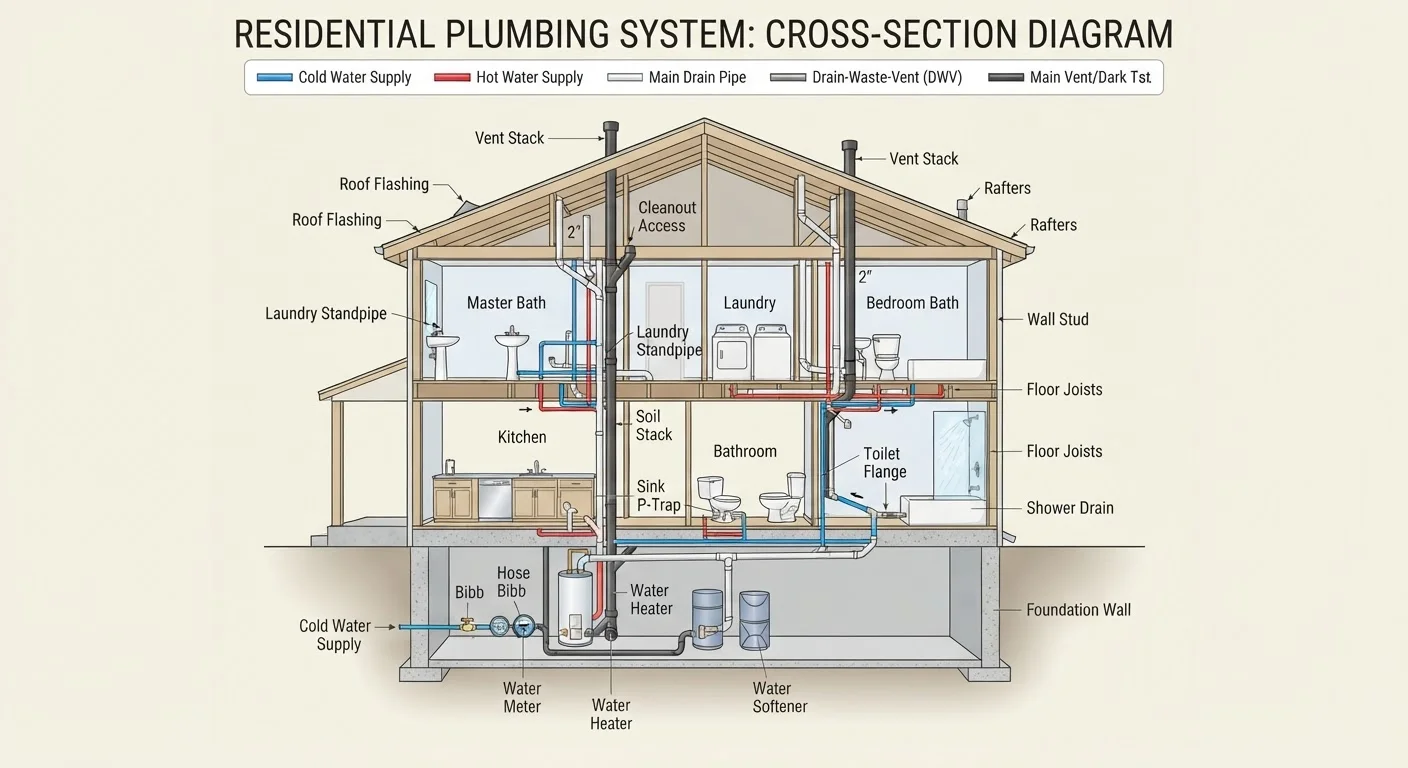
Key Takeaways
- Household plumbing consists of three distinct systems: supply, drain-waste, and venting.
- Water enters under pressure; waste exits by gravity - these are separate pipelines.
- Every fixture has a trap and a shutoff valve you should be able to locate quickly.
- Venting prevents sewer gases from entering the home and keeps drains flowing smoothly.
- Knowing the basics helps you describe problems accurately and make informed repair decisions.
Start here
The Big Picture: Three Systems in One
Next
The Supply System: Water In
Then
The Drain-Waste-Vent System: Water Out
Dig deeper
Fixtures, Traps, and Shutoffs
Apply it
Warning Signs and When to Call a Professional
The Big Picture: Three Systems in One
Most homeowners think of plumbing as pipes under the sink. In reality, your home contains three distinct but interconnected systems: the supply system (clean water in), the drain-waste system (used water out), and the vent system (air management). All three must work together for a fixture to function correctly.
Understanding this separation matters for a practical reason: when something goes wrong, knowing which system is affected helps you describe the problem accurately to a plumber - and gives you a realistic sense of the scope and cost of the repair. It also connects directly to broader home upkeep; many plumbing issues surface as part of seasonal maintenance checks that homeowners often skip.
Supply system
The network of pressurized pipes that deliver fresh cold and hot water from the main line to every fixture in the home.
Drain-waste system
The gravity-fed pipes that carry used water and solid waste away from fixtures to the municipal sewer or septic tank.
Vent stack
A vertical pipe connected to the drain system that exits through the roof, allowing air in so drains flow correctly and sewer gases escape outside.
P-trap
The curved pipe section under a sink or behind a toilet that holds standing water to block sewer gases from entering the home.
Shutoff valve
A valve on the supply line at each fixture that lets you cut water to just that fixture without turning off the whole house supply.
Water pressure (psi)
The force pushing water through supply pipes, measured in pounds per square inch. Residential systems typically operate between 40 and 80 psi.
Pressure regulator (PRV)
A device installed on the main supply line that reduces incoming municipal water pressure to a safe level for home fixtures and appliances.
Main stack
The large central vertical drain pipe that collects waste from all fixtures and carries it out of the house to the sewer or septic system.
The Supply System: Water In
Water enters your home from a municipal main or a private well under pressure - typically between 40 and 80 psi (pounds per square inch). This pressure is what pushes water upward to second-floor bathrooms and out of showerheads without a pump inside the house.
From the main shutoff valve, the supply line branches into two paths: one stays cold, and one runs through the water heater to create a hot supply. Both cold and hot lines then run parallel to every fixture in the home.
- Pipe materials vary by era: older homes may have galvanized steel or copper; newer construction often uses cross-linked polyethylene (PEX), a flexible plastic tubing that resists freezing better than rigid pipe.
- Pressure regulators (also called PRVs) are installed in many homes to reduce incoming municipal pressure to a safer range. A failing PRV can cause banging pipes or rapid fixture wear.
Know Your Main Shutoff Before You Need It
Walk your home now and locate the main water shutoff valve - before a leak forces you to find it under stress. In most homes it's near the water meter, in the basement, or in a utility closet. Label it clearly so any household member can find it quickly in an emergency.
Supply work - adding new lines, moving a water heater, or installing a whole-house filter - is covered in more detail in any first-time renovation guide, since it frequently intersects with remodeling projects.
The Drain-Waste-Vent System: Water Out
Unlike the pressurized supply system, drain pipes rely entirely on gravity. Pipes slope downward at a prescribed angle (typically ¼ inch per foot) so waste flows toward the main stack - a large vertical pipe running through the center of the house - and ultimately out to the municipal sewer or a septic tank.
The vent system is where many homeowners draw a blank. Every drain needs air behind the flowing water, the way a straw collapses when you cover the top with your thumb. Vent pipes connect the drain system to the outdoors (usually through the roof) so air can enter freely. This does two things: it keeps drains flowing at the correct speed, and it prevents sewer gases - including methane and hydrogen sulfide - from being siphoned into the home through fixture traps.
Never Ignore Sewer Gas Smells Indoors
Sewer gases include methane, which is flammable, and hydrogen sulfide, which is toxic at high concentrations. A persistent sewer smell inside the home warrants prompt investigation - not just masking with air fresheners. Contact a licensed plumber to identify the source.
When vent pipes become blocked by debris or animal nests, the resulting pressure imbalance is often the root cause of slow drains, gurgling sounds, or sewer smells that homeowners misdiagnose as simple clogs. If clearing a drain doesn't solve the problem, the vent stack is worth investigating.
Fixtures, Traps, and Shutoffs
Every plumbing fixture - sink, toilet, tub, dishwasher - sits at the junction of the supply and drain systems. Two components you should be able to locate at any fixture are the trap and the shutoff valve.
- Trap
- The curved pipe (shaped like a P when viewed from the side) beneath sinks and behind toilets. It holds a small water plug that blocks sewer gases. If a fixture isn't used for weeks, this water can evaporate - simply running the tap refills it.
- Shutoff valve
- A small valve on the supply line feeding each fixture, usually under the sink or behind the toilet. Turning it off isolates that fixture without cutting water to the whole house - essential during a repair.
Kitchen plumbing adds complexity because dishwashers and refrigerator ice makers tap into the supply lines, and garbage disposals connect to the drain. Understanding these connections is useful context for anyone following a kitchen maintenance routine.
Warning Signs and When to Call a Professional
Basic plumbing literacy makes warning signs easier to catch early - before a slow leak becomes water damage. Watch for:
- Low water pressure at multiple fixtures - may indicate a supply line issue, failing PRV, or mineral buildup in older pipes.
- Persistent slow drains - if plunging doesn't resolve it, the blockage may be deep in the main stack or in the vent system.
- Water stains on ceilings or walls - nearly always indicate an active leak; locate the fixture directly above and check supply connections first.
- Sewer smell indoors - a dry trap, cracked vent pipe, or failed wax ring at the toilet base are common causes.
For anything beyond replacing a faucet cartridge or a toilet flapper, consider whether a licensed plumber is appropriate. Work involving the main drain stack, supply line modifications, or any connection to a gas water heater should be handled by a qualified professional. Most jurisdictions require permits for significant plumbing work - check with your local building department before proceeding. Moisture issues that trace back to plumbing leaks near the foundation can also connect to larger problems covered in basement waterproofing guides.
See the Home Improvement hub for additional guidance on evaluating contractors and scoping repair projects before you commit.