

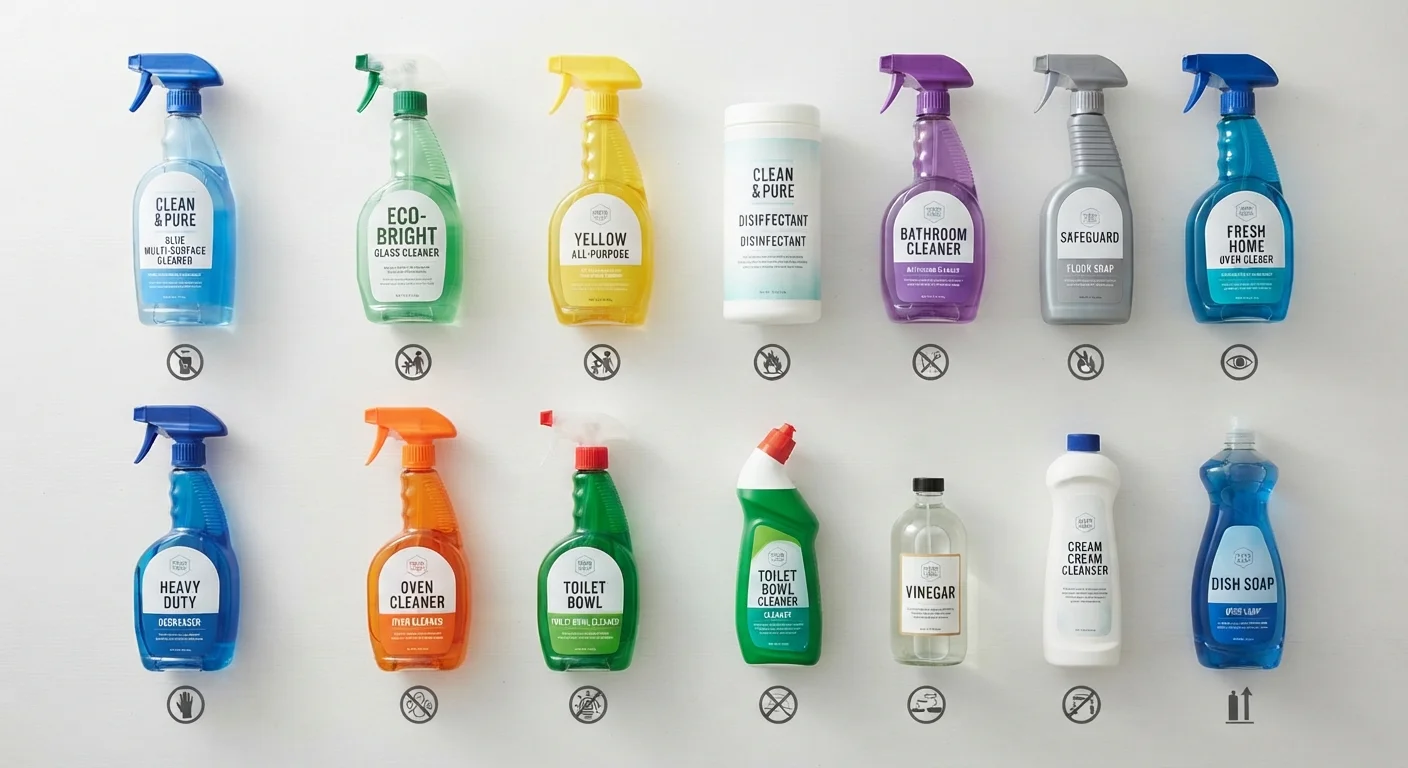
Key Takeaways
- Mixing bleach with ammonia produces toxic chloramine gases that can damage the lungs.
- Bleach combined with acidic cleaners releases chlorine gas, a serious respiratory hazard.
- Hydrogen peroxide and vinegar mixed together form peracetic acid, which is corrosive.
- "Natural" labels do not guarantee that a product is safe to combine with other cleaners.
- Always read product labels and use cleaning products one at a time, rinsing between applications.
Why Chemistry Matters in Your Cleaning Routine
Most of us reach for cleaning products without thinking about what's actually in them. That's understandable - the label says "cleans and disinfects," and that's usually enough. But household cleaners are active chemical formulations, not inert liquids, and some combinations trigger reactions that produce byproducts far more hazardous than either ingredient on its own.
Understanding a few basic principles of chemistry doesn't require a science background. It just requires knowing which categories of ingredients react badly together - and why the logic of "more is better" breaks down completely when it comes to cleaning chemistry.
Myth
Mixing bleach and ammonia just makes a stronger cleaner.
Fact
It creates chloramine gases, which are toxic and can cause serious respiratory damage even at low concentrations.
Sodium hypochlorite (the active ingredient in household bleach) reacts with ammonia to produce a family of compounds called chloramines. These gases - particularly monochloramine and dichloramine - irritate the respiratory tract, cause coughing and shortness of breath, and in enclosed spaces or at high concentrations, can lead to fluid buildup in the lungs. Many glass cleaners, floor cleaners, and multi-surface sprays contain ammonia, so this combination is more common than people realize. There is no benefit to this mixture - only risk.
Myth
Bleach and vinegar together create a powerful disinfecting solution.
Fact
The acidic nature of vinegar causes bleach to release chlorine gas, a corrosive respiratory irritant.
Bleach is alkaline, and vinegar is acetic acid. When an acid is introduced to sodium hypochlorite, the reaction releases chlorine gas. Even diluted household concentrations can produce enough chlorine to cause eye, nose, and throat irritation - and in a poorly ventilated bathroom or kitchen, concentrations can build to genuinely dangerous levels. Neither product becomes more effective through this combination; they neutralize each other's cleaning properties while generating a hazard. Use each product separately, and rinse the surface between applications.
Myth
Hydrogen peroxide and vinegar are both natural, so mixing them is safe.
Fact
Combined, they form peracetic acid, a corrosive compound that can irritate skin, eyes, and the respiratory system.
Each substance has legitimate cleaning uses on its own. However, when hydrogen peroxide (H₂O₂) and acetic acid (vinegar) are combined in the same container, they react to produce peracetic acid. This compound is used in industrial settings precisely because it is a potent oxidizer - strong enough to damage surfaces and biological tissue. Applying them sequentially to a surface (not mixing in a single bottle) is a different scenario, but even that practice should be approached carefully. The "natural" origins of both ingredients do not eliminate the chemical reactivity between them. For a deeper look at how natural cleaners compare to conventional options, see how natural and conventional cleaners stack up.
Myth
You can safely mix any two cleaners as long as you dilute them with water.
Fact
Dilution reduces concentration but does not eliminate chemical reactions - some hazardous byproducts still form.
Water can slow or moderate certain reactions, but it doesn't prevent them. Chlorine gas still forms when bleach meets acid in a diluted solution - just potentially more slowly. The volume of water in a sink or bucket also doesn't provide meaningful protection in an enclosed room with limited airflow. The correct approach is to never combine different cleaning products in the same container or apply them to the same surface simultaneously, regardless of how much water is present.
Myth
If a product doesn't warn against mixing on the label, it's safe to combine with anything.
Fact
Labels list known risks but cannot anticipate every possible combination - absence of a warning is not a green light.
Regulatory labeling requirements focus on the most commonly occurring and well-documented hazards. A label won't list every possible reactive pairing because the combinations are nearly limitless. As a practical rule: treat every cleaning product as chemically active, and assume incompatibility unless you have specific, reliable information indicating otherwise. When in doubt, finish using one product, rinse the surface thoroughly with water, and allow it to dry before applying anything else.
Common Dangerous Combinations - and the Science Behind Them
The myths and facts above cover the most frequently encountered hazardous pairings in US homes. A few additional points are worth keeping in mind as context:
Don't Rely on Smell Alone as a Safety Signal
Some dangerous gases, like carbon monoxide, are odorless - and while most cleaning chemical byproducts do have distinct smells, odor intensity doesn't reliably indicate concentration or danger level. A faint smell doesn't mean a mixture is safe. Always treat unknown chemical combinations as potentially hazardous and ventilate the area thoroughly.
- Rubbing alcohol and bleach: This combination produces chloroform and other chlorinated compounds. Both are common in home first-aid and cleaning contexts, making accidental mixing a real possibility.
- Different drain cleaners: Some drain cleaners are acid-based; others are alkaline. Mixing them - even sequentially in the same drain - can cause violent reactions, including heat generation and spattering.
- Bleach and rubbing alcohol: Produces chloroacetone and other toxic compounds. Even common hand sanitizers containing alcohol should not be used in conjunction with bleach-based products.
Toxic Fumes Can Form Instantly
Some chemical reactions happen within seconds of mixing. You may not smell danger until you've already inhaled harmful concentrations. If you accidentally mix cleaners and notice a sharp odor, stinging eyes, or difficulty breathing, leave the area immediately, get fresh air, and contact Poison Control (1-800-222-1222 in the US) or emergency services if symptoms are severe.
Safe practice is straightforward: use one product at a time, rinse surfaces with water between products, and ensure good ventilation whenever you use any chemical cleaner. Store products in their original containers so label warnings remain visible.