

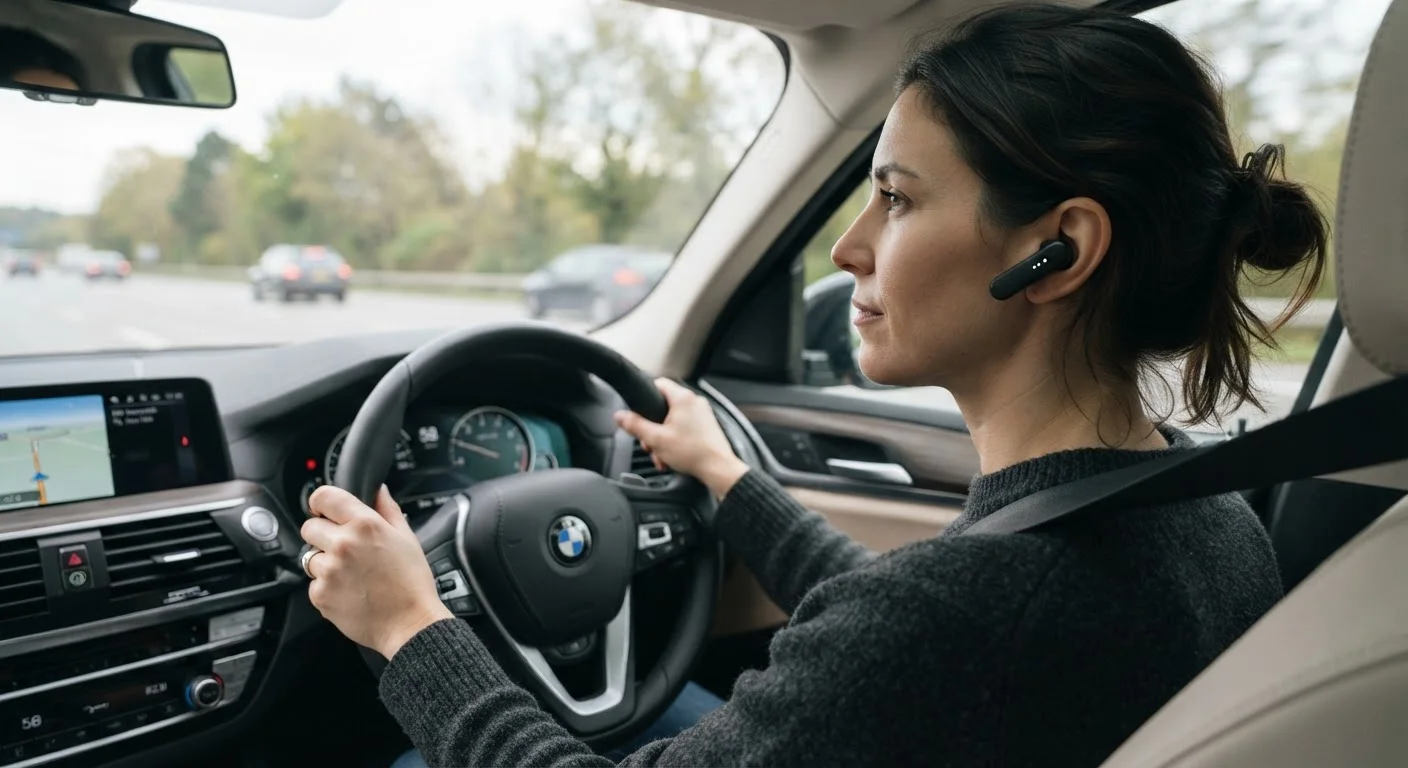
Key Takeaways
- Hands-free phone use is legal in most US states, but legal does not automatically mean safe.
- Physical distraction is reduced with hands-free devices, but cognitive distraction remains a documented concern.
- Research consistently shows that phone conversations impair driving more than talking to an in-car passenger.
- Voice-activated controls vary widely in reliability and can themselves introduce frustration and distraction.
- Drivers should understand the difference between what the law permits and what safety evidence supports.
Both hands remain on the steering wheel
Maintaining a two-handed grip gives drivers full control during sudden lane changes, evasive maneuvers, or unexpected road hazards - a meaningful physical safety advantage over handheld use.
Eyes stay on the road more consistently
Without the need to look at a screen to dial or read messages, hands-free calling reduces the visual distraction component that contributes to many phone-related crashes.
Legal compliance in most US states
Handheld phone use while driving is banned in a growing number of states; hands-free use generally satisfies current legal requirements, reducing the risk of fines or citations.
Accessible for urgent or time-sensitive calls
In situations where a call genuinely cannot wait and pulling over isn't immediately safe, hands-free technology allows a driver to respond without removing hands from the wheel.
Compatible with modern vehicle infotainment systems
Many vehicles now integrate Bluetooth calling directly into the dashboard, providing audio through vehicle speakers and microphones positioned for clearer communication without any handheld device.
Cognitive distraction persists even without hands
Research consistently shows that a phone conversation demands significant mental processing capacity, reducing a driver's ability to scan for hazards and respond quickly - regardless of whether the phone is held or not.
Reaction times remain measurably impaired
Studies have found that drivers engaged in hands-free calls exhibit slower reaction times to sudden events compared to undistracted driving, a difference that becomes significant at higher speeds.
Voice-command systems can introduce new frustration
When voice recognition fails to understand commands correctly, drivers may become frustrated and spend more mental energy correcting errors, adding a layer of distraction rather than removing it.
Drivers tend to overestimate their own safety
The perception that hands-free calling is fully safe can lead to complacency - longer calls, complex topics, and emotional conversations - all of which elevate risk beyond what drivers typically acknowledge.
Emotional or complex calls raise risk significantly
Difficult conversations - arguments, stressful news, complex logistics - demand more cognitive processing than casual exchanges, compounding distraction at any speed.
Our Verdict
Hands-free calling is meaningfully safer than handheld use in one critical way: it keeps both hands available for vehicle control. However, research makes clear that the cognitive demand of any phone conversation - hands-free or not - still degrades situational awareness and reaction time compared to driving without a call. The legal permission to use hands-free technology does not eliminate its risk.
Drivers who must occasionally take urgent calls and want to minimize physical distraction while remaining aware that cognitive risk still applies.
What 'Hands-Free' Actually Means
Hands-free phone use refers to any method of making or receiving calls without holding your device - typically through Bluetooth earpieces, speakerphone mounted on a dash, or a vehicle's integrated infotainment system. Voice commands are often used to initiate and end calls without touching the phone at all.
Most US states have passed laws banning handheld phone use while driving, and many explicitly permit hands-free alternatives. This legal distinction gives hands-free calling a reputation for being a safe option. But legality and safety are not the same thing, and understanding that gap is what this article is about.
For a broader look at how phone connectivity technology works during calls, see our breakdown of 5G, LTE, and Wi-Fi calling.
The Genuine Advantages
There are real, documented reasons hands-free technology is preferable to handheld use - particularly when you consider what holding a phone physically requires of a driver.
Both hands remain on the steering wheel
Maintaining a two-handed grip gives drivers full control during sudden lane changes, evasive maneuvers, or unexpected road hazards - a meaningful physical safety advantage over handheld use.
Eyes stay on the road more consistently
Without the need to look at a screen to dial or read messages, hands-free calling reduces the visual distraction component that contributes to many phone-related crashes.
Legal compliance in most US states
Handheld phone use while driving is banned in a growing number of states; hands-free use generally satisfies current legal requirements, reducing the risk of fines or citations.
Accessible for urgent or time-sensitive calls
In situations where a call genuinely cannot wait and pulling over isn't immediately safe, hands-free technology allows a driver to respond without removing hands from the wheel.
Compatible with modern vehicle infotainment systems
Many vehicles now integrate Bluetooth calling directly into the dashboard, providing audio through vehicle speakers and microphones positioned for clearer communication without any handheld device.
When a call arrives in situations where pulling over isn't immediately practical - on a highway, in traffic - having a hands-free option allows the driver to acknowledge the call without physically reaching for a device and looking away from the road. That reduction in physical distraction is not trivial.
The Real Limitations
Where the hands-free picture gets more complicated is in the research on cognitive distraction - the mental demand of holding a conversation while simultaneously processing the driving environment.
Cognitive distraction persists even without hands
Research consistently shows that a phone conversation demands significant mental processing capacity, reducing a driver's ability to scan for hazards and respond quickly - regardless of whether the phone is held or not.
Reaction times remain measurably impaired
Studies have found that drivers engaged in hands-free calls exhibit slower reaction times to sudden events compared to undistracted driving, a difference that becomes significant at higher speeds.
Voice-command systems can introduce new frustration
When voice recognition fails to understand commands correctly, drivers may become frustrated and spend more mental energy correcting errors, adding a layer of distraction rather than removing it.
Drivers tend to overestimate their own safety
The perception that hands-free calling is fully safe can lead to complacency - longer calls, complex topics, and emotional conversations - all of which elevate risk beyond what drivers typically acknowledge.
Emotional or complex calls raise risk significantly
Difficult conversations - arguments, stressful news, complex logistics - demand more cognitive processing than casual exchanges, compounding distraction at any speed.
Studies by the AAA Foundation for Traffic Safety and the National Safety Council have found that hands-free calls still meaningfully impair a driver's ability to detect hazards, respond to sudden changes, and process peripheral information. The brain has limited attention capacity, and a phone conversation competes directly with the task of driving - regardless of what the hands are doing.
For more on how distraction specifically affects driver performance, our editorial on distracted driving myths and documented risks examines the evidence in depth.
4x
Crash risk increase during phone use
The National Safety Council reports that cell phone use while driving - including hands-free - increases crash risk approximately four times compared to undistracted driving.
37%
Of traffic deaths linked to distraction
The NSC estimates that cell phone distraction is a factor in a substantial share of annual US traffic fatalities, though precise attribution varies by data source and methodology.
Hands-Free vs. Talking to a Passenger
One of the more instructive comparisons in the research is between phone conversations and talking to a passenger seated in the vehicle. The two feel similar - both are verbal conversations - but they behave differently in terms of driving risk.
A passenger shares the driving environment. They naturally pause conversation during complex maneuvers, alert the driver to hazards they can see, and adjust the pace of the conversation in real time. A phone caller has none of that awareness and applies no such accommodation. The conversation continues regardless of road conditions, which means the driver must manage the cognitive gap alone.
This distinction is why even hands-free calling is treated cautiously by safety researchers - the cognitive load more closely resembles a handheld call than a passenger conversation.
It's also worth understanding how distraction differs from other impairment types. Our piece comparing driver fatigue and distraction explains how each affects reaction time and judgment differently.
Why Passenger Conversations Feel Different
Research suggests that in-car passenger conversations are less cognitively demanding partly because passengers naturally modulate the conversation based on driving conditions - pausing when things get complex, pointing out hazards, or simply going quiet. A remote phone caller lacks this shared situational awareness entirely. This is one reason safety researchers treat hands-free calls with more caution than the legal framing might suggest.
Practical Guidance for Drivers
Understanding the trade-offs doesn't require drivers to never use hands-free calling - it requires honest judgment about when it's reasonable and when it isn't.
- Low-complexity driving conditions - light traffic, familiar roads, steady speeds - reduce the overall demand on attention, making a brief hands-free call comparatively lower risk.
- High-complexity conditions - heavy traffic, adverse weather, construction zones, unfamiliar routes - compound the cognitive load already introduced by a call. These are moments to let the call go to voicemail.
- Voice-command reliability matters. Struggling to get your car's voice system to dial correctly introduces its own frustration and distraction. If the system is unreliable, it may be safer to pull over and use the phone directly than to keep attempting voice commands while moving.
Ultimately, hands-free technology is a tool. Like any tool, its value depends on how and when it's used - not simply on the fact that it's technically available and legally permitted.