

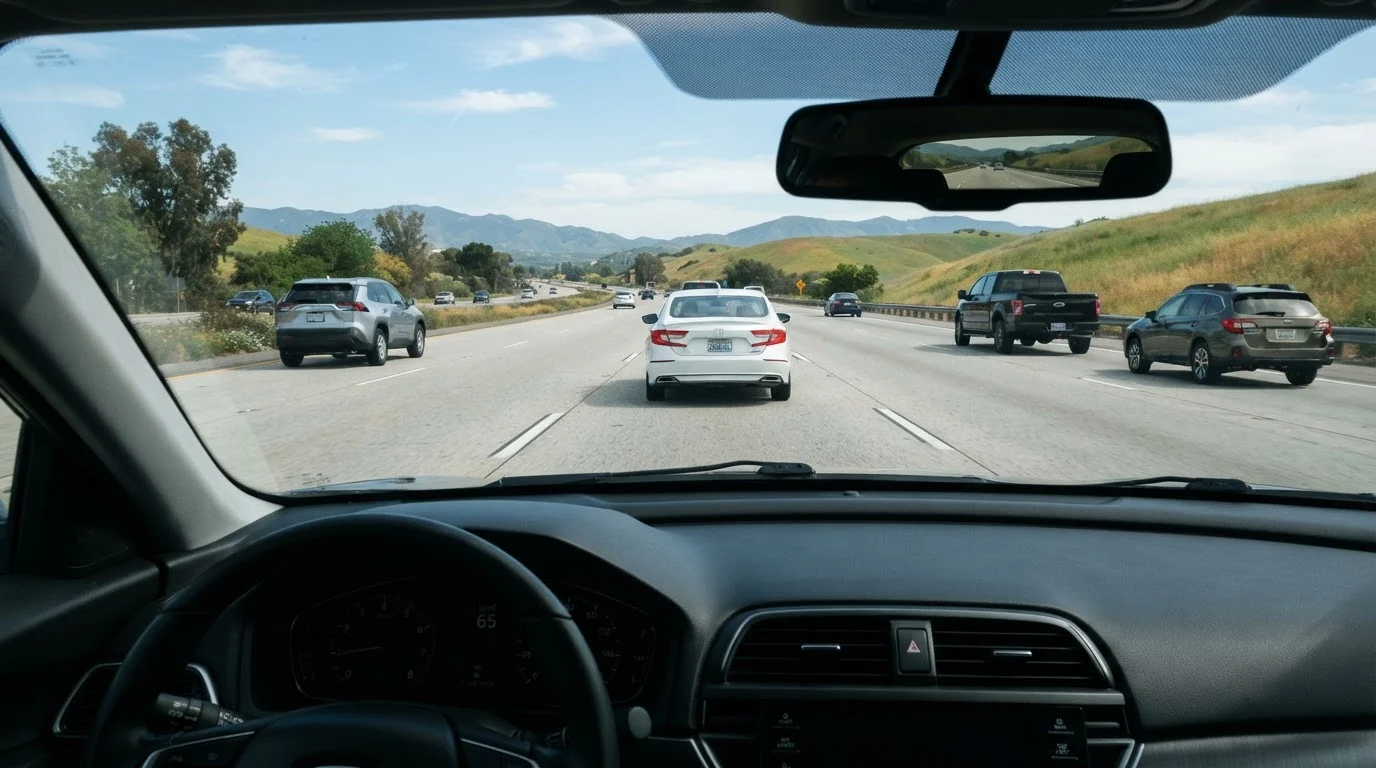
Key Takeaways
- The two-second rule applies at any speed and requires no tools - just a fixed roadside reference point.
- Adverse conditions like rain, fog, or ice require extending the gap to three or four seconds minimum.
- Rear-end collisions are among the most common crash types in the US, and tailgating is a leading contributing factor.
- Larger vehicles such as trucks and motorcycles benefit from even greater following distance due to stopping and visibility differences.
- Distraction reduces your effective reaction time, making proper spacing even more critical.
The Two-Second Rule
The two-second rule is a simple guideline that helps drivers maintain a safe following distance from the vehicle in front of them. After the car ahead passes a fixed point - like a sign or road marking - at least two full seconds should pass before your vehicle reaches that same point. This gap gives you enough time and distance to react and brake if the car ahead stops suddenly.
The two-second rule produces a distance that scales with speed: at 60 mph, two seconds equates to approximately 176 feet of following distance.
What the Two-Second Rule Actually Measures
The two-second rule is not about physical feet - it is about time. Because stopping distance depends on how fast you are traveling, a fixed number of car lengths is not a reliable safety margin. At 30 mph, three car lengths may be adequate; at 65 mph, the same gap could be dangerously short.
By measuring time rather than distance, the rule automatically adjusts. Two seconds of travel at 30 mph is roughly 88 feet. At 65 mph, that same two seconds stretches to about 191 feet - closer to what the situation actually demands.
This is also why the rule works for new drivers learning basic habits: it requires no calculation and can be applied consistently regardless of road type or speed.
~29%
Of all US crashes that are rear-end collisions
According to NHTSA data, rear-end crashes are consistently among the most common collision types on US roads, with following-too-closely identified as a key contributing factor.
1.5 sec
Average driver reaction time before braking begins
Traffic safety researchers commonly cite approximately 1.5 seconds as a typical perception-reaction time, illustrating how quickly a two-second gap can be consumed.
3-4×
Increase in stopping distance on snow vs. dry pavement
Studies on road surface conditions show stopping distances can multiply several times over on snow and ice, underscoring the need for extended following gaps.
When Two Seconds Is Not Enough
The standard two-second gap assumes good visibility, dry pavement, and an alert driver. Change any of those variables and the buffer shrinks - sometimes faster than you can react.
- Rain and wet roads: Water reduces tire grip and can more than double stopping distance. A three- to four-second gap is a reasonable starting point.
- Snow and ice: Stopping distances can increase by a factor of ten on glare ice compared to dry asphalt. Extending your following distance significantly is essential.
- Fog or low visibility: If you cannot see far enough to stop safely, you are effectively driving blind. Slow down and extend your gap.
- Fatigue or distraction: Reaction time is the hidden variable. Driver fatigue and distraction both delay your response, eating into the margin the two-second rule is designed to provide.
- Large vehicles: When following a bus, truck, or towing a trailer, add extra seconds. Heavier loads mean longer stops.
A Simple Way to Remember in Bad Weather
Add one second of following distance for every hazardous condition present. Rain? Add one second. Rain and fog? Add two. This layered approach keeps the math simple and the habit consistent regardless of how conditions change on a single trip.
Why Spacing Is a Core Principle of Defensive Driving
Maintaining safe following distance is not a passive habit - it is an active choice that reflects a broader defensive mindset. Defensive driving means anticipating hazards before they require emergency action, and spacing is the physical embodiment of that principle.
A driver who tailgates has, in effect, removed their own decision-making window. If the car ahead brakes hard, physics determines the outcome - not skill. A proper gap restores that window and keeps the driver in control.
Spacing also reduces the ripple effect in heavy traffic. When one driver brakes, the reaction can cascade backward through lanes. Maintaining distance helps absorb those waves rather than amplify them.
“Space is your most important safety resource on the road. You can recover from almost any hazard if you have enough time and distance - and the two-second rule is the simplest way to ensure you do.”
— National Safety Council, Leading US nonprofit focused on eliminating preventable deaths
Distraction compounds the problem significantly. Research consistently shows that even a brief glance away from the road - to check a mirror or a notification - covers considerable distance at highway speeds. See how distracted driving affects reaction time to understand exactly what is at stake.
Common Habits That Undermine Safe Following Distance
Even drivers who know the two-second rule often abandon it without realizing it. Several situations make it difficult to maintain a proper gap:
- Lane pressure
- When another driver is close behind you, there is a natural urge to speed up or close the gap with the car ahead. Resist it. You are responsible for the space in front of you, not behind.
- Heavy traffic
- Congestion can make a two-second gap feel excessive when other drivers fill it immediately. Even a one-second buffer is better than nothing - but the moment traffic clears, restore your full following distance.
- Merging situations
- When vehicles merge ahead of you, it feels like a loss. In reality, yielding space gracefully is safer than accelerating to close the gap. Understanding proper merging and right-of-way behavior helps put this in perspective.
The friction of everyday driving constantly pressures drivers to shrink their safety margins. Recognizing these situations makes it easier to hold the line.